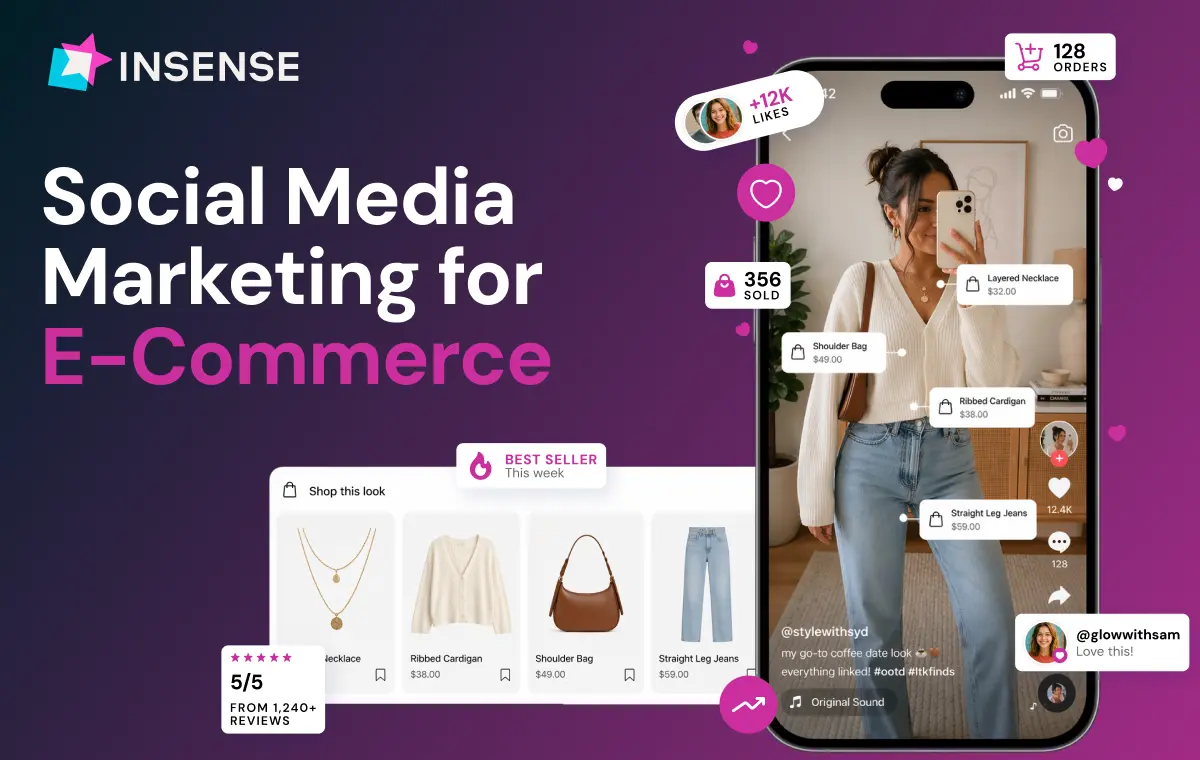
In today’s digital commerce landscape, social media is no longer just a place where brands share photos, publish updates, or communicate with followers. It has evolved into a powerful shopping environment where customers can discover products, explore brand stories, compare options, and complete purchases without leaving their favorite platforms. For independent online stores, creating a seamless shopping experience on platforms like Instagram and Facebook can significantly improve customer engagement and increase sales opportunities. Instead of relying only on traditional website traffic, small businesses can transform their social channels into interactive storefronts where every post, video, and customer interaction has the potential to become a purchasing opportunity. A successful shoppable social media experience connects three important elements: Attractive product presentation Convenient shopping access A trustworthy brand relationship When these elements work together, social media becomes more than a marketing channel. It becomes a digital shopping destination that guides customers from product discovery to checkout. For independent brands, this approach offers a practical way to compete with larger companies. With creative content, smart product organization, and consistent customer interaction, even small businesses can build strong online communities and generate meaningful revenue. This guide explains how to quickly create a shoppable experience on Instagram and Facebook, from setting up product catalogs to optimizing content strategies that encourage customers to buy. 1. Understand the Power of Social Commerce for Independent Brands Traditional online shopping usually follows a simple path: Customer searches → Visits website → Reviews products → Adds items to cart → Completes purchase However, modern consumers often discover products differently: Customer sees a video → Becomes interested → Checks product details → Shares with friends → Purchases immediately This change has made […]

July 29, 2026

In today’s hyper-competitive digital economy, cross-border e-commerce represents both the single largest growth opportunity and the most complex operational challenge for online merchants. Shopify brands and direct-to-consumer (DTC) sellers can reach millions of international buyers with a single campaign. Yet, behind every successful ad campaign lies a treacherous double-edged sword: the physical supply chain and the financial supply chain. If your products take weeks to arrive, arrive damaged, or cost too much to manufacture, your customer acquisition costs (CAC) will destroy your profit margins. Conversely, if you can source and ship products efficiently, but your money is trapped across fragmented foreign payment gateways, hit with massive FX (foreign exchange) conversion fees, or delayed by lengthy bank holding periods, your cash flow suffocates before you can scale. To solve these twin bottlenecks once and for all, DropSure  has officially partnered with Reevol . By uniting DropSure’s end-to-end supply chain infrastructure—spanning factory-direct sourcing, strict supplier quality management, global warehousing, and automated fulfillment—with Reevol’s AI-powered cross-border financial ecosystem, multi-currency receivables, and instant global payout infrastructure, we are introducing a unified solution for modern e-commerce. Here is an in-depth look at how this strategic partnership works, why physical and financial orchestration matter, and how your store can leverage this alliance to dominate global markets. Part 1: The New Reality of Global E-Commerce—Why Growth Stalls To understand why the DropSure x Reevol integration is revolutionary, we must look closely at the operational traps that prevent promising Shopify stores from scaling beyond $50k or $100k per month. The Physical Bottleneck: Supply Chain Fragmentation Scaling globally requires physical predictability. Traditional dropshipping and early-stage e-commerce supply chains suffer from several recurring friction points: Middleman Price Inflation: Sourcing through […]

July 28, 2026

Introduction: Why the First 3 Seconds Decide Everything In today’s digital world, attention has become one of the most valuable resources. Every day, users scroll through thousands of pieces of content across social media platforms, video apps, search pages, and online communities. They see countless advertisements, product recommendations, influencer posts, and brand messages competing for the same limited amount of attention. For independent website owners, this creates both a challenge and an opportunity. The challenge is simple: users are becoming faster at ignoring content that does not immediately interest them. The opportunity is equally powerful: if your content can capture attention within the first few seconds, you can turn casual viewers into potential customers and guide them toward your independent website. This is where the Golden 3-Second Rule comes into play. The first three seconds of any marketing message, short video, advertisement, or social media post often determine whether users continue watching or immediately move on. During this short window, your audience subconsciously decides: “Is this relevant to me?” “Does this solve my problem?” “Is this worth my time?” “Should I click the link?” A successful traffic strategy is not only about creating more content. It is about creating content that wins attention instantly. For independent brands, mastering these first three seconds can dramatically improve website visits, brand awareness, and customer conversion opportunities. Understanding the Golden 3-Second Rule The Golden 3-Second Rule is based on a simple idea: You must communicate value before the audience has a reason to leave. When users encounter your content, they are not actively searching for reasons to buy from you. They are looking for reasons to ignore you. This psychological difference is extremely important. […]

July 24, 2026

In today’s digital marketing landscape, companies have access to more customer data than ever before. Every click, impression, search query, social interaction, email open, and purchase event can potentially become part of a detailed customer journey map. With advanced analytics platforms and attribution models, marketers are constantly trying to answer one critical question: Which advertising channels are truly driving business growth? However, there is a hidden analytical trap that often leads companies in the wrong direction: survivorship bias. Survivorship bias occurs when organizations focus only on the customers who successfully converted and then analyze the touchpoints those customers experienced, while ignoring the larger group of people who interacted with similar advertising campaigns but never purchased. By looking only at “winners,” marketers may mistakenly believe that certain ads, platforms, or channels deserve more credit than they actually do. For example, imagine a customer who saw a brand’s social media advertisement, clicked a search ad several days later, received an email promotion, and finally purchased after visiting the company website. A traditional attribution report might conclude that all these channels contributed to the sale. But what about the thousands of people who saw the same social media ad, clicked the same search campaign, and received the same email — yet never bought anything? Without analyzing the entire audience, marketers cannot accurately determine whether those touchpoints actually influenced the purchase decision or simply appeared in the journey of people who were already likely to buy. Modern advertising measurement requires a shift from asking: “Which channels appear before conversions?” to asking: “Which channels create measurable incremental business impact?” This distinction separates surface-level reporting from true marketing intelligence. Understanding Survivorship Bias in Advertising Analytics What […]

July 21, 2026

Many businesses experience the same frustrating problem: an advertising campaign starts strong, generates impressive clicks, drives conversions, and delivers excellent returns. Then, after several weeks or months, performance begins to decline. The budget has not changed. The audience is still relevant. The product remains competitive. Yet the results are no longer what they used to be. In many cases, the problem is not the advertising platform, targeting settings, or offer itself. The real issue is creative fatigue. Creative fatigue happens when audiences see the same advertisement too many times and gradually lose interest. A message that once captured attention becomes familiar. An image that once stood out becomes invisible. A video that once generated curiosity becomes easy to ignore. For modern advertisers, this is one of the biggest challenges affecting campaign performance. Consumers are exposed to thousands of marketing messages every day. They quickly recognize repeated patterns, skip familiar content, and focus their attention on something new. This means businesses cannot rely on a single winning advertisement forever. The key to maintaining strong advertising performance is building an efficient ad creative rotation strategy that keeps content fresh, maintains audience interest, and continuously discovers new opportunities for growth. 1. Understanding Creative Fatigue: The Silent Performance Killer Creative fatigue is not a sudden failure. It usually develops gradually. At the beginning of a campaign, a new creative attracts attention because it provides something unfamiliar. The audience has not seen the message before, so curiosity and engagement are naturally higher. Over time, repeated exposure reduces the impact. People begin thinking: “I have seen this advertisement already.” “This brand keeps showing me the same thing.” “This product is not new anymore.” “I already know […]

July 20, 2026

For years, digital advertisers relied heavily on interest targeting to find potential customers. If you were selling fitness equipment, you targeted people interested in health and exercise. If you sold fashion accessories, you reached users who followed clothing brands or style influencers. While this approach still has value, the digital advertising landscape has changed dramatically. Consumer behavior has become more complex, privacy regulations have evolved, and advertising platforms now use more advanced machine learning than ever before. As a result, simply targeting interests often isn’t enough to deliver consistent, profitable growth. Today’s most successful advertisers understand an important principle: The best future customers often look more like your existing customers than they do a list of predefined interests. This is exactly where Lookalike Audiences become one of the most powerful tools for scaling campaigns. Whether you’re running an eCommerce business, generating B2B leads, promoting a SaaS platform, or growing a local brand, learning how to use Lookalike Audiences effectively can significantly improve campaign performance while reducing wasted ad spend. In this guide, we’ll explain what Lookalike Audiences are, why they outperform traditional interest targeting in many situations, and how to build a scalable customer acquisition strategy using data instead of guesswork. What Is a Lookalike Audience? A Lookalike Audience is a group of new people who share similar characteristics and behaviors with an existing audience that you already know is valuable. Instead of asking an advertising platform to find people who “like running” or “follow fashion pages,” you’re asking it to identify users who behave similarly to your best customers. Advertising algorithms analyze thousands of anonymous signals, including behavioral patterns, purchasing tendencies, engagement habits, and demographic similarities. The result is […]

July 17, 2026
1 2 3 4 52
DropSure is Your Best Partner
22 Years Experience
Affiliate Rebates
100% Quality Guarantee
Top-Up Rewards
10+ Global Warehouses
Custom Branding Support
Smart inventory System
24/7 Customer Support
Get a Quote in 24 Hours
Start Sourcing for Free