En
En
 9 min read
When advertisers talk about Facebook Ads failing, they usually blame the usual suspects: bad creatives, weak targeting, or insufficient budget. But there’s a more subtle reason that often goes unnoticed—and it’s the silent killer of ad performance: mismanaging the machine learning learning phase.
This phase is where Facebook’s delivery system is actively trying to understand your campaign. It is not just “warming up.” It is building a mathematical model of your audience, your conversion patterns, and your ad’s predictive value. If you disrupt it, you are not optimizing—you are resetting intelligence.
This article breaks down what is really happening under the hood, why blind testing destroys performance, and most importantly, the operational red lines you should never cross if you want stable, scalable results.
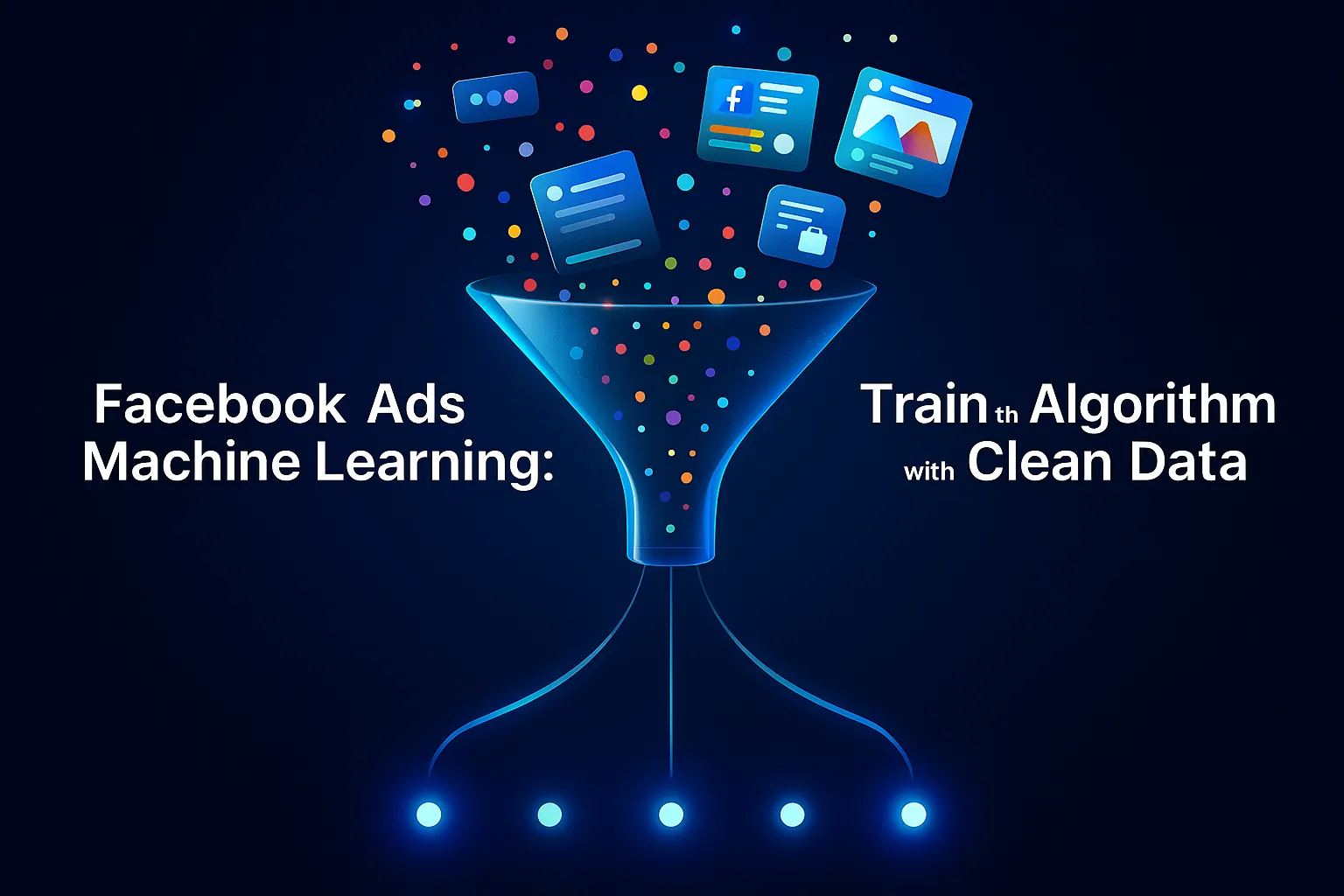
1. Understanding the Learning Phase Beyond the Basics
Most advertisers know the surface definition: the learning phase is when Facebook’s algorithm is gathering data to optimize delivery.
But in reality, it is closer to this:
A probabilistic modeling window where the system tries to minimize uncertainty in predicting conversion outcomes across different user segments.
Every impression, click, scroll stop, add-to-cart, and conversion becomes training data. The algorithm is asking:
- Who is most likely to convert?
- At what time are they most responsive?
- Which creative triggers action?
- What behavioral signals precede conversion?
During this phase, Facebook is not optimizing for performance yet—it is optimizing for predictability.
Once predictability is achieved, optimization begins.
2. Why “Learning Phase Stability” Is the Real Performance Lever
Many advertisers obsess over CPM, CTR, or ROAS in the first 24–72 hours. This is a mistake.
Early-stage metrics are noise-heavy and unstable. The real indicator of success is whether the system can exit learning efficiently.
A stable learning phase leads to:
- Lower long-term CPA
- More consistent delivery
- Stronger audience modeling
- Faster scaling capacity
- Reduced volatility in results
An unstable learning phase leads to:
- Constant performance swings
- Inflated acquisition costs
- Delivery stagnation
- Audience misclassification
- Endless “testing loops” that never stabilize
In short: you are not optimizing ads—you are either helping or breaking the algorithm’s learning process.
3. The Core Mechanism: What Triggers Learning Reset
To understand the red lines, you must understand what causes Facebook to reset or destabilize learning.
The system re-enters learning when there is a significant disruption in expected data distribution.
That includes:
- Major budget changes
- Creative swaps
- Audience edits
- Conversion event changes
- Bid strategy shifts
- Ad set restructuring
Each of these actions signals:
“The previous model may no longer be valid.”
So the system restarts exploration.
This is where most advertisers unintentionally sabotage performance.
4. The Fatal Mistake: Blind Trial-and-Error Testing
The biggest misconception in paid social advertising is this:
“If something is not working, just keep testing until it works.”
This works in creative ideation—but not in machine learning optimization environments.
Because every “test” is not free.
Each test:
- Breaks model continuity
- Reduces statistical confidence
- Resets optimization progress
- Increases data fragmentation
When you constantly change variables, you are not training the system—you are confusing it.
Think of it like trying to teach someone a language while changing the alphabet every hour.
5. The Learning Phase Red Lines (Critical Rules You Must Not Cross)
Below are the operational boundaries that determine whether your campaign stabilizes or collapses into perpetual learning.
Red Line 1: Do Not Make Frequent Structural Changes in the First 72 Hours
The first 72 hours are the most sensitive period in any campaign lifecycle.
Avoid:
- Editing ad sets repeatedly
- Changing targeting parameters
- Switching optimization events
- Rebuilding campaigns from scratch
Why this matters:
The system needs uninterrupted exposure to patterns. Interrupting this process causes model fragmentation, where no stable baseline is formed.
A campaign that cannot stabilize in 72 hours often never stabilizes at all.
Red Line 2: Do Not Judge Performance Too Early
Early performance is not predictive.
A campaign may show:
- High CPA on Day 1
- Low CTR on initial impressions
- Volatile CPM swings
None of these are final signals.
What matters is:
- Direction of trend stabilization
- Conversion signal consistency
- Cost convergence over time
Making decisions too early forces unnecessary resets.
Red Line 3: Do Not Split Traffic Excessively
A common mistake is creating too many ad sets or audience segments in testing mode.
The problem:
Each ad set needs minimum conversion volume to stabilize.
When you split traffic too thin:
- No segment reaches statistical learning threshold
- Each ad set stays stuck in learning
- Optimization never converges
Instead of clarity, you create fragmentation.
Red Line 4: Avoid Creative Over-Iteration During Learning
Creatives are often changed too aggressively.
But during learning, consistency matters more than novelty.
Frequent creative swaps:
- Reset engagement signals
- Break pattern recognition
- Prevent audience mapping stabilization
The algorithm is trying to answer:
“Which type of message works for which type of person?”
If you change the message too often, it never learns.
Red Line 5: Do Not Change Conversion Events Mid-Flight
One of the most destructive actions is switching optimization goals after launch.
For example:
- From Add-to-Cart → Purchase
- From Landing Page View → Purchase
- From Lead → Qualified Lead
This resets the entire learning foundation because:
Conversion signals define what “success” means to the system.
Change the definition, and you erase prior learning.
Red Line 6: Avoid Constant Budget Oscillation
Budget changes are interpreted as intent shifts.
Frequent increases or decreases cause:
- Delivery recalibration
- Audience reallocation
- Temporary instability in bidding logic
The system reacts to budget changes like market shocks.
Stable budgets = stable learning.
Erratic budgets = perpetual uncertainty.
Red Line 7: Do Not Over-Optimize Based on Insufficient Data
This is one of the most expensive mistakes.
Examples:
- Killing ads after 10 clicks
- Scaling winners after 1 conversion
- Declaring losers after 1 day
This introduces false negatives and false positives, destroying long-term optimization accuracy.
Machine learning requires:
Signal accumulation, not instant judgment.
6. Why Most Advertisers Stay Stuck in Learning Forever
If you’ve ever felt like your campaigns are always “almost working,” this is usually why:
- Too many edits
- Too many tests
- Too little patience
- Too much reactive optimization
The algorithm is never allowed to complete its modeling cycle.
Instead of converging, it keeps restarting.
So the system never reaches:
- Stable delivery
- Predictive accuracy
- Efficient scaling mode
It remains in a loop of partial learning.
7. The Hidden Truth: Stability Beats Optimization
A counterintuitive truth in Facebook advertising is this:
A stable average-performing campaign will outperform a constantly optimized unstable campaign.
Why?
Because stability allows:
- Better audience prediction
- Lower variance in bidding
- Stronger conversion pattern recognition
- Compounding optimization effects
Meanwhile, unstable campaigns never accumulate enough coherent data to improve.
8. What Proper Learning Phase Management Looks Like
Instead of “testing everything,” a structured approach looks like this:
- Launch with controlled variables
- Maintain consistency for a defined learning window
- Monitor directional trends, not daily fluctuations
- Allow sufficient conversion volume accumulation
- Make changes only after statistical stabilization
In practice, this means:
You are not constantly fixing ads.
You are letting the system learn before you intervene.
9. Scaling Happens After Learning, Not During It
One of the biggest misconceptions is trying to scale too early.
Scaling during learning:
- Distorts data
- Forces recalibration
- Increases instability
Scaling after learning:
- Leverages established patterns
- Maintains predictive accuracy
- Improves marginal efficiency
Think of learning as building the foundation.
Scaling is building the structure.
You cannot expand what is not stable.
10. The Psychology Problem: Why Advertisers Break Their Own Campaigns
Even when people understand the rules, they still violate them.
Why?
Because of psychological discomfort:
- Waiting feels like inactivity
- Volatility feels like failure
- Uncertainty triggers intervention
So advertisers intervene too early.
But machine learning systems do not reward emotional responsiveness.
They reward:
Controlled consistency over time.
11. A Practical Mental Model for Decision-Making
Instead of asking:
- “Is this working today?”
Ask:
- “Is the system learning in a consistent direction?”
Instead of:
- “Should I change this now?”
Ask:
- “Will this change help or reset the learning process?”
Instead of:
- “Why is performance unstable?”
Ask:
- “Have I allowed enough uninterrupted learning cycles?”
This shift alone dramatically improves outcomes.
12. Final Thoughts: Treat the Algorithm Like a Student, Not a Machine
The biggest mistake in modern advertising is treating the platform like a tool you control completely.
In reality, it behaves more like a learning student:
- It needs examples
- It needs repetition
- It needs consistency
- It needs time
If you constantly interrupt the learning process, you never get intelligence—you only get noise.
The difference between struggling advertisers and scaling advertisers is not creativity alone.
It is discipline in respecting the learning phase.
Stop treating every fluctuation as a problem to fix.
Start treating the system as something that is still forming its understanding of reality.
Because once it learns properly, everything becomes easier:
- Lower costs
- Better targeting
- More stable scaling
- Predictable returns
And that is the real goal—not constant testing, but compounding learning efficiency.