En
En
 10 min read
The digital advertising landscape has changed dramatically over the past few years. What once relied heavily on browser cookies and client-side tracking has evolved into a far more privacy-conscious ecosystem. Apple’s privacy initiatives, browser restrictions, ad blockers, and stricter data regulations have fundamentally changed how businesses collect and measure conversion data.
For marketers, eCommerce brands, SaaS companies, and agencies, one challenge has become impossible to ignore: missing conversion data.
If your advertising reports no longer match your actual sales, if attribution windows appear inconsistent, or if optimization algorithms seem less effective than they used to be, you’re not alone. These are common symptoms of relying solely on browser-based tracking.
Fortunately, there is a modern solution designed specifically for this new era of digital marketing: Conversion API (CAPI).
In 2026, implementing CAPI is no longer considered an advanced optimization—it has become an essential part of maintaining accurate measurement, improving campaign performance, and building a more resilient tracking infrastructure.
This guide explains what Conversion API is, why it matters more than ever, how it works, and the best practices for implementing it successfully.
Why iOS Changed Digital Advertising Forever
Before understanding Conversion API, it’s important to understand what changed.
For years, advertisers depended primarily on browser pixels.
A visitor would:
- Visit a website
- Trigger browser events
- Complete a purchase
- Allow advertising platforms to attribute the conversion
This model worked reasonably well until privacy regulations and platform-level restrictions reshaped online tracking.
Apple’s App Tracking Transparency (ATT), Intelligent Tracking Prevention (ITP), along with increasing browser limitations from Safari, Firefox, and Chrome, significantly reduced the reliability of traditional browser tracking.
The result?
Businesses suddenly experienced:
- Missing purchase events
- Lower reported ROAS
- Reduced attribution accuracy
- Incomplete customer journeys
- Poor campaign optimization signals
The customer didn’t disappear.
The data did.
The Problem with Browser-Based Pixels
Pixels operate inside the user’s browser.
That means they’re affected by:
- Cookie restrictions
- Browser privacy settings
- Ad blockers
- Network interruptions
- JavaScript errors
- Consent preferences
- Page loading failures
Every interruption increases the likelihood that valuable conversion events never reach advertising platforms.
Imagine spending $20,000 on ads while only receiving reports for 70% of your actual purchases.
Your campaigns may be performing well—but your reporting suggests otherwise.
What Is Conversion API (CAPI)?
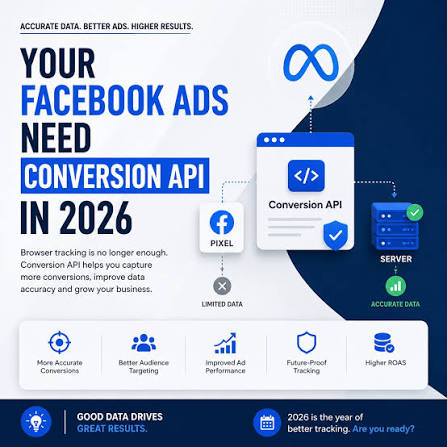
Conversion API is a server-to-server event transmission system.
Instead of relying entirely on the visitor’s browser, your own server sends conversion events directly to advertising platforms.
This fundamentally changes the tracking architecture.
Traditional Pixel Flow:
User → Browser → Advertising Platform
Conversion API Flow:
User → Website → Server → Advertising Platform
Because the browser is no longer the only messenger, many common tracking interruptions can be avoided.
Why Server-Side Tracking Is More Reliable
Server communication offers several advantages.
Unlike browser scripts, server requests are not easily interrupted by:
- Browser extensions
- JavaScript failures
- Client-side loading issues
- Cookie expiration
- Some browser privacy restrictions
As a result, more events successfully reach advertising systems.
Better data leads to:
- More accurate reporting
- Improved optimization
- Better audience creation
- Higher attribution confidence
Browser Tracking vs. Server Tracking
Let’s compare both approaches.
| Browser Pixel | Conversion API |
|---|---|
| Runs in browser | Runs on server |
| Affected by ad blockers | Much less affected |
| Cookie dependent | Less cookie dependent |
| Vulnerable to script failures | More reliable delivery |
| Limited event recovery | Stronger redundancy |
| Easier implementation | Slightly more technical |
Most modern advertisers no longer choose one or the other.
Instead, they use both together.
Why Combining Pixel and CAPI Works Best
One common misconception is that Conversion API replaces browser pixels.
It doesn’t.
The strongest tracking architecture combines:
Browser Pixel
plus
Conversion API
This hybrid model provides redundancy.
If the browser event succeeds, excellent.
If the browser event fails, the server event often succeeds.
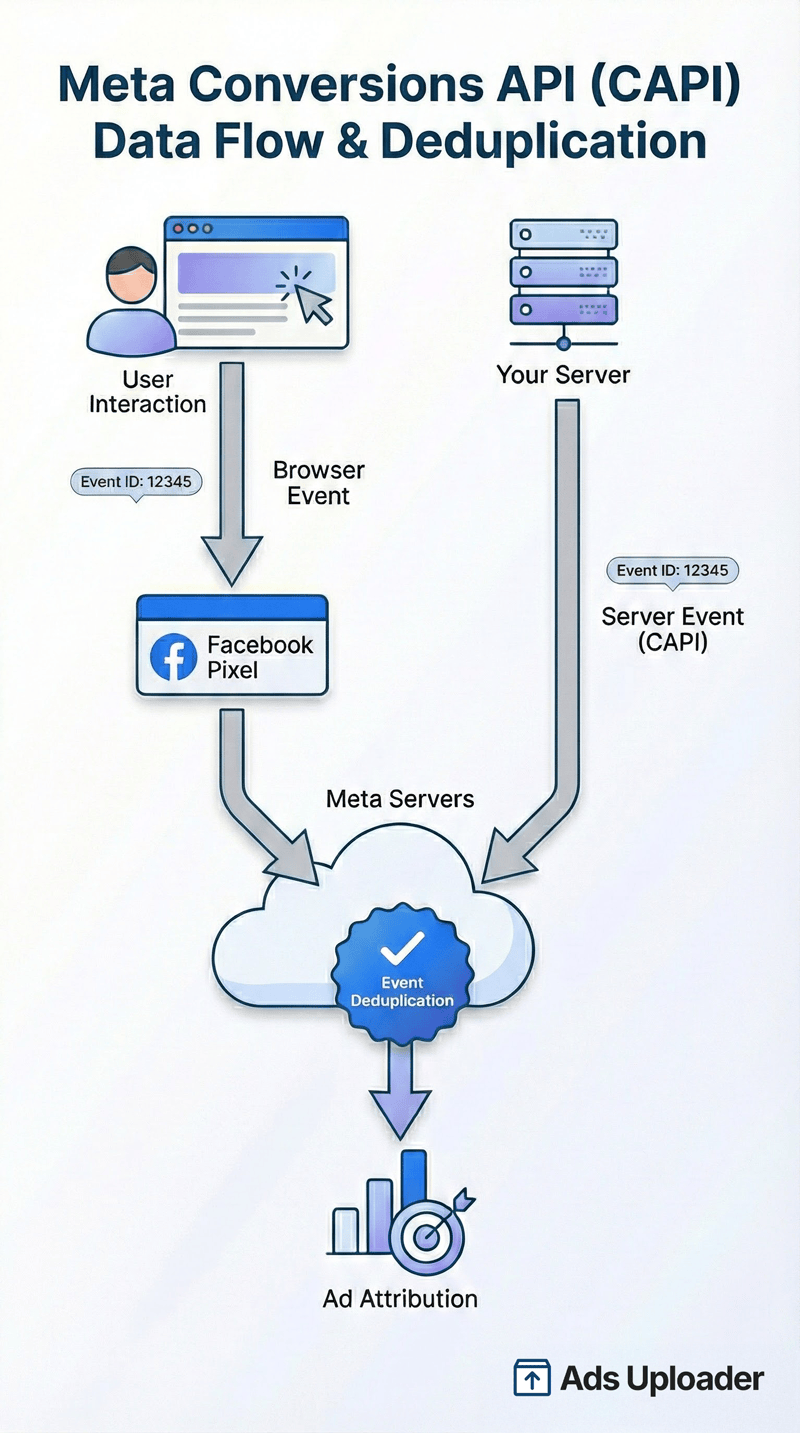
Together they significantly improve overall event coverage.
Understanding Event Deduplication
Running both browser and server tracking introduces another challenge.
What happens if both send the same purchase?
Advertising platforms solve this using event deduplication.
Each conversion includes:
- Event ID
- Event Name
- Timestamp
If two identical events arrive, the platform recognizes them as the same conversion instead of counting them twice.
Proper deduplication is one of the most important implementation steps.
Which Events Should Be Sent Through CAPI?
Although purchases receive the most attention, many businesses benefit from sending additional events.
Common server-side events include:
Purchase
The most valuable conversion event.
Includes:
- Revenue
- Currency
- Product IDs
- Order value
Add to Cart
Helps improve optimization for shopping campaigns.
Initiate Checkout
Provides insight into checkout abandonment.
View Content
Useful for audience building.
Lead
Essential for service businesses.
Complete Registration
Critical for SaaS companies.
Subscribe
Important for recurring revenue businesses.
Essential Customer Parameters
Accurate event matching depends on customer information.
Typical identifiers include:
- Email address (hashed)
- Phone number (hashed)
- First name
- Last name
- ZIP code
- Country
- External ID
- Browser information
- IP address
The more high-quality identifiers included (while respecting applicable privacy laws and user consent), the better the event matching rate tends to be.
Why Event Match Quality Matters
Advertising platforms attempt to connect incoming events with actual users.
Higher-quality matching enables:
- Better attribution
- More accurate reporting
- Improved audience building
- Stronger machine learning optimization
Poor event matching reduces the effectiveness of every campaign.
Common CAPI Architecture Options
There are several ways to implement Conversion API.
Option 1: Partner Integrations
Many platforms provide built-in integrations.
Popular examples include:
- Shopify
- WooCommerce
- BigCommerce
- Magento
These solutions require minimal coding.
Option 2: Tag Management Platforms
Modern server-side tag management allows centralized event routing.
Advantages include:
- Easier maintenance
- Flexible configuration
- Multi-platform integrations
Option 3: Custom Server Implementation
Larger organizations often build custom pipelines.
Benefits:
- Maximum flexibility
- Full event control
- Advanced data transformation
- Custom business logic
This approach requires developer resources but provides the highest level of customization.
Common Implementation Mistakes
Even experienced marketers make mistakes.
Duplicate Events
Incorrect Event IDs lead to inflated conversions.
Missing Purchase Values
Optimization algorithms rely heavily on revenue data.
Incomplete purchase events reduce campaign effectiveness.
Poor Event Timing
Events should be transmitted promptly after they occur.
Delayed events reduce attribution quality.
Missing Customer Identifiers
Sending only purchase values without customer information weakens event matching.
Ignoring Error Logs
Server requests occasionally fail.
Successful implementations continuously monitor:
- Failed requests
- Validation errors
- API responses
Privacy Still Matters
One misconception is that server-side tracking bypasses privacy laws.
It does not.
Businesses must still comply with:
- Consent requirements
- Privacy policies
- Applicable data protection regulations
- User preferences
Conversion API improves reliability—not legal exemptions.
Transparency with users remains essential.
Measuring Success After Implementation
How do you know your implementation is working?
Look for improvements in:
- Event Match Quality (EMQ)
- Purchase attribution
- Revenue reporting
- Campaign optimization stability
- Audience sizes
- Conversion consistency
Many businesses notice reporting improvements within days after proper implementation, while machine learning optimization may take several weeks to fully benefit from richer data.
CAPI Beyond eCommerce
Although online stores receive the most attention, Conversion API benefits many industries.
SaaS
Track:
- Trial signups
- Paid subscriptions
- Upgrades
Education
Measure:
- Course enrollments
- Webinar registrations
- Student applications
Healthcare
Track:
- Appointment requests
- Consultation bookings
(while following applicable healthcare privacy regulations)
Financial Services
Capture:
- Quote requests
- Loan applications
- Account openings
B2B Companies
Monitor:
- Lead submissions
- Demo requests
- Proposal downloads
Preparing for a Cookieless Future
The advertising ecosystem continues to evolve toward privacy-first technologies.
Future trends include:
- First-party data strategies
- Server-side measurement
- Consent-aware tracking
- Enhanced Conversions
- AI-powered attribution
- Privacy-preserving analytics
Conversion API fits naturally into this evolving landscape because it reduces dependence on fragile client-side mechanisms.
Businesses that adopt server-side infrastructure today are generally better positioned for future privacy changes.
Best Practices Checklist for 2026
Before launching your implementation, review the following checklist:
- Combine browser pixels with Conversion API rather than replacing one with the other.
- Configure event deduplication using consistent Event IDs.
- Include complete purchase information, including value and currency.
- Send customer identifiers securely and in the expected format.
- Monitor server logs and API responses for failed requests.
- Test every event before deploying to production.
- Respect user consent preferences and applicable privacy regulations.
- Keep your tracking documentation updated as your website evolves.
- Review event quality metrics regularly to identify opportunities for improvement.
- Revalidate your implementation after major website or checkout updates.
The Business Impact of Better Data
Reliable conversion data affects far more than reporting dashboards.
When advertising platforms receive complete and accurate event signals, they can make better optimization decisions. This often leads to:
- More efficient budget allocation
- Improved bidding strategies
- Higher-quality audience modeling
- Better campaign scalability
- Increased confidence in marketing performance analysis
In an environment where every advertising dollar counts, stronger measurement creates a competitive advantage.
Final Thoughts
The era of relying solely on browser-based tracking is over. Privacy protections, browser limitations, and evolving consumer expectations have permanently changed how digital measurement works. While no solution can recover every lost signal, Conversion API has become one of the most effective ways to improve data reliability and strengthen advertising performance.
Rather than viewing CAPI as just another technical integration, think of it as the foundation of a modern measurement strategy. By combining browser pixels with server-side event delivery, implementing proper deduplication, maintaining high event quality, and respecting user privacy, businesses can build a tracking infrastructure that is more accurate, resilient, and future-ready.
As digital marketing continues to evolve throughout 2026 and beyond, organizations that invest in robust first-party data collection and server-side tracking will be better equipped to measure success, optimize campaigns, and make informed business decisions—even in an increasingly privacy-focused world.