
















< Blogs

TikTok Product Research Playbook How to Use Tools to Track Viral Trends and Spot the Next Winning Product

Vivan Z.
Created on January 28, 2026 – Last updated on January 28, 20264 min read
Written by: Vivan Z.

TikTok Product Research Playbook
How to Use Tools to Track Viral Trends and Spot the Next Winning Product

If TikTok interest is real, you’ll often see:

  • A delayed sales spike

  • Rapid review accumulation

  • New listings appearing

No sales signal = high risk.


7.2 Search Trend Confirmation

TikTok trends eventually spill into search.

I look for:

  • Rising branded and non-branded queries

  • “Does this really work?” type searches

  • Comparison-based keywords

This confirms that curiosity is turning into purchase intent.


8. Using Ad Libraries to Decode Trend Timing

Ad libraries are not just for copying ads—they’re for timing decisions.

8.1 What Early-Stage TikTok Ads Look Like

Early trend ads often:

  • Use UGC-style creatives

  • Focus on problem awareness

  • Avoid heavy discounts

  • Test multiple hooks quickly

Late-stage ads:

  • Push urgency hard

  • Stack discounts

  • Look repetitive

  • Have dozens of clones

Tools help you spot this transition.


9. The 5 Signals That Tell Me a Trend Is Worth Testing

Before testing any TikTok product, I look for these signals:

  1. Multiple creators posting organically

  2. One or two aggressive trend merchants testing ads

  3. Comment sections full of purchase questions

  4. Early marketplace sales growth

  5. Low brand dominance

If at least 4 out of 5 are present, the product is test-worthy.


10. Filtering Out “Fake Trends”

Not everything viral should be sold.

10.1 Red Flags Tools Help You Catch

Avoid products with:

  • One-hit wonder creators

  • No repeat posting

  • Zero marketplace footprint

  • Extreme return complaints

  • Complex usage explanation

If the product needs a tutorial longer than the video—it won’t scale.


11. Timing: The Most Underrated Skill on TikTok

You don’t need to be first.
You just can’t be last.

11.1 The TikTok Product Lifecycle

  1. Discovery phase

  2. Early adoption

  3. Viral acceleration

  4. Market saturation

  5. Creative fatigue

Tools help you identify phase 2, not phase 4.


12. Why Most Sellers Lose Money Chasing TikTok Trends

They:

  • Enter too late

  • Copy saturated creatives

  • Ignore logistics

  • Scale without validation

Tools don’t remove risk—but they compress uncertainty.


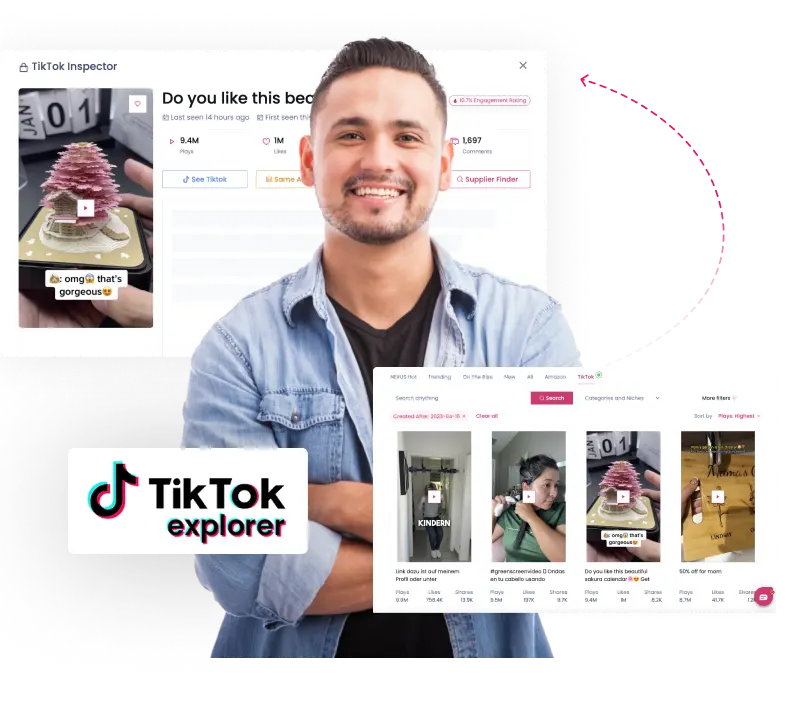
13. How I Personally Use Tools (Step-by-Step)

Here’s my simplified weekly process:

Step 1: Monitor TikTok content velocity
Step 2: Identify active trend merchants
Step 3: Cross-check marketplaces
Step 4: Confirm search interest
Step 5: Analyze ad saturation
Step 6: Decide: test or skip

This process takes hours, not weeks.


14. Tools Don’t Replace Judgment—They Sharpen It

The biggest misconception is that tools “find winning products.”

They don’t.

They:

  • Highlight anomalies

  • Reveal patterns

  • Remove emotional bias

You still decide.

15. Why TikTok Rewards Speed—but Punishes Laziness

TikTok doesn’t care if you’re small or new.

It cares if:

  • Your content hooks attention

  • Your product solves a visual problem

  • Your offer is simple

Tools help you move fast without being reckless.


16. Building a Repeatable TikTok Trend System

One viral product is luck.
Two is coincidence.
Three is a system.

That system starts with:

  • Monitoring trends daily

  • Tracking merchants weekly

  • Trusting data over excitement


17. From Trend Follower to Trend Interpreter

The real goal isn’t chasing trends.

It’s learning to:

  • Read signals

  • Interpret momentum

  • Exit before collapse

  • Reinvest into the next wave

That’s how real TikTok sellers survive long-term.


Conclusion: TikTok Trends Favor the Prepared

TikTok doesn’t reward guesswork.
It rewards awareness, speed, and discipline.

If you rely on scrolling alone, you’ll always be late.
If you rely on tools without thinking, you’ll misread signals.

But if you combine:

  • Smart tools

  • Clear frameworks

  • Human judgment

You stop chasing viral products—and start anticipating them.

And that’s where the real money is made.
DropSure is Your Best Partner
22 Years Experience
Affiliate Rebates
100% Quality Guarantee
Top-Up Rewards
10+ Global Warehouses
Custom Branding Support
Smart inventory System
24/7 Customer Support
Get a Quote in 24 Hours
Start Sourcing for Free

Keep Learning

As global e-commerce continues to expand, staying compliant with local tax regulations is becoming increasingly essential for businesses. Among the most important tax systems that affect cross-border sales in the European Union are VAT, OSS, and IOSS. These systems not only ensure compliance but also help businesses streamline their operations and avoid costly mistakes. In this article, we will break down what VAT, OSS, and IOSS are, how they work, and how understanding these frameworks can help you stay ahead in the global e-commerce game as we approach 2025.   Here’s an table with Standard VAT Rate for some important countries:    Note: The United States does not have VAT; it only has sales tax. Sales tax is levied only at the retail stage, unlike in most countries where taxes are applied to the value added at each stage of the supply chain.   What is VAT ?   VAT is charged at each stage of the supply chain, including production, wholesale, and retail. At every stage, tax is applied to the “added value” of goods and services. The “added value” refers to the extra value created at each stage, like processing, transforming, transporting, and distributing the product. Example: Let’s say you’re a toy factory. You make a toy and sell it to a store. The store then sells it to a customer. At each step, from production to sale, a small tax is added. But each person only pays VAT on the “added value” they created, not the entire product.   Let’s walk through the process: Assume you buy a television at an electronics store, priced at 500 euros. The VAT rate is 20%. 1.Merchant Purchase (Wholesaler) The merchant […]

Dropshipping, as a low-barrier entrepreneurial model, has attracted an influx of countless people, but few have actually succeeded. Many people ask: “How long does it take to learn Dropshipping?” The answer is not fixed – some people realize their first order within 1 month, some people are still losing money after half a year. The key is whether you understand the underlying logic and are willing to iterate consistently. In this article, we’ll unveil the learning path and core strategies in the context of new industry trends for 2025. The Four Stages  to Learn Dropshipping  Stage 1: Basic Awareness (1-2 weeks)  Hey, if you’re just starting out in Dropshipping, don’t be fooled by those cases of “earning $100,000 per month”. Although it sounds attractive, most newbies often ignore the basic skills behind. Do not rush to think of a million dollars a month, first figure out how the e-commerce is the key. First, you need to understand the core concept and characteristics of dropshipping. Dropshipping is a business model where you ship directly through your suppliers, which means you don’t need to buy inventory in advance and avoid the risk of inventory buildup. Your source of profit is primarily the difference between the selling price and the supplier’s purchase price. Sounds simple, but in practice, balancing advertising investment and profit is the most challenging part. Having clarified the importance of market and product direction, we’ll then explore in detail how to pinpoint and optimize your product selection with specific strategies and steps. 1. Market Research: Utilize tools such as Google Trends, AliExpress, etc. to understand current hot products and future trends. Focus on your competitors and analyze their hot products. […]

In the dropshipping industry, choosing the right supplier is crucial, and price often plays a key role in our decision-making process. I’m sure every dropshipper is interested in how to find affordable dropshipping suppliers. Next, let’s embark on our dropshipping journey by starting with the search for a supplier that is both budget-friendly and reliable. I believe that by the end of this guide, you will have gained more tips for finding suppliers. Who Are The Cheapest Dropshipping Suppliers? Without further ado, let’s take a look at which suppliers can offer the most cost-effective products for dropshippers. This section will introduce you to those suppliers who are both affordable and reliable in quality. Choosing them will significantly enhance the smooth operation of your dropshipping business. Whether you are a newcomer to the industry or an experienced veteran, this list of suppliers will provide valuable references to help your dropshipping venture thrive. 1.AutoDS Marketplace AutoDS Marketplace is an automation tool platform specifically designed for cross-border e-commerce sellers. Its main features include product sourcing, price monitoring, inventory management, and order processing. This platform helps sellers efficiently manage their product listings across various e-commerce platforms, optimizing their operational processes. The products offered by AutoDS Marketplace typically come from multiple suppliers with competitive pricing, allowing sellers to acquire goods at lower costs and thereby increase their profit margins. Additionally, AutoDS Marketplace features automation for pricing, inventory management, and order processing, enabling sellers to reduce labor costs and time investment, which further lowers operational expenses. Moreover, bulk purchase discounts may be available on AutoDS Marketplace, allowing sellers to resell at higher profits based on these savings. 2.AliExpress AliExpress is a well-known online retail platform launched […]

Recommended for you