














 En
 43 min read
Influencer marketing has become one of the most powerful ways for brands to reach new audiences, build credibility, and generate sales. From independent online stores to established direct-to-consumer (DTC) companies, businesses increasingly rely on content creators to introduce products, share authentic experiences, and influence purchasing decisions.
But there is one problem that many brands continue to overlook: their influencer outreach messages are terrible.
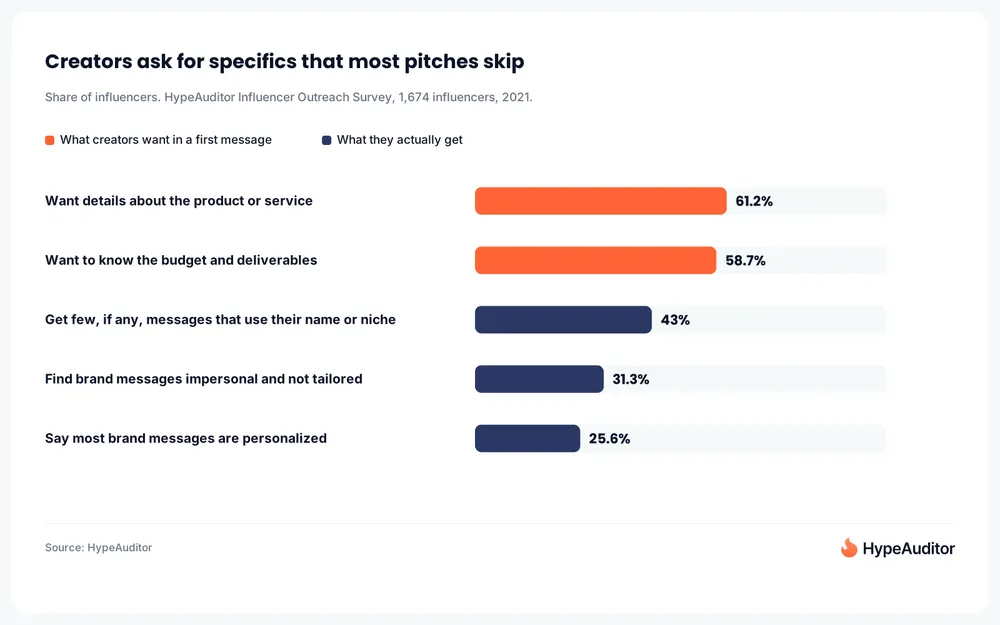
Influencers receive dozens, sometimes hundreds, of collaboration requests. Their inboxes are filled with generic introductions, copy-and-paste product pitches, vague partnership proposals, and messages that look more like automated advertisements than genuine business conversations.
If your first message sounds like spam, there is a good chance it will be ignored.
You might have an excellent product, an attractive commission structure, and a generous collaboration budget. However, none of those advantages matter if your outreach message fails to capture an influencer’s attention.
Successful influencer outreach is not about sending more messages. It is about sending better messages to the right people.
A thoughtful message demonstrates that you understand the creator’s content, respect their audience, and have a clear reason for proposing a partnership. It also makes it easy for the influencer to understand what you are offering and decide whether the opportunity is worth discussing.
In this guide, we will explore five practical influencer outreach templates designed for different collaboration scenarios. You will also learn how to personalize your messages, improve response rates, follow up professionally, avoid common mistakes, and build long-term relationships with content creators.
Whether you are launching a new product, growing an independent store, or building a scalable influencer marketing strategy, these techniques can help turn cold outreach into meaningful business opportunities.
1. Why Do Influencers Ignore Most Brand Collaboration Messages?
Before improving your outreach strategy, it is important to understand why so many influencer messages receive no response.
The problem is rarely just the subject line or the length of the email. In many cases, the entire message fails to communicate value.
Influencers are business owners, content creators, and community builders. Their time, reputation, and audience trust are valuable assets.
A collaboration request must offer a reasonable opportunity for them, not just another sales channel for your brand.
1.1 Generic Messages Make Influencers Feel Replaceable
Consider receiving this message:
“Hi! We love your content and think you would be a great fit for our brand. We would love to collaborate. Let us know if you are interested!”
It sounds friendly, but it provides almost no useful information.
Which piece of content did the brand enjoy?
Why is the influencer a good fit?
What does the collaboration involve?
Is the opportunity paid?
What does the brand expect in return?
The influencer has to ask several questions before deciding whether the opportunity is worth considering.
Worse, the message could have been sent to hundreds of other creators without changing a single word.
A personalized outreach message should make it clear that the brand has actually researched the creator.
Mention a specific video, post, product category, or audience characteristic. This small detail can make the message feel much more genuine.
1.2 Brands Often Talk Too Much About Themselves
Another common mistake is turning the first outreach message into a company introduction.
Some brands spend several paragraphs describing their founding story, product technology, manufacturing capabilities, awards, and business achievements.
Although this information may be useful later, it does not necessarily answer the influencer’s most important question:
“Why should I consider working with you?”
A better message focuses on the creator’s interests and the potential benefits of the collaboration.
For example, instead of writing:
“Our company was established in 2018 and specializes in manufacturing innovative lifestyle products for customers around the world.”
Try:
“I noticed your recent home organization videos focus on practical products that make small spaces easier to manage. We have a new storage solution that could be a natural fit for that content.”
The second version connects the product with the creator’s actual content.
1.3 Unclear Compensation Creates Unnecessary Friction
Influencers need to understand what they are being asked to provide and what they will receive.
A vague offer such as “We can offer you great exposure” is unlikely to be persuasive.
Exposure is not a substitute for compensation, especially for established creators who invest significant time in planning, filming, editing, and publishing content.
Depending on the campaign, compensation may include:
- A fixed content creation fee
- Free products
- Affiliate commissions
- Performance-based bonuses
- A combination of payment and product gifting
- Long-term ambassador agreements
You do not always need to include every financial detail in your first message.
However, the basic collaboration model should be clear enough to prevent misunderstandings.
1.4 Poor Timing and Excessive Follow-Ups Damage Relationships
Even a well-written message can go unanswered.
Influencers may be traveling, working on sponsored content, managing their own businesses, or dealing with a crowded inbox.
Sending multiple messages within a few hours will not make your opportunity more attractive.
It may instead make your brand appear unprofessional.
A better approach is to use a respectful follow-up schedule and give creators enough time to respond.
1.5 The Product May Not Match the Influencer’s Audience
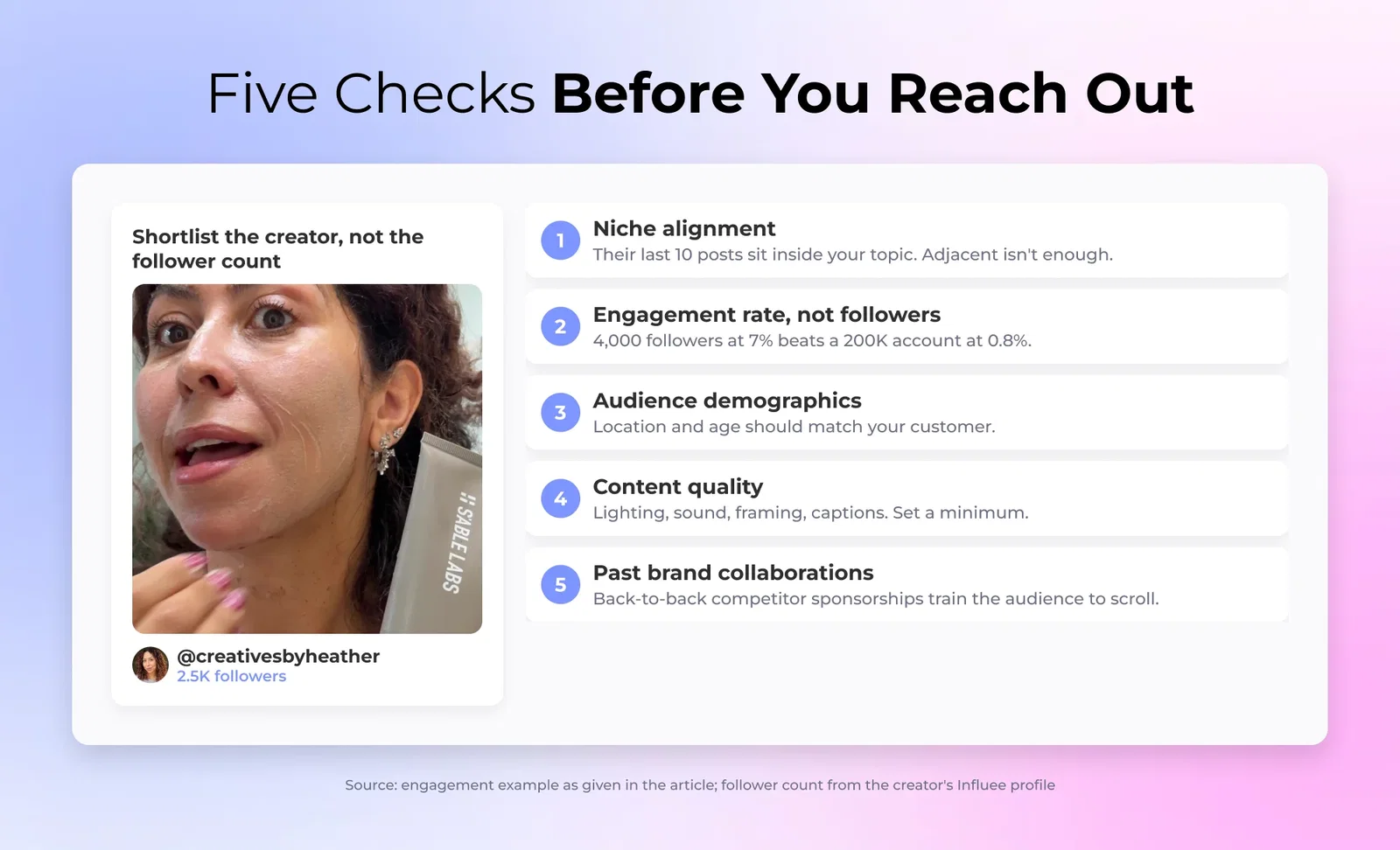
A creator with 200,000 followers is not automatically a better partner than someone with 8,000 followers.
If their audience has little interest in your product, the collaboration may generate limited results.
For example, a premium aquarium equipment brand might receive better engagement from a specialized fishkeeping creator than from a general lifestyle influencer with a much larger following.
The best outreach starts with audience relevance, not follower count.
2. Before Sending a Message: Find the Right Influencers
A great outreach message cannot compensate for poor influencer selection.
Before contacting creators, establish clear criteria for identifying potential partners.
This saves time, reduces unnecessary messages, and improves the likelihood of meaningful collaborations.
2.1 Focus on Audience Relevance
Start by identifying creators whose content naturally connects with your products.
For example:
| Product Category | Relevant Influencer Niches |
|---|---|
| Beauty products | Skincare, makeup, beauty routines |
| Home decor | Interior design, home improvement, organization |
| Fitness products | Fitness, wellness, workout routines |
| Pet supplies | Pet care, dog training, cat lifestyle |
| Aquarium equipment | Fishkeeping, aquascaping, aquarium maintenance |
| Fashion accessories | Fashion styling, personal style, lifestyle |
| Kitchen products | Cooking, meal preparation, home organization |
| Outdoor products | Camping, hiking, travel, outdoor lifestyle |
The closer the relationship between your product and the creator’s regular content, the easier it becomes to develop an authentic collaboration.
2.2 Evaluate Engagement Instead of Just Follower Count
Follower count provides a rough indication of audience size, but it does not reveal how actively that audience interacts with the creator.
Review:
- Average views per video
- Comments and meaningful discussions
- Audience questions
- Content consistency
- Engagement quality
- Sponsored post performance
- Audience demographics, when available
Look beyond the numbers.
A creator with a smaller but highly engaged audience may be more valuable than a larger account whose followers rarely interact.
Also remember that engagement rates vary by platform, account size, niche, and content format. Avoid applying one universal benchmark to every influencer.
2.3 Check Previous Brand Collaborations
Review the creator’s previous sponsored posts.
Ask yourself:
- Have they worked with similar brands?
- Do they produce product demonstrations?
- Do they explain product benefits clearly?
- Do sponsored posts receive meaningful engagement?
- Does their audience respond positively to recommendations?
This helps you understand whether the influencer is comfortable with commercial content and whether their communication style fits your brand.
2.4 Create a Simple Influencer Prospect List
Before sending messages, organize your research.
A basic spreadsheet can include:
| Information | What to Record |
|---|---|
| Influencer name | Creator’s preferred name |
| Platform | Instagram, TikTok, YouTube, etc. |
| Profile link | Direct account URL |
| Niche | Main content category |
| Audience size | Current follower or subscriber count |
| Engagement notes | Comments, views, interaction quality |
| Relevant content | Specific post or video worth mentioning |
| Contact method | Business email or preferred contact channel |
| Collaboration type | Gifting, paid partnership, affiliate, etc. |
| Outreach status | Not contacted, contacted, replied, negotiating |
| Follow-up date | Planned follow-up date |
This simple system prevents duplicate outreach and makes it easier to manage multiple campaigns.
3. Five Influencer Outreach Templates That Can Improve Reply Rates
There is no single message that works for every influencer.
A creator receiving a product gift proposal needs different information from someone being approached for a paid advertising campaign.
The following five templates cover common influencer collaboration scenarios.
Each template includes a practical English message, an explanation of when to use it, and suggestions for making it more effective.
Template 1: The Personalized First Contact Email
<badge color=”success”>Best for first-time outreach</badge>
This is the most versatile template for contacting creators you have not worked with before.
The goal is simple: establish a connection, explain why you selected them, and introduce the collaboration opportunity without overwhelming them.
Suggested subject lines:
- Loved Your Recent [Topic] Video — Collaboration Idea
- A Brand Partnership Opportunity for [Creator Name]
- Your Content and [Brand Name] Could Be a Great Match
- Quick Collaboration Idea for Your [Niche] Content
Email template:
Subject: Loved Your Recent [Topic] Video — Collaboration Idea
Hi [First Name],
I recently came across your [specific video/post] about [specific topic], and I really enjoyed how you [mention a specific detail about their content].
I’m reaching out from [Brand Name]. We specialize in [brief product or brand description], and I thought our [Product Name] could be a great fit for the type of content you create.
We would love to explore a potential collaboration with you, whether that’s a product feature, an honest review, or another creative format that works for your audience.
We are open to discussing the collaboration structure and would be happy to share more details about the product and our proposal.
Would you be interested in hearing more?
Best,
[Your Name]
[Position]
[Brand Name]
[Website]
Why this template works
First, it demonstrates that the brand has actually looked at the influencer’s content.
Second, it introduces the product without turning the email into a lengthy sales pitch.
Third, it gives the creator flexibility in how the collaboration might work.
Finally, the closing question is simple. The influencer does not need to commit to a partnership immediately. They only need to decide whether they want to learn more.
How to improve it
Do not use generic compliments such as “Your content is amazing.”
Instead, reference something specific.
For example:
“I liked your recent video comparing compact kitchen appliances, especially the way you demonstrated how each product performs in a small apartment.”
This shows that your outreach is intentional.
The more specific the observation, the less likely the message will feel automated.
Template 2: The Product Gifting Collaboration Email
<badge color=”info”>Best for product seeding campaigns</badge>
Product gifting is a common way for brands to introduce products to relevant creators.
Instead of immediately requesting a sponsored post, the brand offers a product for the influencer to experience.
However, there is an important distinction between gifting and sponsored content.
If you are sending a product without requiring a post, say so clearly.
Do not disguise a mandatory content deliverable as a gift.
Suggested subject lines:
- We’d Love to Send You Something From [Brand Name]
- A Little Gift for Your [Niche] Content
- Product Gifting Opportunity — [Product Name]
- We’d Love You to Try Our New [Product Category]
Email template:
Subject: We’d Love to Send You Something From [Brand Name]
Hi [First Name],
I’ve been following your content on [platform], and your recent posts about [specific topic] caught my attention.
I’m [Your Name] from [Brand Name], a company focused on [brief brand description].
We recently launched [Product Name], and I thought it might be something you’d genuinely enjoy trying based on your interest in [relevant niche or topic].
We would love to send you one as a complimentary gift, with absolutely no obligation to create or publish content.
If you enjoy the product and decide it is something your audience might appreciate, we’d be happy to explore a potential collaboration in the future.
Would you be open to receiving one?
Best,
[Your Name]
[Brand Name]
[Website]
Why this template works
The biggest advantage is transparency.
Many influencers receive product gifting messages that secretly expect a video, story, or review in exchange for a free item.
By clearly stating that there is no posting obligation, your brand establishes a more trustworthy relationship.
It also gives creators the freedom to form their own opinions about the product.
This can be especially useful when working with micro-influencers or niche creators who are selective about the products they recommend.
Important communication tip
If you expect a specific deliverable, such as one Instagram Reel or two TikTok videos, you are proposing a structured collaboration rather than unconditional gifting.
In that situation, explain the deliverable expectations and compensation clearly before the creator agrees.
Also, if a creator receives a free product and later chooses to publish content, applicable disclosure rules may still apply even when no post was required.
Template 3: The Paid Influencer Partnership Proposal
<badge color=”success”>Best for established creators</badge>
When contacting professional creators with established audiences, a vague collaboration invitation may not be enough.
These influencers often have dedicated business contact information, media kits, rate cards, and established partnership processes.
Your first message should communicate that your brand understands the value of professional content creation.
Suggested subject lines:
- Paid Partnership Opportunity With [Brand Name]
- Sponsored Content Collaboration — [Product Category]
- Let’s Discuss a Paid Partnership
- Brand Campaign Opportunity for [Creator Name]
Email template:
Subject: Paid Partnership Opportunity With [Brand Name]
Hi [First Name],
I’m [Your Name], reaching out from [Brand Name].
I’ve been following your content about [specific topic], and I especially enjoyed your recent
discussing [specific detail].
Your approach to [relevant subject] aligns well with the audience we hope to reach through our upcoming campaign.
We are currently looking for creators to collaborate with us on a paid campaign featuring [Product Name], designed for [brief target customer description].
We would love to discuss a potential partnership involving:
- [Proposed content format]
- [Expected content quantity]
- [Campaign timeline]
- Paid compensation based on the agreed scope
We would also be happy to review your media kit, rates, and preferred collaboration requirements.
Would you be available to discuss the opportunity?
Looking forward to hearing from you.
Best regards,
[Your Name]
[Position]
[Brand Name]
[Website]
Why this template works
It communicates that the brand is offering a professional business opportunity rather than asking the creator to work for free.
It also introduces the campaign structure without forcing the influencer to accept an arbitrary rate.
Inviting the creator to share their media kit or pricing makes the negotiation more collaborative.
How to make the proposal more attractive
Whenever possible, provide more detail about the campaign.
For example, instead of saying:
“We want you to promote our product.”
Explain:
“We are planning a short-form video campaign demonstrating how our compact air purifier works in small apartments. We are looking for creators who regularly produce home organization and practical lifestyle content.”
The second description gives the influencer a clearer idea of the creative direction.
You should also be prepared to discuss usage rights, exclusivity, revisions, publication dates, and paid advertising permissions.
These details can significantly affect the total value and cost of a partnership.
Template 4: The Long-Term Brand Ambassador Invitation
<badge color=”discovery”>Best for relationship building</badge>
Not every influencer campaign should be a one-time transaction.
Some of the most valuable partnerships develop over several months or even years.
A long-term brand ambassador relationship allows creators to become more familiar with your products and gives their audiences repeated opportunities to recognize your brand.
This can be particularly valuable for products that require demonstrations, education, or repeated use.
Suggested subject lines:
- Let’s Build Something Long-Term Together
- Brand Ambassador Opportunity With [Brand Name]
- Interested in a Long-Term Partnership?
- A Potential Ongoing Collaboration for [Creator Name]
Email template:
Subject: Brand Ambassador Opportunity With [Brand Name]
Hi [First Name],
I’ve been enjoying your content, particularly the way you share practical advice about [specific topic].
I’m reaching out from [Brand Name]. We are looking to build long-term relationships with creators who genuinely connect with our products and share our interest in [relevant niche or value].
Your content about [specific subject] stood out to us, and we believe there could be a natural connection between your audience and our brand.
Rather than proposing a one-time sponsored post, we’d love to explore a longer-term partnership that could include:
- Regular product features
- Exclusive product launches
- Sponsored content opportunities
- Affiliate commissions or other agreed compensation
- Early access to new products
We would love to hear what a successful long-term partnership would look like from your perspective.
Would you be interested in discussing this further?
Best,
[Your Name]
[Brand Name]
[Website]
Why this template works
It communicates a different mindset.
Instead of treating the influencer as a temporary advertising channel, the brand positions the creator as a potential long-term partner.
This can be attractive to creators who prefer consistent relationships over repeatedly negotiating one-off sponsorships.
How to improve it
Do not promise a long-term partnership before understanding the creator’s interests and expectations.
Start with a conversation.
Ask what types of collaborations they enjoy, what content formats work best for their audience, and what compensation structures they prefer.
A sustainable ambassador relationship should create value for both sides.
Template 5: The Professional Follow-Up Email
<badge color=”warning”>Best for unanswered outreach</badge>
Sometimes the influencer simply misses your first message.
This does not necessarily mean they are uninterested.
Their inbox may be crowded, your email may have been filtered, or they may have planned to respond later and forgotten.
A polite follow-up can bring your proposal back to their attention.
However, there is a difference between professional follow-up and harassment.
A good follow-up is short, respectful, and easy to answer.
Suggested subject lines:
- Following Up on My Collaboration Idea
- Quick Follow-Up — [Brand Name]
- Re: Partnership Opportunity With [Brand Name]
- Just Checking In About Our Collaboration Proposal
Email template:
Subject: Following Up on My Collaboration Idea
Hi [First Name],
I hope you’re doing well!
I wanted to briefly follow up on my previous message about a potential collaboration between you and [Brand Name].
We still think your content about [specific topic] could be a great fit for our [Product Name].
If you’re interested, I’d be happy to send over more information about the product, campaign details, and proposed collaboration structure.
If now isn’t the right time, no worries at all. We completely understand.
Thanks for your time, and I hope to connect with you soon!
Best,
[Your Name]
[Brand Name]
Why this template works
It reminds the influencer about the opportunity without creating pressure.
It also provides an easy way to decline.
This is important because maintaining a positive relationship is often more valuable than forcing a response.
When should you send it?
A practical starting point is to wait approximately five to seven business days before sending the first follow-up.
If there is still no response, you may consider one final message after another seven to ten business days.
After that, stop contacting the creator about the same opportunity unless they re-engage.
These are suggested intervals, not universal rules. Adjust them based on the platform, campaign timeline, and creator’s stated communication preferences.
4. Five Communication Techniques That Make Influencer Outreach More Effective
Having five good templates is useful, but templates alone will not create successful partnerships.
The real difference comes from how you adapt and deliver them.
Here are five practical communication techniques that can make your outreach more relevant and professional.
Technique 1: Personalize the First Two Sentences
The opening of your message determines whether the influencer has a reason to continue reading.
Avoid:
“Hi, we are a leading global company looking for influencers to promote our products.”
Instead, demonstrate that you understand their content.
For example:
“Hi Sarah, I really enjoyed your recent video about organizing a small home office. Your comparison of different desk accessories was especially helpful, and I liked how you focused on practical solutions rather than just appearance.”
This opening is more specific and creates a natural connection.
You do not need to write a long paragraph about the influencer.
One genuine observation is usually enough.
Technique 2: Explain Why the Collaboration Makes Sense
Influencers want to understand why their audience would care about your product.
Do not simply list product features.
Connect those features with the creator’s content.
For example:
Weak approach:
“Our water purifier uses advanced filtration technology and has several innovative features.”
Better approach:
“I noticed that you regularly create content about improving indoor air quality and creating healthier living spaces. Our compact air purifier could fit naturally into one of your home improvement demonstrations.”
The second message explains the connection between the product and the influencer’s established content.
Technique 3: Make the Offer Easy to Understand
A creator should not need to exchange five emails just to discover what the brand wants.
Whenever possible, explain:
- What product or service is involved
- Whether the collaboration is paid or gifted
- What content format is being considered
- Whether there are expected deliverables
- Whether the brand has a campaign timeline
You do not need to include every contractual detail in the first message.
However, the basic offer should be transparent.
Technique 4: Use a Simple Call to Action
Avoid ending your outreach email with multiple questions.
For example:
“Can you send us your media kit, rates, audience demographics, availability, preferred content formats, shipping address, and partnership requirements?”
That is too much work for an initial response.
Instead, ask one simple question:
“Would you be interested in reviewing the campaign details?”
Or:
“Would you be open to receiving the product?”
The easier it is to respond, the less friction you create.
Technique 5: Communicate Like a Real Person
Influencer outreach should sound professional without becoming robotic.
Avoid excessive marketing language, exaggerated praise, and complicated business terminology.
Use natural sentences.
Be friendly, direct, and respectful.
Creators are more likely to engage with a brand when the conversation feels like a genuine business relationship rather than an automated sales funnel.
5. Email, Instagram DM, or TikTok Message: Which Contact Method Should You Use?
Not every influencer prefers the same communication channel.
Some creators use email for business inquiries, while others actively manage brand collaborations through social media messages.
Choosing the right contact method can improve your chances of getting noticed.
5.1 Email: Best for Formal Business Partnerships
Email is generally the best option for:
- Paid sponsorship proposals
- Detailed campaign discussions
- Long-term brand ambassador opportunities
- Media kit and rate negotiations
- Contract-related communication
It provides enough space to explain your proposal clearly and makes it easier to share supporting documents.
Whenever possible, use the business email address listed in the influencer’s profile or official website.
5.2 Instagram DM: Best for Initial Conversations
Instagram direct messages can work well when approaching lifestyle creators, fashion influencers, beauty creators, and other accounts that actively communicate with followers.
However, keep your first message short.
Instagram DM example:
Hey [Name]!
I came across your recent [specific post/reel] and really liked your approach to [specific topic].
I’m with [Brand Name], and I think our [Product Name] could be a great fit for your content.
We’re exploring some creator partnerships and would love to see if you’re interested.
Would it be okay if I sent you a few more details?
Thanks!
This message is short enough to read quickly while still providing context.
If the creator lists an email for business inquiries, use that channel instead of repeatedly messaging their personal account.
5.3 TikTok: Best for Short-Form Video Creators
TikTok can be especially useful for discovering creators who specialize in product demonstrations, tutorials, reviews, and entertaining product-related content.
However, not every creator accepts business inquiries through direct messages.
Some accounts have limited messaging settings, and business contact information may be provided elsewhere.
TikTok DM example:
Hi [Name]!
Your recent video about [specific topic] caught our attention. We especially liked how you demonstrated [specific detail].
We’re [Brand Name], and we’d love to explore a possible collaboration featuring [Product Name].
Are you currently open to brand partnerships?
Happy to share more details if you’re interested!
Best,
[Your Name]
5.4 Which Channel Is Most Effective?
There is no universal winner.
The best communication channel is the one the creator has chosen for business inquiries.
| Communication Channel | Best Use Case | Main Advantage |
|---|---|---|
| Paid campaigns and formal partnerships | Professional and detailed | |
| Instagram DM | Initial contact and creator discovery | Personal and convenient |
| TikTok DM | Short-form video collaborations | Direct access to platform creators |
| YouTube business email | Video sponsorship proposals | Suitable for professional inquiries |
| Creator marketplace | Structured campaigns | Easier creator discovery and management |
A good rule is simple: follow the contact instructions provided by the influencer.
Do not send the same pitch through email, Instagram, TikTok, and every other available channel at the same time.
That behavior can quickly feel intrusive.
6. How to Write Subject Lines That Encourage Influencers to Open Your Email
Even a well-written message may be overlooked if the subject line is unclear.
Your subject line should communicate the purpose of the email without sounding like clickbait.
Here are several practical examples.
For product gifting:
- A Product We’d Love You to Try
- We’d Love to Send You Something
- Product Gifting Opportunity From [Brand Name]
For paid collaborations:
- Paid Partnership Opportunity — [Brand Name]
- Sponsored Content Opportunity for [Creator Name]
- Let’s Discuss a Brand Partnership
For niche creators:
- Collaboration Idea for Your Home Decor Content
- Loved Your Recent Aquarium Setup Video
- A Partnership Idea for Your Fitness Content
For long-term partnerships:
- Exploring a Long-Term Partnership
- Brand Ambassador Opportunity
- Let’s Build a Partnership Together
Avoid misleading subject lines such as:
- URGENT!!! YOU HAVE BEEN SELECTED!
- Guaranteed Money for You!
- Exclusive Secret Opportunity!
- Open This Before It Expires!
These approaches can damage trust and make your brand look unprofessional.
The best subject line is clear, relevant, and honest.
7. How to Negotiate With Influencers Without Making the Conversation Awkward
Getting a reply is only the beginning.
Once an influencer expresses interest, the next challenge is negotiating a collaboration that works for both parties.
Many brands make the mistake of immediately asking for a discount.
This can create unnecessary tension, especially when the creator has already invested time in reviewing the proposal.
7.1 Ask for Their Rates and Media Kit
If the influencer is open to a paid collaboration, ask whether they have a media kit or current rate card.
This can help you understand:
- Audience demographics
- Average content views
- Engagement information
- Previous brand partnerships
- Available content formats
- Standard pricing
A professional creator may price different formats separately.
For example, an Instagram Reel, a Story package, and a YouTube integration require different levels of work.
7.2 Discuss the Deliverables Before Agreeing on Price
A quote is meaningful only when both sides understand what is included.
Clarify:
- Number of posts or videos
- Content length
- Publication platform
- Expected publication date
- Number of revisions
- Content approval process
- Whether raw footage is included
- Usage rights
- Exclusivity requirements
- Paid advertising permissions
A creator’s standard organic posting fee should not automatically be treated as permission for unlimited advertising usage.
If you intend to use the creator’s content in paid ads, discuss the scope, duration, platforms, and compensation separately.
7.3 Avoid Treating Every Influencer as a Discount Supplier
Some brands approach negotiations as if their only goal is to reduce the creator’s rate.
However, the lowest price does not necessarily produce the best results.
An experienced creator may deliver stronger storytelling, more authentic product demonstrations, and higher-quality content.
Evaluate the full value of the partnership, not just the initial cost.
7.4 Use Flexible Collaboration Structures
If the creator’s standard rate exceeds your budget, explore alternatives.
For example:
- A smaller content package
- A shorter campaign
- A product demonstration instead of a full production
- A paid post combined with affiliate commission
- A performance bonus
- A trial campaign before a longer agreement
Any alternative should still provide fair compensation for the agreed work.
7.5 Confirm Everything in Writing
Once both sides agree, document the collaboration terms.
A written agreement helps prevent misunderstandings regarding payment, deliverables, deadlines, usage rights, disclosures, and cancellation terms.
This is especially important for campaigns involving paid advertising or long-term partnerships.
8. How to Build an Influencer Outreach Process That Scales
If your brand contacts only five creators, managing outreach manually is relatively simple.
However, as your campaign grows, organization becomes essential.
A repeatable process can help your team maintain personalization without sending hundreds of careless messages.
Step 1: Define Your Campaign Objective
Before searching for influencers, determine what you want the campaign to achieve.
Common objectives include:
- Increasing brand awareness
- Generating product sales
- Driving website traffic
- Collecting user-generated content
- Launching a new product
- Building social proof
- Growing an affiliate program
Different objectives require different creators and compensation structures.
For example, a campaign designed to generate direct sales may prioritize product-review creators and affiliate partners.
A brand-awareness campaign may focus more on reach, audience relevance, and content quality.
Step 2: Establish Influencer Selection Criteria
Set basic requirements for your ideal creator.
These may include:
- Relevant niche
- Target audience location
- Audience age range
- Content quality
- Engagement quality
- Previous sponsorship experience
- Platform preference
- Brand safety considerations
Do not make follower count the only qualification.
Step 3: Build a Qualified Contact List
Research creators and collect accurate business contact information.
Prioritize official business emails, creator websites, and platform-provided contact methods.
Avoid purchasing questionable contact databases or collecting personal information through inappropriate methods.
Respect creators who explicitly state that they are not accepting collaboration requests.
Step 4: Segment Influencers Into Groups
Instead of using one template for everyone, divide creators into useful categories.
For example:
| Influencer Segment | Recommended Outreach |
|---|---|
| Small niche creators | Personalized product gifting |
| Engaged micro-influencers | Product gifting or affiliate partnerships |
| Established creators | Paid partnership proposals |
| Professional industry experts | Sponsored educational content |
| Existing brand advocates | Long-term ambassador invitations |
This makes it easier to match the message with the opportunity.
Step 5: Personalize Every Message
Use templates as a starting point, not as a substitute for research.
At minimum, personalize:
- The creator’s name
- The specific content you reference
- The reason for selecting them
- The product’s relevance
- The collaboration opportunity
Avoid sending messages that contain incorrect names, outdated references, or irrelevant product descriptions.
Step 6: Track Every Interaction
Use a spreadsheet or influencer relationship management platform to record:
- Initial contact date
- Communication channel
- Message template used
- Reply status
- Follow-up date
- Negotiation status
- Agreed deliverables
- Campaign performance
This prevents duplicate messages and makes campaign management more efficient.
Step 7: Review Results and Improve
After each campaign, review the outreach performance.
Measure:
- Messages delivered
- Delivery failure rate
- Positive reply rate
- Total reply rate
- Qualified creator conversations
- Partnership acceptance rate
- Cost per collaboration
- Content performance
- Sales and conversions
Do not evaluate your outreach strategy using reply rate alone.
An influencer who replies positively but has no relevant audience may not create meaningful business value.
The ultimate goal is to build partnerships that support your campaign objectives.
9. How to Measure Influencer Outreach Success
Many brands focus exclusively on how many messages they send.
However, sending 500 messages is not necessarily more successful than sending 50 carefully researched proposals.
A better approach is to track the entire outreach funnel.
9.1 Delivery Rate
Delivery rate measures how many messages successfully reach their intended destinations.
A low delivery rate may indicate incorrect email addresses, inactive accounts, or technical deliverability problems.
9.2 Reply Rate
Reply rate measures the percentage of contacted influencers who respond.
A simple formula is:
Reply Rate = (Number of Replies ÷ Number of Successfully Delivered Messages) × 100
For example, if 100 messages are successfully delivered and 20 influencers respond, the reply rate is 20%.
This is an illustrative example, not a guaranteed industry benchmark.
9.3 Positive Reply Rate
Not every response represents interest.
Some influencers may decline, request removal from your contact list, or explain that they are unavailable.
Positive reply rate focuses on responses indicating potential interest.
Formula:
Positive Reply Rate = (Number of Positive Replies ÷ Number of Successfully Delivered Messages) × 100
This metric provides a more useful indication of whether your targeting and offer are relevant.
9.4 Partnership Conversion Rate
Partnership conversion rate measures how many contacted influencers ultimately agree to work with your brand.
A high reply rate with a low partnership conversion rate may indicate problems with compensation, campaign expectations, or negotiation.
9.5 Campaign Return on Investment
For campaigns designed to generate revenue, compare the financial results with the total campaign investment.
A simplified formula is:
Influencer Campaign ROI = [(Attributed Revenue − Campaign Cost) ÷ Campaign Cost] × 100
Campaign costs may include creator fees, product costs, shipping, agency fees, and other expenses.
However, attributed revenue is not always equal to incremental revenue.
Use tracking links, discount codes, analytics, and other measurement methods where appropriate.
For brand-awareness campaigns, consider additional indicators such as reach, impressions, engagement, video completion, and branded search activity.
10. Common Influencer Outreach Mistakes That Can Damage Your Brand
Even experienced marketers sometimes make avoidable mistakes.
Here are some of the most common problems to watch out for.
Mistake 1: Sending the Same Message to Everyone
Copy-and-paste outreach is easy, but it often lacks relevance.
Creators can recognize generic messages quickly.
Use a consistent structure, but personalize the details.
Mistake 2: Offering Exposure Instead of Fair Compensation
Telling a creator that working with your brand will give them exposure is rarely a strong proposal.
Creators already have audiences.
If you need specific deliverables, explain the compensation structure clearly.
Mistake 3: Making the First Email Too Long
An initial outreach message should introduce the opportunity, not explain every detail of your business.
Keep the first email focused.
Share additional information after the creator expresses interest.
Mistake 4: Demanding Content in Exchange for a Gift
A free product does not automatically justify unlimited content requirements.
If you expect a creator to produce a video, publish a review, or provide usage rights, explain the arrangement before sending the product.
Mistake 5: Ignoring the Influencer’s Content Style
Do not approach a creator whose content is incompatible with your product simply because they have a large following.
A strong partnership should feel natural to their audience.
Mistake 6: Sending Too Many Follow-Ups
Repeated messages can make your brand look desperate or intrusive.
Use a reasonable follow-up schedule and respect silence as a possible indication of disinterest.
Mistake 7: Ignoring Advertising Disclosure Requirements
Influencer marketing is not exempt from advertising regulations.
In the United States, the Federal Trade Commission (FTC) requires appropriate disclosure of material connections between brands and endorsers.
This can include payments, free products, discounts, affiliate commissions, and other benefits.
Creators and brands should ensure disclosures are clear, noticeable, and appropriate for the platform and content format.
Do not assume that a hashtag hidden among unrelated tags is always sufficient.
Mistake 8: Failing to Respect Creator Rights
Content ownership and usage permissions should never be assumed.
If your brand wants to repost, edit, distribute, or use influencer content in advertisements, discuss the necessary permissions in advance.
Mistake 9: Ignoring Creators After the Campaign
A collaboration should not end the moment the sponsored content goes live.
Thank the creator, share relevant campaign results when appropriate, and maintain professional communication.
This creates opportunities for future partnerships.
11. Practical Example: Turning a Cold Influencer Email Into a Better Partnership Opportunity
Let’s compare two approaches.
Imagine that an independent online store sells premium reusable water bottles and wants to collaborate with fitness creators.
The Weak Outreach Message
Subject: Collaboration Opportunity
Hi,
We are a company selling high-quality water bottles.
We love your content and want you to promote our products.
We can send you a free bottle if you post about it.
Please let us know if you are interested.
Thanks.
Why This Message Is Weak
It does not reference any specific content.
It does not explain why the influencer’s audience would care.
It does not specify what type of content is expected.
It offers no clear information about compensation.
The overall message feels like a generic advertisement.
The Improved Outreach Message
Subject: Loved Your Morning Workout Routine — Partnership Idea
Hi Jessica,
I recently watched your video about building a consistent morning workout routine, and I really liked how you shared practical habits that make fitness easier to maintain.
I’m reaching out from [Brand Name]. We create reusable water bottles designed for people who want convenient hydration during workouts, outdoor activities, and everyday routines.
I thought our insulated bottle might be a natural fit for the type of fitness content you create.
We’re currently exploring creator partnerships and would love to discuss a potential product feature or paid collaboration.
If you’re interested, I’d be happy to send over our product details and campaign proposal.
Would you be open to learning more?
Best,
[Your Name]
Why the Improved Version Is Better
It demonstrates genuine interest in the influencer’s content.
It connects the product with a specific audience need.
It introduces the collaboration without demanding immediate commitment.
It also provides a clear next step.
Most importantly, it treats the influencer as a potential business partner rather than a distribution channel.
12. Frequently Asked Questions About Influencer Outreach
Q1: How do I contact an influencer for the first time?
Start by researching their content and identifying a genuine connection between their audience and your product.
Use the business email or contact method listed on their profile.
Write a short, personalized message explaining who you are, why you selected them, and what type of collaboration you are proposing.
Finish with one simple question inviting them to continue the conversation.
Q2: How long should an influencer outreach email be?
A practical starting point is approximately 100 to 200 words for an initial email.
This is not a strict rule, but shorter messages are generally easier to scan.
Focus on personalization, the collaboration opportunity, and a clear call to action.
More detailed information can be shared after the influencer expresses interest.
Q3: How many times should I follow up with an influencer?
One or two polite follow-ups are generally a reasonable starting point.
Consider waiting five to seven business days before the first follow-up and another seven to ten business days before a final message.
If the creator does not respond, stop contacting them about that opportunity.
Always respect an explicit request not to receive further messages.
Q4: Should I offer free products or paid collaborations?
It depends on your campaign objectives and the creator’s expectations.
Product gifting can be useful for introducing products without requiring content.
Paid collaborations are more appropriate when you need specific content deliverables, publication commitments, or defined usage rights.
Some campaigns combine payment, free products, and affiliate commissions.
The important thing is to communicate the arrangement clearly.
Q5: What is the best subject line for an influencer collaboration email?
The best subject lines are short, relevant, and transparent.
Examples include:
- Paid Partnership Opportunity With [Brand Name]
- We’d Love to Send You Our New Product
- Collaboration Idea for Your [Niche] Content
- Brand Ambassador Opportunity
- Loved Your Recent [Topic] Video
Avoid exaggerated promises and misleading subject lines.
Q6: Should I contact influencers with small audiences?
Absolutely.
Micro-influencers and niche creators can be valuable partners when their audiences closely match your target customers.
Evaluate content quality, audience relevance, engagement, and previous partnership performance rather than relying exclusively on follower count.
Q7: What should I do if an influencer asks for a higher rate than my budget?
Thank them for sharing their pricing.
Then evaluate whether the expected deliverables justify the investment.
If the budget is limited, discuss a smaller campaign, fewer deliverables, a shorter usage period, or another mutually acceptable structure.
Do not pressure creators to accept unpaid work for commercial deliverables.
Q8: Is it better to contact influencers by email or Instagram DM?
For formal paid partnerships, email is generally more suitable.
For a short initial conversation with creators who actively accept business inquiries through Instagram, direct messages can also work.
Always follow the creator’s preferred contact method.
Q9: How can I tell whether an influencer outreach campaign is working?
Track delivery rate, total reply rate, positive reply rate, qualified conversations, partnership acceptance rate, and campaign performance.
A successful campaign should produce relevant relationships and meaningful business results, not simply a large number of replies.
Q10: Can I automate influencer outreach?
Yes, some parts of the process can be automated.
For example, you can use tools to organize creator information, manage outreach status, schedule reminders, and track campaign results.
However, personalization should remain a priority.
Avoid sending large volumes of identical messages or ignoring platform rules, email requirements, and creators’ communication preferences.
Q11: Should I mention my budget in the first outreach email?
For a paid campaign, mentioning an indicative budget or compensation range can save time when both parties are evaluating fit.
However, if you do not yet know the creator’s pricing, you can invite them to share their rates.
The right approach depends on your campaign budget, partnership structure, and negotiation process.
Q12: What if an influencer agrees to collaborate but never publishes the content?
This is why campaign expectations should be documented before the collaboration begins.
Use a written agreement specifying deliverables, deadlines, payment terms, approval processes, and remedies for nonperformance.
For product gifting without a posting obligation, do not assume that the influencer owes you content simply because they accepted the product.
13. Final Thoughts: Stop Sending More Messages and Start Building Better Relationships
Influencer marketing is not a numbers game in which the brand that sends the most emails automatically wins.
Successful outreach depends on understanding creators, respecting their audiences, communicating clear opportunities, and offering partnerships that create value on both sides.
The five influencer outreach templates in this guide provide a practical starting point:
- Personalized first contact: Introduce your brand and explain why the creator is a good fit.
- Product gifting: Offer a genuine product experience without hiding content requirements.
- Paid partnership: Present a clear commercial opportunity and invite professional negotiation.
- Long-term ambassador invitation: Build ongoing relationships instead of relying only on one-time promotions.
- Professional follow-up: Reconnect respectfully without overwhelming the creator.
However, templates are only tools.
The real improvement comes from understanding who you are contacting and why your collaboration makes sense.
Before sending your next influencer message, take a few minutes to review the creator’s content, identify an authentic connection, and consider what value your brand can offer.
Make your message personal.
Make your proposal clear.
Respect the creator’s time and professional boundaries.
And most importantly, treat every collaboration as the beginning of a potential business relationship rather than another opportunity to send an advertisement.
When brands stop spamming influencers and start communicating with them like real partners, better conversations become possible—and those conversations can lead to stronger content, more authentic recommendations, and more sustainable business growth.