














 En
En
 11 min read
Google Ads has changed dramatically over the past few years.
Manual campaign control is shrinking. Automation is expanding. Machine learning is no longer optional—it is now the foundation of modern advertising performance.
At the center of this transformation sits Performance Max (PMax), Google’s AI-driven campaign type that combines Search, Shopping, YouTube, Display, Discover, Gmail, and Maps inventory into a single automated system.
For many advertisers, PMax initially looked like a miracle.
Launch a campaign, upload creatives, define goals, and let Google’s algorithm find conversions automatically.
But by 2026, most experienced advertisers have realized something important:
Performance Max is only as smart as the data you feed into it.
Poor data creates poor optimization.
Weak signals generate weak traffic.
Low-quality conversions confuse machine learning.
And incomplete business signals often cause Google to optimize for revenue volume instead of actual profitability.
The brands seeing the strongest ROI from PMax today are not necessarily spending the most money.
They are feeding the platform better, cleaner, and more strategically structured data.
This guide explores how advanced advertisers are improving Performance Max ROI in 2026 through smarter data feeding strategies, conversion architecture, audience intelligence, profitability signals, creative feedback loops, and first-party data ecosystems.
If you are still optimizing PMax using basic purchase events alone, you are likely leaving significant profit on the table.
Why PMax Became the Center of Google Advertising
Performance Max was designed to solve several challenges Google faced:
- Fragmented campaign management
- Cross-channel attribution complexity
- Mobile-first user behavior
- AI-driven bidding scalability
- Privacy-related signal loss
Instead of advertisers manually managing multiple campaign types separately, PMax centralizes optimization into one machine-learning system.
Google’s AI now decides:
- Where ads appear
- Which audiences to target
- Which creative combinations to prioritize
- How bids adjust in real time
- Which users are most likely to convert
This level of automation creates enormous efficiency potential.
But it also creates a major problem:
Advertisers lose direct control over optimization logic.
That means data quality becomes everything.
The Biggest PMax Mistake in 2026
The majority of advertisers still feed Google incomplete conversion signals.
Typical examples include:
- Standard purchase value
- Basic add-to-cart events
- Generic conversion imports
- Unfiltered lead submissions
This creates several optimization problems.
Google may aggressively pursue:
- Low-margin customers
- Coupon hunters
- High-return-rate buyers
- Weak-quality leads
- One-time purchasers
- Low-LTV audiences
The algorithm is not “wrong.”
It is simply optimizing for the signals it receives.
If your data lacks profitability context, customer quality indicators, or business intelligence, PMax cannot optimize effectively for ROI.
Why Data Feeding Matters More Than Campaign Settings
In earlier Google Ads eras, advertisers focused heavily on:
- Keyword match types
- Bid adjustments
- Device targeting
- Manual placements
- Ad scheduling
In PMax, much of this control has been abstracted away.
The competitive advantage now comes from:
- Signal quality
- Audience architecture
- Conversion structure
- First-party customer intelligence
- Creative feedback loops
Modern advertisers are no longer “campaign managers.”
They are machine-learning trainers.
Understanding the PMax Optimization Engine
Performance Max relies on several core inputs:
- Conversion data
- Audience signals
- Product feed information
- Creative assets
- User behavior patterns
- Historical account performance
- Contextual signals
Google’s AI uses these inputs to predict:
- Conversion probability
- Revenue likelihood
- Engagement quality
- Purchase intent
Better inputs produce better optimization outcomes.
The Shift from Revenue Optimization to Profit Optimization
One of the most important changes happening in 2026 is the move away from pure revenue-focused advertising.
Revenue alone is no longer a reliable success metric.
A campaign generating:
- $500,000 in sales
may actually produce lower profitability than another campaign generating:
- $300,000 in sales
if the first campaign relies heavily on:
- Thin-margin products
- Aggressive discounts
- High return rates
- Expensive fulfillment
- Weak customer retention
Advanced PMax advertisers increasingly optimize toward:
- Gross profit
- Contribution margin
- Predicted LTV
- Net profitability
- Margin-adjusted conversion values
This changes everything about campaign learning.
Enhanced Conversion Value Architecture
Basic purchase tracking is no longer enough.
In 2026, sophisticated advertisers increasingly use weighted conversion structures.
Instead of feeding raw revenue into Google Ads, they feed adjusted business value.
Examples include:
- Margin-weighted purchases
- High-LTV customer scores
- Inventory-priority products
- Subscription probability
- Repeat purchase likelihood
This helps Google prioritize users who generate stronger business outcomes rather than just higher transaction volume.
Why First-Party Data Is the New Advertising Currency
Privacy changes continue reshaping digital advertising.
Third-party tracking signals are weakening.
Cross-platform attribution is becoming less reliable.
As a result, first-party data has become one of the most valuable competitive advantages in PMax optimization.
This includes:
- Email subscribers
- Customer purchase history
- CRM data
- Cart behavior
- Repeat purchase patterns
- Loyalty program activity
- Customer lifetime value
The more proprietary customer intelligence you own, the stronger your optimization capabilities become.
Feeding Customer Lifetime Value Into PMax
Most advertisers still optimize toward first-purchase revenue only.
This is a major limitation.
Some customers buy once.
Others become long-term high-value customers.
PMax becomes dramatically more effective when advertisers differentiate between:
- Low-value customers
- Mid-value customers
- High-LTV customers
Advanced advertisers increasingly upload:
- Offline conversion values
- CRM enrichment data
- Repeat purchase indicators
- Subscription retention metrics
This allows Google to identify patterns associated with stronger long-term profitability.
Cart Data: One of the Most Underutilized Signals
Shopping cart behavior contains enormous predictive value.
Users who:
- Build multi-item carts
- Add premium products
- Accept upsells
- Explore bundles
- Revisit carts repeatedly
often represent stronger purchase intent and higher profitability potential.
By feeding enhanced cart-quality signals into Google Ads, advertisers improve audience learning significantly.
Product Feed Optimization Is Now an AI Training System
In PMax, product feeds are no longer just catalog uploads.
They are machine-learning instruction systems.
Feed quality directly affects:
- Matching accuracy
- Shopping visibility
- Audience relevance
- Creative generation
- Conversion quality
Weak product feeds create weak optimization.
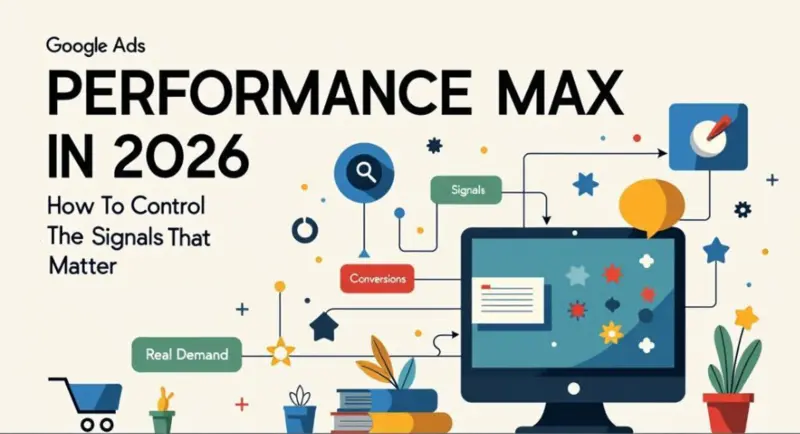
Advanced Product Feed Strategies in 2026
Sophisticated brands now optimize product feeds using:
- Profitability labels
- Margin segmentation
- Inventory urgency signals
- Seasonal demand indicators
- High-LTV product categorization
- Creative performance mapping
Custom labels are especially powerful.
Advertisers increasingly classify products based on:
- High margin
- Best sellers
- Low return rate
- Subscription-friendly
- Premium buyers
- Seasonal demand
This helps PMax prioritize better inventory intelligently.
Why Creative Assets Matter More Than Ever
PMax is heavily creative-driven.
Google’s AI dynamically combines:
- Headlines
- Descriptions
- Images
- Videos
- Product visuals
- Audience behavior
to generate personalized ad experiences across multiple placements.
Weak creative assets reduce optimization quality significantly.
The Rise of Creative Signal Feedback Loops
Advanced advertisers now treat creative testing as a data feedback system.
Instead of evaluating creatives only by CTR, they analyze:
- Profitability contribution
- Conversion quality
- Customer retention
- Product affinity
- Engagement depth
- Purchase path influence
This creates smarter asset optimization over time.
Video Assets Are Becoming Increasingly Important
In 2026, YouTube inventory plays an even larger role inside PMax ecosystems.
Advertisers without strong video assets often experience:
- Limited reach efficiency
- Higher acquisition costs
- Reduced audience engagement
High-performing video content typically includes:
- Product demonstrations
- UGC-style authenticity
- Lifestyle positioning
- Problem-solving messaging
- Short-form storytelling
Video now acts as both a branding tool and conversion signal generator.
Audience Signals: Still Important Even in AI Campaigns
Some advertisers mistakenly believe audience signals no longer matter because Google automates targeting.
This is false.
Audience signals still shape initial learning direction.
Strong audience signals help PMax understand:
- Customer profiles
- Purchase intent patterns
- Behavioral similarities
- High-converting segments
Weak audience inputs slow optimization significantly.
Advanced Audience Signal Strategies
Leading advertisers increasingly combine:
- Customer match lists
- High-LTV audiences
- Cart abandoners
- Repeat purchasers
- Subscription customers
- CRM segmentation
- Website engagement tiers
This creates stronger machine-learning guidance during early campaign phases.
Why Offline Conversion Imports Matter
Online purchases do not always represent final business value.
For lead-generation businesses especially, offline conversion imports are critical.
Examples include:
- Closed deals
- Qualified leads
- Appointment attendance
- Revenue-confirmed sales
- Retention outcomes
PMax performs far better when final business outcomes—not just initial form fills—are fed back into the system.
Conversion Delay Windows Are Often Misunderstood
Many advertisers evaluate PMax too quickly.
Machine-learning systems require time to stabilize.
However, advanced advertisers also understand that:
Different conversion types require different learning windows.
Examples:
- Low-ticket ecommerce may optimize quickly
- High-ticket B2B funnels require longer data maturation
- Subscription businesses need retention analysis
Improper evaluation windows often cause premature campaign changes that destabilize learning.
Why Segmentation Still Matters in PMax
Although PMax automates many functions, campaign segmentation remains valuable.
Advanced advertisers often segment campaigns by:
- Profitability tiers
- Product category
- Geography
- Customer lifecycle
- Brand vs non-brand
- Margin class
- Inventory priority
Segmentation improves signal clarity and budget control.
Brand Traffic Distortion Problems
One of the biggest PMax controversies involves branded traffic cannibalization.
Without careful structure, PMax may over-credit itself for:
- Existing brand demand
- Returning customers
- Organic searches
Advanced advertisers increasingly isolate:
- Branded search
- Non-branded acquisition
- Retention audiences
to improve attribution clarity.
The Role of Incrementality in 2026
Sophisticated advertisers are focusing more heavily on incremental growth.
The key question is no longer:
“How many conversions did PMax generate?”
Instead, the question becomes:
“How many additional profitable conversions would not have happened otherwise?”
Incrementality testing is becoming increasingly important for evaluating true campaign value.
AI Is Rewarding Better Data Discipline
As Google’s AI becomes more advanced, poor-quality advertisers are increasingly penalized indirectly.
Messy tracking systems create:
- Weak optimization
- Higher acquisition costs
- Poor scaling efficiency
- Audience confusion
Meanwhile, disciplined advertisers feeding structured, enriched, and profitability-focused data gain compounding advantages over time.
The Importance of Clean Attribution Systems
Attribution chaos damages PMax learning.
Inconsistent tracking between:
- GA4
- Google Ads
- Shopify
- CRM systems
- Server-side tracking
creates unreliable optimization signals.
Advertisers investing in clean attribution infrastructure often outperform competitors significantly.
Server-Side Tracking and Signal Recovery
Signal loss remains a major challenge in modern advertising.
Server-side tracking helps recover:
- Purchase data
- User behavior
- Conversion reliability
- Attribution consistency
This improves machine-learning stability inside PMax ecosystems.
Why Overfeeding Data Can Also Hurt Performance
More data is not always better.
Low-quality conversion events often confuse optimization.
Examples include:
- Weak leads
- Accidental submissions
- Low-intent traffic
- Unqualified conversions
Advanced advertisers increasingly filter data aggressively before feeding it into Google Ads.
The Future of PMax Optimization
By 2026, Performance Max is evolving into a full business optimization engine rather than a simple advertising tool.
Future developments likely include:
- Real-time profitability bidding
- AI-generated creative adaptation
- Predictive customer scoring
- Automated LTV forecasting
- Inventory-aware bidding systems
- Cross-platform first-party identity integration
The advertisers who succeed will be those capable of feeding AI systems the richest and most accurate business signals.
Final Thoughts
Performance Max is no longer just a campaign type.
It is an AI-driven optimization ecosystem.
And like all machine-learning systems, its performance depends heavily on training quality.
The brands achieving the strongest ROI in 2026 are not relying on automation blindly.
They are strategically feeding Google:
- Better conversion signals
- Cleaner attribution data
- Profitability-aware values
- Stronger first-party intelligence
- Smarter audience segmentation
- Higher-quality creative assets
In the modern advertising landscape, campaign success is no longer determined primarily by manual optimization skills.
It is determined by data architecture.
The better you train the algorithm, the better the algorithm performs for your business.
And in a world increasingly dominated by AI-driven advertising, intelligent data feeding has become one of the most important competitive advantages an advertiser can build.