














 En

 47 min read
Introduction: Why Social Media Is Essential for Independent Online Stores
Launching an independent online store is easier than ever, but building a recognizable brand and generating consistent sales remains a significant challenge. With thousands of e-commerce businesses competing for attention, having an attractive website and competitive products is no longer enough. Brands must also establish a strong presence across social media, create compelling content, build customer relationships, and turn online attention into measurable revenue.
For cross-border e-commerce businesses, these challenges become even more complex. Brands often sell to customers in different countries, operate across multiple time zones, and compete with local retailers that understand their audiences better. They must overcome language barriers, cultural differences, unfamiliar purchasing habits, and varying levels of customer trust.
This is where a well-designed social media ecosystem becomes valuable.
Rather than treating Instagram, TikTok, Facebook, Pinterest, YouTube, and other platforms as separate marketing channels, successful brands coordinate them into a connected system. Each platform serves a specific purpose, while all channels support the same brand identity, customer journey, and commercial objectives.
A strong social media ecosystem helps independent stores accomplish several important goals:
- Increase brand awareness in international markets.
- Reach potential customers who have never visited the website.
- Educate shoppers about products and their benefits.
- Build trust through customer reviews, creator collaborations, and community engagement.
- Drive qualified traffic to product pages and collection pages.
- Increase purchases, repeat orders, and customer lifetime value.
- Reduce dependence on a single advertising platform or traffic source.
However, building a social media ecosystem does not mean opening accounts everywhere and publishing content every day. Without a clear strategy, businesses can waste resources maintaining inactive profiles, producing irrelevant content, and attracting followers who never become customers.
The real objective is to build a coordinated, measurable system that connects content, community, creators, advertising, and e-commerce conversion.
This guide explains how to build that system from the ground up, even if your brand has limited resources, little existing recognition, and no established social media audience.
1. Establish a Clear Foundation Before Opening Social Media Accounts
Before selecting platforms or planning content, define what your brand stands for, whom it serves, and why customers should choose it over alternatives.
A social media strategy built on unclear positioning will struggle regardless of how frequently the brand posts.
1.1 Define Your Ideal Customer
Cross-border e-commerce brands often make the mistake of targeting everyone who might be interested in their products.
A home decor store, for example, could appeal to homeowners, renters, interior designers, property managers, gift shoppers, and people preparing to move. These groups may purchase similar products, but their motivations and expectations are different.
Start by developing a practical customer profile that includes:
- Location: Which countries, regions, and cities offer the strongest commercial opportunities?
- Demographics: What age groups and household types are most relevant?
- Lifestyle: What interests, habits, and daily challenges influence purchasing decisions?
- Buying motivations: Are customers looking for convenience, affordability, durability, aesthetics, or status?
- Purchase objections: What concerns might prevent them from ordering?
- Preferred platforms: Where do they discover products, research options, and seek recommendations?
For example, a Shopify store selling cellular shades in the United States might target homeowners who want better insulation, improved privacy, and attractive window treatments. Pinterest could help these shoppers discover room inspiration, while Instagram could demonstrate how the shades transform a space.
A brand selling fashion accessories to younger consumers might prioritize TikTok and Instagram because short-form video, styling demonstrations, and creator recommendations can introduce products in an engaging way.
The key is to identify your highest-value customer segment first rather than trying to appeal to every possible audience.
1.2 Create a Distinctive Brand Position
Your brand should communicate a clear reason to exist beyond the fact that it sells certain products.
A useful positioning statement follows this structure:
“We help [target audience] achieve [desired outcome] through [distinctive product or service advantage].”
For example:
“We help modern homeowners create comfortable, energy-conscious living spaces with stylish, practical window coverings.”
This statement can guide social media content, advertising messages, product descriptions, and creator partnerships.
Your positioning should also address three questions:
- What problem does your product solve?
- What makes your solution different?
- Why should customers believe your claims?
Avoid relying exclusively on vague phrases such as “premium quality,” “best prices,” or “excellent service.” These claims are common and rarely create meaningful differentiation.
Instead, emphasize verifiable benefits such as specific product materials, customization options, installation guidance, transparent delivery information, warranties, or demonstrated product performance.
1.3 Develop Consistent Brand Guidelines
When customers encounter your brand across several platforms, they should recognize it immediately.
Create a simple brand guideline covering:
- Logo usage and profile imagery.
- Primary and secondary colors.
- Typography and graphic styles.
- Photography and video aesthetics.
- Tone of voice and vocabulary.
- Standard product naming conventions.
- Rules for customer service responses.
- Approved product claims and promotional language.
Your content does not need to look identical everywhere. TikTok videos may feel spontaneous, while Pinterest graphics may be more polished. What matters is that both reflect the same brand personality.
Consistency reduces confusion and makes repeated exposure more valuable.
1.4 Set Commercial Goals Before Setting Follower Goals
Follower growth is useful, but it should not be the primary measure of success.
A brand with 3,000 engaged followers who regularly purchase products may be more successful than a brand with 100,000 followers who rarely visit its store.
Establish goals across four levels:
Awareness: Reach, video views, impressions, and growth in relevant audiences.
Consideration: Saves, shares, meaningful comments, profile visits, product-page visits, and email sign-ups.
Conversion: Purchases, conversion rate, customer acquisition cost, and revenue attributable to marketing activities.
Retention: Repeat purchase rate, returning customer revenue, customer-generated content, and referral activity.
Choose a small number of primary indicators for each stage. This creates a clear connection between daily social media activities and the broader business.
2. Choose the Right Social Media Platforms for Your Brand
Not every social media platform deserves equal investment. The best combination depends on your products, target audience, available content resources, and commercial objectives.
For most new cross-border e-commerce brands, it is better to operate two or three platforms well than to maintain six accounts with inconsistent content.
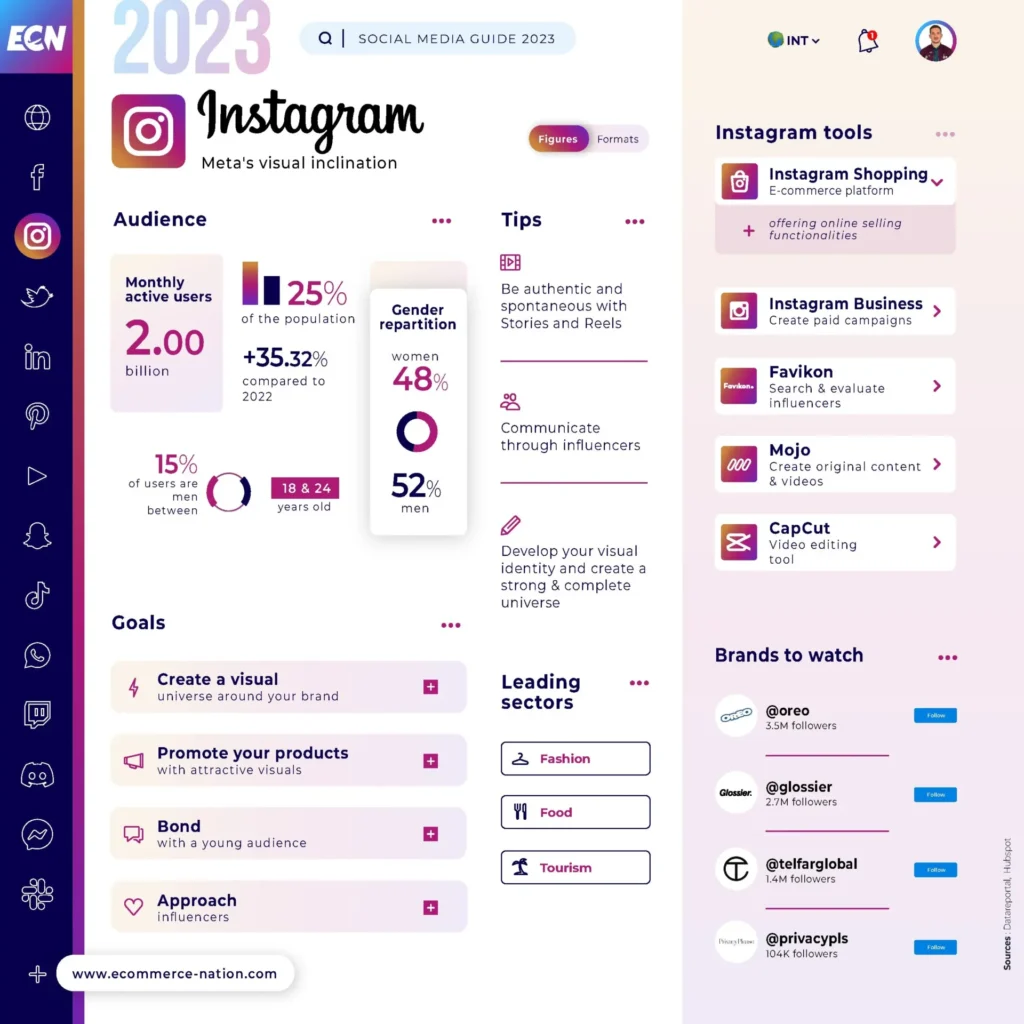
2.1 Instagram: Build Brand Identity and Product Desire
Instagram is particularly useful for brands that benefit from visual storytelling, lifestyle imagery, product demonstrations, and customer-generated content.
Its main content formats include Reels, Stories, carousels, photos, and direct messages.
Reels can introduce products to new audiences. Carousels can explain features or compare product options. Stories can communicate promotions, answer questions, and share behind-the-scenes moments.
For example, a home decor store could publish:
- Before-and-after room transformations.
- Short demonstrations of product installation.
- Styling suggestions for different interior design preferences.
- Customer photos showing products in real homes.
- Explanations of materials, colors, and customization options.
- Answers to frequently asked purchasing questions.
Instagram can support the entire customer journey, from discovery to product consideration and direct interaction.
However, simply posting beautiful product images is rarely sufficient. Content should demonstrate why the product matters and how it fits into customers’ lives.
2.2 TikTok: Reach New Audiences Through Short-Form Video
TikTok is valuable for brands that can communicate product value quickly through demonstrations, storytelling, entertainment, or practical advice.
Its discovery-oriented experience can help smaller businesses reach people beyond their existing followers. Actual distribution depends on content quality, audience response, competition, and other platform factors.
Effective formats include:
- Problem-and-solution videos.
- Product demonstrations.
- Unboxing experiences.
- Unexpected product uses.
- Comparisons between common alternatives.
- Customer testimonials.
- Behind-the-scenes business stories.
- Responses to common questions.
Consider a brand selling organizational products. Instead of publishing a generic product advertisement, it could show a cluttered drawer, demonstrate a simple organization method, and reveal the result.
This format communicates the benefit immediately and gives viewers a reason to continue watching.
TikTok works best when content feels native to the platform. Overly polished advertisements may be less engaging than clear, authentic demonstrations, although creative execution varies by audience and category.
2.3 Facebook: Support Community, Trust, and Retargeting
Facebook remains useful for many e-commerce brands, particularly those targeting established consumer groups, households, hobby communities, or customers who actively participate in relevant groups.
It can support:
- Product education and announcements.
- Customer reviews and testimonials.
- Community discussions.
- Customer service communication.
- Promotional campaigns.
- Paid advertising and retargeting where available.
- Distribution of selected videos and other content.
For example, a gardening supply store might share seasonal planting advice, answer questions, and participate appropriately in gardening communities.
A critical distinction is that a Facebook Page is not the same as a community strategy. Publishing posts alone does not guarantee meaningful engagement. Brands should participate in relevant conversations, provide helpful information, and respect each community’s rules.
Facebook can also work alongside Instagram through Meta’s advertising ecosystem, allowing eligible businesses to coordinate campaigns across supported placements.
2.4 Pinterest: Capture Visual Search and Planning Intent
Pinterest is especially relevant for products people discover while planning projects, organizing their homes, choosing gifts, or researching purchases.
Strong categories include home decor, fashion, beauty, weddings, gardening, crafts, and lifestyle products.
Unlike purely entertainment-driven platforms, Pinterest often supports longer consideration periods. Users may save ideas and return to them days or weeks later.
Useful content includes:
- Room design inspiration.
- Seasonal decorating guides.
- Product comparison graphics.
- Step-by-step tutorials.
- Gift guides.
- Style boards.
- Practical planning checklists.
- Product pins linked to relevant landing pages.
For a window covering business, Pinterest content could address questions such as which shades work best in bedrooms, how to choose window treatments for large windows, or how to coordinate neutral shades with different interior styles.
Each Pin should communicate a clear topic, use descriptive wording, and direct interested users to a relevant page rather than always sending them to the homepage.
Pinterest is not automatically the best platform for every product. Evaluate whether your category has strong visual appeal and whether users commonly research or save related ideas.
2.5 YouTube: Build Authority and Answer Complex Questions
YouTube is particularly effective when products require education, comparison, installation guidance, or a detailed explanation of their benefits.
Potential formats include:
- Product reviews.
- Installation tutorials.
- Buying guides.
- Product comparisons.
- Frequently asked questions.
- Customer stories.
- Long-form demonstrations.
- YouTube Shorts.
For instance, a store selling specialized household products could create a video explaining product selection, installation requirements, maintenance, and common purchasing mistakes.
Long-form content can help shoppers make informed decisions, while Shorts can introduce the brand to new viewers.
Videos can also continue attracting viewers through search and recommendations after their original publication, although results vary.
2.6 LinkedIn and Other Specialized Platforms
LinkedIn may be appropriate for brands selling business-to-business products, commercial equipment, wholesale services, or professional solutions.
Reddit, specialized forums, and niche communities can also provide valuable opportunities for customer research and authentic participation.
However, these channels require a different approach. Promotional behavior that works on Instagram may be unwelcome in a discussion community.
Choose platforms based on audience behavior and commercial relevance, not popularity alone.
2.7 Build a Platform Portfolio Instead of a Platform Collection
A practical starting portfolio might look like this:
| Platform | Primary role | Best starting content |
|---|---|---|
| TikTok | Discovery | Short demonstrations and relatable videos |
| Brand identity and engagement | Reels, carousels, Stories, customer content | |
| Visual discovery and planning | Guides, product Pins, inspiration collections | |
| Community and advertising | Reviews, discussions, selected product content | |
| YouTube | Education and consideration | Tutorials, comparisons, detailed demonstrations |
These roles are guidelines, not rigid boundaries. Each platform can support multiple stages of the customer journey.
Begin with two or three channels that fit your resources. Expand only after you have a repeatable publishing process and evidence that the additional platform can contribute meaningful value.
3. Build a Content Strategy That Connects Attention With Purchases
A social media ecosystem needs more than a collection of attractive posts. It requires a structured content strategy that addresses customer needs at different stages of the buying journey.
3.1 Use Five Core Content Pillars
A balanced content system can be organized into five categories.
Pillar One: Educational Content
Teach customers something useful.
Examples include buying guides, product maintenance tips, tutorials, comparison checklists, and explanations of common mistakes.
Educational content establishes credibility and helps shoppers understand the value of your products before they are ready to purchase.
Pillar Two: Product Demonstration
Show what the product does and how it works.
Examples include unboxing videos, installation demonstrations, material close-ups, product testing, and before-and-after comparisons.
Demonstrations are particularly important for unfamiliar products because they reduce uncertainty and help customers visualize the actual experience.
Pillar Three: Lifestyle and Inspiration
Show how the product fits into real situations.
A fashion store might demonstrate several ways to style one accessory. A home decor brand might show how a product works in a small apartment, a family home, or a minimalist interior.
Lifestyle content connects product features with emotional benefits and practical aspirations.
Pillar Four: Social Proof
Help prospective customers understand how other people experience the product.
This can include verified customer reviews, approved testimonials, creator demonstrations, user-submitted photographs, and responses to common concerns.
Only use authentic customer experiences and obtain appropriate permission before publishing customer content.
Pillar Five: Promotional Content
Communicate specific offers and purchasing opportunities.
Examples include seasonal campaigns, new product launches, bundles, limited-time discounts, and product restocks.
Promotions are important, but an account dominated by discount announcements may train customers to wait for lower prices instead of appreciating the brand’s value.
3.2 Apply a Balanced Content Mix
A useful starting framework is to allocate approximately:
- 35% to educational content.
- 25% to product demonstrations.
- 20% to lifestyle and inspiration.
- 10% to social proof.
- 10% to direct promotions.
These percentages are starting assumptions, not universal rules. A new product launch, a highly visual category, or a seasonal sales period may require a different balance.
Review engagement, qualified traffic, purchases, and production costs to determine which content categories deserve more investment.
3.3 Create Content Around Customer Questions
One of the most effective ways to generate relevant ideas is to study what customers want to know before buying.
Review product reviews, customer support tickets, search queries, social media comments, competitor discussions, and post-purchase feedback.
Look for recurring questions:
- Will this product fit my needs?
- How difficult is it to install?
- What is the difference between the available options?
- Is the material durable?
- How long will shipping take?
- What happens if the product does not fit?
- How do I clean or maintain it?
- Is the higher-priced version worth the difference?
Each question can become a short video, carousel, tutorial, or detailed guide.
For example, a cellular shades store could create content explaining how to measure a window, compare light-filtering options, select colors, and avoid common installation mistakes.
This approach produces content that serves a real commercial purpose: reducing uncertainty and helping customers make better decisions.
3.4 Build a Repeatable Content Series
Individual posts can attract attention, but recognizable series make content production more manageable.
Examples include:
- “One Product, Three Ways.”
- “Common Buying Mistakes.”
- “Before You Buy.”
- “Customer Question of the Week.”
- “Behind the Product.”
- “Small Changes, Big Results.”
- “Myth vs. Fact.”
- “Five-Minute Product Tutorials.”
A series provides a familiar structure while allowing each episode to address a new question.
It also makes it easier to evaluate performance. If a specific series repeatedly attracts qualified traffic or generates purchases, the brand can invest in more episodes.
3.5 Make Every Post Easy to Understand
Social media users often decide within seconds whether content deserves their attention.
For short-form video, begin with a clear opening statement or visual demonstration.
Weak opening: “Hello everyone, welcome back to our page.”
Stronger opening: “Three mistakes to avoid when choosing window shades.”
The second example immediately communicates a benefit.
Effective content generally includes:
- A clear opening that establishes relevance.
- A problem, question, or interesting demonstration.
- A useful explanation or product reveal.
- A clear conclusion.
- A relevant next step.
That next step might be saving the post, commenting with a question, watching another tutorial, visiting a product page, or purchasing an item.
Avoid adding several unrelated calls to action to the same post.
4. Develop a Cross-Platform Content Repurposing System
One of the biggest challenges for small e-commerce teams is producing enough content without overwhelming their resources.
The solution is not necessarily to create more original material. It is to extract more value from each useful idea.
4.1 Start With One Core Content Asset
Suppose your brand produces a five-minute video explaining how to choose the right window shades.
That video can become several assets:
- A YouTube tutorial.
- Three short vertical videos highlighting individual tips.
- An Instagram carousel summarizing the selection process.
- A Pinterest Pin linking to a detailed buying guide.
- A Facebook post answering a common question.
- An email newsletter featuring the tutorial.
- A product-page FAQ based on the same topic.
The underlying information remains consistent, but the format changes to suit the audience and platform.
This approach helps maintain publishing frequency while controlling production costs.
4.2 Adapt Content Rather Than Copying It Blindly
Cross-posting can be efficient, but identical content does not always perform equally well everywhere.
Before publishing, review:
- Video dimensions and length.
- Captions and on-screen text.
- Opening hooks.
- Music and licensing permissions.
- Links and calls to action.
- Platform-specific features.
- Relevant hashtags and descriptive keywords.
A video designed for TikTok may need a different caption and opening for Instagram Reels. A Pinterest graphic may require a more descriptive title and a destination page that provides additional information.
Repurposing should preserve the original idea while adapting its presentation.
4.3 Create a Central Content Library
Organize assets in a shared folder or content management system.
Useful categories include:
- Product photographs.
- Raw video footage.
- Edited videos.
- Customer-generated content.
- Creator collaborations.
- Brand guidelines.
- Approved claims.
- Seasonal campaigns.
- High-performing posts.
- Reusable templates.
Include file names, product identifiers, publication dates, usage permissions, and performance notes where practical.
A well-organized library reduces duplicated work and makes it easier for team members to find approved assets.
4.4 Establish a Realistic Publishing Schedule
Consistency matters more than an ambitious schedule that becomes impossible to maintain.
A new brand might begin with three short-form videos per week, two Instagram feed posts, several Stories throughout the week, and three to five Pinterest Pins per week if Pinterest fits the category.
These are illustrative starting points, not platform requirements. Your actual schedule should reflect production capacity and the quality of the content you can consistently deliver.
Batch production can improve efficiency. For example, record several product demonstrations in one session, edit them together, and schedule publication across the following two weeks.
Leave room for timely content, customer questions, and emerging opportunities.
5. Create a Social Media Calendar and Operating Workflow
Without an organized workflow, even a good content strategy can become inconsistent.
A content calendar turns the strategy into a repeatable operating process.
5.1 Plan Content Four Weeks Ahead
At the beginning of each month, identify:
- Product launches.
- Seasonal events.
- Relevant holidays.
- Promotional periods.
- Creator collaborations.
- Educational topics.
- Customer stories.
- Paid advertising campaigns.
Then assign each content idea to a platform, publication date, content pillar, owner, and intended business objective.
A simple calendar might look like this:
| Day | Content theme | Format | Primary objective |
|---|---|---|---|
| Monday | Educational tip | Short video | Reach and saves |
| Tuesday | Product demonstration | Reel | Product consideration |
| Wednesday | Customer question | Carousel | Trust and education |
| Thursday | Lifestyle inspiration | Pin or image | Discovery |
| Friday | Creator or customer story | Video | Social proof |
| Saturday | Product recommendation | Stories | Website visits |
| Sunday | Community interaction | Q&A or poll | Engagement |
The schedule can be adjusted to suit each platform. It is a planning framework, not a requirement to publish every format every day.
5.2 Use a Simple Approval Process
A practical workflow includes six steps:
- Research the topic and customer question.
- Write the script or creative brief.
- Produce and edit the content.
- Check brand accuracy, product claims, and permissions.
- Publish or schedule the content.
- Record results and identify improvements.
For a small business, one person may perform several steps. The important thing is that each step has a clear owner.
Establishing an approval process is particularly important when content includes pricing, shipping promises, product specifications, creator endorsements, or claims about performance.
5.3 Maintain a Content Performance Library
Record the results of significant posts, including:
- Topic and content pillar.
- Format and duration.
- Opening hook.
- Reach and impressions.
- Watch time or completion rate where available.
- Saves and shares.
- Profile and website visits.
- Purchases and attributed revenue where measurable.
- Production time and cost.
After several weeks, patterns may emerge. For example, demonstration videos may attract more qualified visitors than generic lifestyle imagery, while detailed guides may generate fewer immediate clicks but contribute to longer-term purchasing decisions.
Use these findings to improve future production instead of relying on personal preferences alone.
6. Build a Consistent Brand Experience Across Every Channel
A social media ecosystem works best when each channel reinforces the same identity and leads customers toward a coherent buying experience.
6.1 Optimize Your Social Profiles
Each profile should clearly communicate what the brand offers and why someone should follow it.
Review these elements:
- Recognizable profile image.
- Clear brand description.
- Relevant category or business information.
- Appropriate contact details.
- A useful website or landing-page link.
- Pinned introductory or high-value content.
- Updated product information.
- Consistent naming and branding.
Avoid vague descriptions that make customers guess what the business sells.
A visitor should understand the brand’s core offering within seconds.
6.2 Match Landing Pages to Content
When a social post highlights a particular product, send visitors to that product or a relevant collection whenever possible.
For example, a Pin about bedroom blackout shades should direct visitors to a relevant product category or buying guide, not a generic homepage that forces them to search again.
The landing page should continue the promise made by the content.
If the post emphasizes easy installation, the destination page should explain installation requirements. If it highlights customization, the page should make available options easy to understand.
This consistency reduces friction and increases the likelihood that interested visitors will continue toward checkout.
6.3 Use Clear Calls to Action
Calls to action should match the audience’s level of interest.
For discovery-stage content, ask users to follow, save, share, or watch another video.
For consideration-stage content, encourage users to compare products, read a buying guide, or explore customer reviews.
For purchase-oriented content, provide a direct route to the product, current offer, or relevant collection.
Not every post needs to generate an immediate sale. Some content builds the knowledge and trust that make future purchases more likely.
6.4 Connect Social Media With Email Marketing
Social platforms help brands reach audiences, but businesses do not fully control the distribution of their posts or the stability of platform algorithms.
Email marketing provides another way to maintain customer relationships.
Offer useful reasons to subscribe, such as a buying guide, product selection checklist, exclusive launch information, or welcome incentive.
With appropriate consent and privacy practices, use email to deliver educational content, product recommendations, abandoned-checkout reminders, and post-purchase guidance.
The goal is not to move every follower into an email list immediately. It is to create additional ways for interested customers to continue interacting with the brand.
7. Use Influencer Marketing and Creator Partnerships to Accelerate Growth
Creators can introduce products to relevant audiences and demonstrate how those products work in real situations.
For newer brands, creator partnerships may provide valuable content and third-party perspectives that are difficult to reproduce through brand-owned accounts alone.
7.1 Choose Creators Based on Audience Fit
A creator’s follower count does not automatically indicate commercial value.
Evaluate potential partners based on:
- Audience geography.
- Audience interests.
- Engagement quality.
- Content style.
- Credibility within the category.
- Previous brand partnerships.
- Ability to demonstrate products clearly.
- Audience comments and purchasing intent.
- Cost relative to the expected business outcome.
A smaller creator with an engaged audience in your target market may be a better fit than a larger creator whose followers are spread across countries you do not serve.
7.2 Build a Structured Creator Outreach Process
Begin by identifying creators who already produce content related to your products or customers’ interests.
Review their recent posts and look for natural opportunities to introduce your offering.
A personalized outreach message should explain:
- Why the creator is a good fit.
- What makes the product relevant to their audience.
- What collaboration you are proposing.
- Whether compensation, samples, or affiliate commissions are available.
- What deliverables and usage rights would be expected.
Avoid sending identical, generic messages to hundreds of creators. Relevant outreach is more likely to start a useful conversation.
7.3 Give Creators Clear Briefs Without Overcontrolling Them
A useful creative brief includes the target audience, product benefits, required factual details, deliverables, deadlines, disclosure requirements, and content usage permissions.
It should also leave room for the creator’s own style.
Creators understand their audiences better than most brands do. Overly scripted content can lose the authenticity that makes creator partnerships valuable.
At the same time, brands should review factual claims, product representations, and compliance requirements before publication.
7.4 Measure Creator Partnerships Beyond Views
Track performance using a combination of metrics:
- Content reach and engagement.
- Qualified website visits.
- Product-page activity.
- Purchases and revenue.
- Customer acquisition cost.
- Affiliate commissions.
- Content production value.
- Reusable creative assets.
Use unique tracking links, creator-specific discount codes, and consistent campaign naming where appropriate.
Attribution will not always capture every influence. A customer might discover a product through a creator, research it on another platform, and purchase later through a direct visit.
Evaluate creator campaigns using both attributable results and the broader evidence of audience quality and commercial impact.
7.5 Turn Successful Collaborations Into Long-Term Relationships
If a creator produces relevant content and demonstrates a strong fit, consider repeat collaborations.
Long-term partnerships can create a more consistent brand narrative and allow creators to show how products perform over time.
With appropriate permissions, successful creator assets can also be adapted for the brand’s organic social media and paid advertising campaigns.
Before reusing content in advertisements, confirm that the contract covers the intended channels, duration, territory, editing rights, and paid usage.
8. Combine Organic Content With Paid Social Advertising
Organic content and paid advertising serve different purposes, but they can strengthen each other.
Organic publishing helps brands discover what audiences find useful and gives prospective customers a place to learn about the business. Paid advertising can increase distribution, reach specific audiences, and support measurable acquisition campaigns.
8.1 Test Creative Concepts Before Scaling Spending
Do not assume that the most visually polished post will produce the best sales results.
Test different concepts, such as:
- Product demonstration versus lifestyle imagery.
- Customer testimonial versus founder explanation.
- Problem-and-solution video versus product comparison.
- Educational hook versus promotional hook.
- Different benefit statements.
- Different calls to action.
Use organic performance as one source of creative insight, but do not treat organic engagement as a guaranteed predictor of paid results. Paid distribution reaches different audiences and operates under different conditions.
8.2 Separate Campaign Objectives
A useful advertising structure distinguishes between acquisition, consideration, and retargeting.
Acquisition campaigns introduce the brand to potential new customers.
Consideration campaigns encourage interested shoppers to explore product details, comparisons, and demonstrations.
Retargeting campaigns reach eligible audiences who have previously interacted with the brand or website, subject to platform availability, consent, and audience-size requirements.
The appropriate structure depends on your budget, purchase volume, product price, and available tracking data. Small accounts may not have enough data to support many separate campaigns, so avoid unnecessary fragmentation.
8.3 Evaluate Purchases and Return on Ad Spend
For e-commerce businesses, impressions and clicks are useful diagnostic metrics, but commercial decisions should ultimately connect to business outcomes.
Two important measures are:
Customer acquisition cost (CAC):
Total acquisition spending divided by the number of new customers acquired during the defined period.
Return on ad spend (ROAS):
Revenue attributed to advertising divided by advertising expenditure.
For example, if a campaign spends $1,000 and generates $3,000 in attributed purchase revenue, its reported ROAS is 3.0.
However, a ROAS of 3.0 does not automatically mean the campaign is profitable. Product costs, shipping, payment processing, discounts, returns, and other expenses must also be considered.
Keep purchase events distinct from intermediate actions such as add-to-cart and checkout initiation. If your reporting system combines these events into a single conversion-value figure, that figure may not accurately represent completed sales.
For sound decisions, evaluate completed purchases and purchase-based revenue separately from other conversion events.
Also establish consistent attribution windows and compare reporting periods carefully. Platform-reported results may overlap, so adding reported revenue from multiple platforms can overstate the actual total.
8.4 Scale Proven Creative Gradually
Once a creative concept consistently attracts qualified traffic and generates purchases at an acceptable cost, consider increasing its distribution.
Continue monitoring purchase volume, ROAS, new-customer acquisition cost, and profitability as spending changes.
A creative that performs well at low spending may not maintain the same efficiency at higher budgets. Audience saturation, competition, and changes in delivery can affect results.
Keep testing new creative concepts so the brand is not dependent on a single successful advertisement.
9. Turn Social Media Engagement Into Website Conversions
Attracting attention is only the beginning. An effective social media ecosystem must help interested users become customers.
9.1 Improve the Product Page Experience
When a visitor arrives from social media, the product page should answer the questions that motivated the click.
Important elements include:
- Clear product titles.
- High-quality product photographs.
- Accurate descriptions.
- Benefits and specifications.
- Available colors, sizes, and customization options.
- Transparent shipping information.
- Return and warranty policies.
- Authentic customer reviews.
- Clear pricing.
- A visible add-to-cart button.
For products that require explanation, include tutorials, comparison tables, measurement guides, or installation instructions.
Do not assume that visitors will understand product terminology or search through several pages to find essential information.
9.2 Reduce Purchasing Anxiety
Cross-border customers may worry about delivery times, customs charges, product quality, return shipping, or customer service availability.
Address these concerns before checkout.
Explain shipping regions, estimated delivery timelines, relevant duties or fees, return conditions, and available support channels accurately.
Use trust signals that reflect actual business practices. Avoid unsupported guarantees or misleading urgency claims.
For products requiring customization, clearly explain the measurement, selection, and ordering process.
9.3 Measure the Entire Purchase Journey
Monitor how users move from social content to the final order.
A simplified funnel might include:
- Social media exposure.
- Profile visit or content interaction.
- Website session.
- Product-page visit.
- Add to cart.
- Checkout initiation.
- Completed purchase.
Analyze the number of users and conversion rates between stages.
If content receives substantial engagement but generates few website visits, the topic, audience, or call to action may need improvement.
If website traffic is strong but purchases are weak, investigate product relevance, pricing, shipping costs, page speed, checkout usability, and customer trust.
If many shoppers add products to their carts but do not complete checkout, review shipping surprises, payment options, checkout errors, and delivery expectations.
The objective is to identify the actual bottleneck rather than assuming every weak sales result is a social media problem.
10. Build a Measurement System That Supports Better Decisions
A social media ecosystem produces large amounts of data. The challenge is distinguishing useful signals from numbers that look impressive but have little commercial significance.
10.1 Define a Core Performance Dashboard
A practical dashboard should include the following categories.
Audience development
- Reach and impressions.
- Relevant audience growth.
- Video views and watch time.
- Profile visits.
Content quality
- Engagement rate.
- Saves and shares.
- Completion rate where available.
- Performance by content format and topic.
Website traffic
- Social sessions.
- Landing-page engagement.
- Product-page visits.
- Email sign-ups.
Sales performance
- Completed purchases.
- Purchase conversion rate.
- Attributed purchase revenue.
- Customer acquisition cost.
- Purchase-based ROAS.
- Average order value.
Customer retention
- Repeat purchase rate.
- Returning customer revenue.
- Customer referrals.
- Post-purchase feedback.
You do not need to report every metric daily. Choose a small set of indicators that reflect the current business objective.
10.2 Use Consistent Campaign Tracking
Add tracking parameters to links shared across social platforms and campaigns.
For example, a link can identify its source as Pinterest, its medium as organic social, and its campaign as a seasonal room makeover guide.
Use a consistent naming convention so results can be compared across platforms, dates, and content types.
Verify that analytics systems record completed purchases correctly. Test the entire journey from a social link through checkout, including whether purchase events are duplicated or missing.
Privacy requirements and platform restrictions may affect tracking, so configure measurement in accordance with applicable rules and customer consent.
10.3 Review Performance at Multiple Time Scales
Daily monitoring helps identify technical issues or unusually strong content. Weekly reviews help adjust publishing and creative decisions. Monthly reviews provide a broader view of commercial performance.
Avoid making major strategic decisions from one unusually good or bad post.
Instead, compare groups of content, similar campaign periods, and meaningful sample sizes.
For example, if five product demonstrations consistently attract more qualified visitors than five generic product images, the evidence is more useful than a single viral post.
10.4 Evaluate Profitability, Not Just Revenue
Revenue growth can conceal weak economics.
Suppose a store generates $10,000 in purchase revenue from a campaign but spends $4,000 on advertising. Whether that campaign is profitable depends on product costs, fulfillment, discounts, returns, and other variable expenses.
A useful analysis combines advertising efficiency with contribution margin and customer acquisition costs.
Also distinguish new-customer acquisition from repeat purchases. Returning customers may generate sales with less acquisition spending, but their revenue should not automatically be attributed to a campaign that did not cause the purchase.
Reliable measurement allows the business to scale sustainable growth rather than simply increasing spending.
11. Build a Community Instead of Collecting Followers
A social media ecosystem becomes more valuable when customers participate in the brand’s development.
Community engagement helps businesses understand customer needs, generate authentic content, and build relationships that extend beyond a single transaction.
11.1 Respond to Comments and Messages
Treat questions as opportunities to help potential customers.
Provide accurate answers, acknowledge legitimate concerns, and move sensitive order-specific issues into an appropriate private support channel.
Create response guidelines for common questions about product specifications, delivery, returns, and compatibility.
Timely, useful communication can reduce uncertainty and demonstrate that the brand is attentive to its customers.
11.2 Encourage Customer-Generated Content
Invite customers to share their experiences through reviews, photographs, videos, or product demonstrations.
You can encourage participation with post-purchase emails, community prompts, or optional branded hashtags.
Make participation easy and explain how customers can submit content.
Before republishing customer material, obtain the required permission and clearly disclose any incentives or material relationships. Do not pressure customers to provide positive reviews or misrepresent their experiences.
11.3 Create Opportunities for Participation
Use questions, polls, product-selection discussions, and feedback requests to invite customers into the brand conversation.
For example, a home decor store might ask followers which room they are renovating, what challenges they face when choosing window coverings, or which color options they would like to see next.
These conversations can inform product development and content planning.
Participation should be genuine. If the business asks for feedback, it should review the responses and communicate meaningful changes where appropriate.
11.4 Develop Customer Advocacy Over Time
Satisfied customers may become repeat buyers, recommend products to friends, or voluntarily share their experiences online.
Encourage these behaviors through useful post-purchase support, reliable service, product education, and appropriate referral programs.
Customer advocacy is more sustainable when it results from a positive experience rather than repeated requests for promotion.
12. Common Mistakes That Prevent Social Media Growth
Even a well-designed strategy can underperform when execution is inconsistent.
Mistake 1: Opening Too Many Accounts Too Early
Managing six platforms without sufficient staff or content can lead to irregular publishing and weak engagement.
Start with the channels most relevant to your audience and expand when your workflow is stable.
Mistake 2: Publishing Only Product Advertisements
Constant promotional posts provide little reason for people to follow the account.
Balance sales content with education, inspiration, demonstrations, and authentic customer experiences.
Mistake 3: Chasing Viral Views Without Commercial Relevance
A humorous video may attract millions of views but generate few purchases if the audience has no interest in the product.
Evaluate whether content attracts the right people, communicates the brand’s value, and contributes to meaningful business outcomes.
Mistake 4: Copying Competitors Without Differentiation
Competitor research can reveal successful formats and customer questions, but copying their content does not create a distinctive brand.
Use competitor activity to identify unmet needs, overlooked audiences, and opportunities to explain your product more clearly.
Mistake 5: Ignoring Local Market Differences
International audiences may respond differently to language, humor, imagery, holidays, pricing, and purchasing expectations.
Research the market you are targeting and adapt content where necessary.
Use local spelling and terminology when appropriate, and ensure that shipping information and product claims are relevant to each market.
Mistake 6: Buying Followers or Artificial Engagement
Artificial engagement can distort performance data and make it harder to understand the real audience.
Focus on attracting relevant people through useful content, credible partnerships, appropriate advertising, and genuine interaction.
Mistake 7: Failing to Connect Content With the Website
A popular post has limited commercial value if interested viewers cannot easily find the relevant product.
Ensure that profile links, product links, and landing pages provide a clear next step.
Mistake 8: Changing Strategy Too Frequently
Frequent changes make it difficult to determine what works.
Allow enough time to gather meaningful evidence, then improve the strategy through structured testing rather than reacting to every fluctuation.
Mistake 9: Ignoring Customer Feedback
Negative comments and repeated questions can reveal real product or service problems.
Respond professionally, investigate recurring issues, and improve the underlying customer experience when needed.
Mistake 10: Treating Platform Algorithms as the Entire Strategy
Algorithms influence distribution, but they are only one part of the system.
Product relevance, content quality, brand trust, pricing, customer service, and website usability all affect commercial outcomes.
Build a business that can withstand changes in platform distribution rather than depending entirely on one source of attention.
13. A Practical 90-Day Roadmap for Building Your Social Media Ecosystem
The first 90 days should focus on building a repeatable system, testing assumptions, and establishing a measurable foundation.
Days 1–15: Research and Foundation
During the first two weeks:
- Define your primary target market.
- Identify the highest-priority customer segment.
- Establish brand positioning and messaging.
- Research relevant competitors and creators.
- Select two or three initial platforms.
- Optimize social profiles.
- Review website conversion readiness.
- Configure appropriate analytics and campaign tracking.
- Develop the first month of content ideas.
Primary objective: Establish a clear strategy and ensure the brand is ready to receive traffic.
Do not spend most of this period designing elaborate graphics or creating dozens of accounts. Focus on the fundamentals that will influence every later decision.
Days 16–30: Launch and Establish Consistency
During the next two weeks:
- Publish the first batch of educational content.
- Introduce the brand and its product benefits.
- Produce several short-form demonstrations.
- Create initial Pinterest or other platform-specific assets where relevant.
- Begin responding to comments and questions.
- Test different opening hooks and content formats.
- Record baseline performance.
Primary objective: Establish a sustainable publishing rhythm and learn how the audience responds.
At this stage, the priority is not necessarily rapid follower growth. It is developing a reliable production process and identifying early signs of audience interest.
Days 31–60: Test, Learn, and Improve
During the second month:
- Review performance by content category.
- Identify topics that generate qualified engagement.
- Improve weak openings and calls to action.
- Repurpose successful content across relevant platforms.
- Begin creator outreach.
- Collect customer questions and feedback.
- Improve product pages based on observed objections.
- Test a small paid campaign if the budget allows.
- Check purchase tracking and attribution quality.
Primary objective: Determine which activities deserve more resources.
Avoid expanding to additional platforms simply because the account has become more active. Expand when there is evidence that the current workflow is manageable and new channels offer meaningful opportunities.
Days 61–90: Scale Proven Activities
During the final month:
- Increase production of successful content formats.
- Establish recurring content series.
- Formalize creator partnerships where justified.
- Improve landing pages and product education.
- Refine paid creative testing.
- Review purchase-based ROAS and acquisition costs.
- Develop a more consistent customer-generated content process.
- Create a quarterly content and campaign plan.
Primary objective: Turn early experimentation into a repeatable growth system.
At the end of 90 days, document what worked, what failed, what remains uncertain, and which activities should receive additional investment.
A successful outcome is not defined by reaching an arbitrary follower count. It is defined by having a clearer understanding of the target audience, a sustainable publishing process, measurable commercial activity, and a practical plan for continued growth.
14. Build the Right Team and Control Operating Costs
A social media ecosystem does not require a large marketing department from day one.
A small business can begin with a founder or marketing generalist who coordinates strategy, a content creator or editor who produces assets, and customer support personnel who help manage inquiries.
As the business grows, specialized roles may include:
- Social media manager.
- Short-form video producer.
- Graphic designer.
- Influencer partnership manager.
- Paid social specialist.
- Community manager.
- Marketing analyst.
Some roles can be combined or outsourced depending on the company’s budget.
14.1 Prioritize High-Value Activities
When resources are limited, prioritize activities that support multiple objectives.
A product demonstration can provide organic content, material for a product page, creative for paid advertising, and footage for creator collaboration.
A detailed buying guide can support social media posts, Pinterest Pins, email marketing, and customer service.
This makes content production more efficient without sacrificing usefulness.
14.2 Use Automation Carefully
Scheduling tools, content calendars, shared asset libraries, and reporting dashboards can reduce repetitive work.
Automation is particularly useful for publication scheduling and standardized performance reporting.
However, automated responses should not replace thoughtful customer service when people have complex questions, complaints, or order problems.
The goal is to reduce unnecessary administrative work while preserving the human interactions that build trust.
14.3 Establish a Clear Budget
Divide your social media budget into practical categories:
- Content production.
- Creator partnerships.
- Paid distribution.
- Software and analytics.
- Community management.
- Testing and experimentation.
The appropriate allocation depends on the business model and stage of growth.
A new store may need to invest more heavily in creating a basic library of useful content, while an established brand may allocate more resources to creator campaigns and paid distribution.
Review the budget regularly and connect spending decisions to evidence of commercial value.
15. Advanced Growth: Connect Social Media With the Entire E-Commerce Operation
Once the initial system is established, social media can become part of a broader customer acquisition and retention strategy.
15.1 Coordinate Product Launches Across Channels
For a new product launch, develop a sequence of content rather than publishing a single announcement.
The sequence might include a teaser, a behind-the-scenes introduction, a product demonstration, a comparison guide, creator content, a launch announcement, and post-launch customer feedback.
Each piece should answer a different question or serve a distinct purpose.
Coordinate timing across platforms while adapting creative to each channel.
15.2 Build Seasonal Campaigns Around Customer Needs
Seasonal opportunities should reflect how customers use the product, not simply the calendar.
A home decor brand might plan content around spring cleaning, summer light control, autumn home updates, and winter insulation needs.
A fashion brand might focus on travel, back-to-school preparation, holiday gifting, and seasonal wardrobe changes.
Begin planning early enough to produce relevant content, coordinate inventory, and communicate realistic delivery timelines.
15.3 Connect Inventory and Customer Service With Marketing
Marketing can generate demand, but the operational side of the business must be ready to fulfill it.
Before scaling a campaign, verify product availability, delivery capacity, return processes, and customer service readiness.
If a promoted item becomes unavailable, update the relevant posts and landing pages where possible. Communicate accurate restocking information rather than continuing to drive customers toward a product they cannot purchase.
This coordination helps protect customer trust and prevents wasted advertising expenditure.
15.4 Use Social Listening to Inform Business Decisions
Social listening means systematically reviewing public conversations, customer questions, product feedback, and emerging category discussions.
Look for recurring product complaints, unmet needs, new use cases, and changing customer preferences.
For example, if customers repeatedly ask whether a product is suitable for rental apartments, the business may need clearer installation guidance or a more suitable product recommendation.
These insights can inform product development, merchandising, website content, and customer support.
Social listening should complement, rather than replace, direct customer research and reliable sales data.
16. The Long-Term Principles of a Successful Social Media Ecosystem
A sustainable social media ecosystem is built through repeated learning rather than one-time execution.
Several principles remain important as the business grows.
Start with the customer. Choose channels, topics, and formats based on customer behavior and purchasing needs.
Give each platform a clear role. Coordinate channels without forcing every platform to perform the same function.
Prioritize useful content. Demonstrate product value, answer real questions, and reduce purchasing uncertainty.
Make consistency operational. Use calendars, content libraries, reusable formats, and realistic publishing schedules.
Build trust deliberately. Support claims with evidence, provide accurate information, and treat customers professionally.
Connect engagement with commerce. Make it easy for interested audiences to explore products and complete purchases.
Measure meaningful outcomes. Evaluate purchases, acquisition costs, and profitability alongside awareness and engagement.
Invest in relationships. Develop creator partnerships, customer communities, and post-purchase experiences that encourage long-term loyalty.
Keep learning. Platforms, audiences, and competitive conditions change. Review evidence regularly and adjust the strategy accordingly.
The objective is not to dominate every platform. It is to create a coordinated brand presence that consistently reaches relevant customers, helps them make informed decisions, and supports profitable business growth.
Conclusion: From Social Media Accounts to a Scalable Brand Growth System
Building a social media ecosystem from zero to one is a process of establishing foundations, testing opportunities, developing repeatable operations, and improving performance over time.
For a cross-border e-commerce brand, the first step is to understand the target customer and define a clear market position. The next step is to select the platforms that match customer behavior, create useful content, and develop a consistent publishing workflow.
From there, creator partnerships, paid advertising, community engagement, website optimization, and reliable measurement can work together to support growth.
The most important lesson is that social media should not operate as an isolated marketing activity. It should be connected to product strategy, customer service, inventory management, website conversion, and customer retention.
A strong social media ecosystem does more than generate views and followers. It helps potential customers discover the brand, understand its products, trust its promises, and complete their purchases. Over time, it can also encourage repeat buying, customer advocacy, and a more diversified source of business growth.
Start with a manageable number of channels, establish a consistent content system, and use real customer and sales data to guide your decisions. Expand only when the evidence supports it.
With clear positioning, useful content, disciplined execution, and continuous improvement, an independent online store can turn a collection of social media accounts into an integrated engine for international brand development and sustainable e-commerce growth.