















 En
En
 27 min read
Introduction: The New Era of Social Media Marketing Has Arrived
The way brands attract customers online is changing faster than ever.
For independent online stores, social media is no longer just a place to post product photos, share updates, or announce promotions. In 2026, social platforms have become complete customer acquisition ecosystems where brands create communities, build trust, educate audiences, and convert followers into loyal buyers.
However, competition has also become more intense.
Thousands of new online stores launch every day, and consumers are constantly exposed to endless streams of advertisements, videos, and product recommendations. Traditional marketing methods that worked several years ago are becoming less effective.
Simply posting beautiful images is no longer enough.
Successful brands need to create content faster, understand customers better, personalize communication, and build stronger relationships across multiple platforms.
This is where artificial intelligence is transforming the future of social media marketing.
AI tools are changing how independent brands:
- Create social media content
- Produce short-form videos
- Analyze customer behavior
- Discover trending topics
- Personalize marketing messages
- Improve advertising performance
- Generate more qualified traffic
In 2026, AI is no longer just a technology experiment for large companies. It has become a practical growth tool that allows small and medium-sized online stores to compete with bigger brands.
The brands that understand how to combine AI efficiency with human creativity will have a major advantage in the next stage of digital commerce.
Why AI Will Become Essential for Social Media Growth in 2026
Running an independent online store requires managing many responsibilities at the same time:
- Product development
- Customer service
- Website optimization
- Advertising campaigns
- Social media management
- Content production
- Data analysis
For many small businesses, creating enough high-quality content consistently is one of the biggest challenges.
A successful social media strategy requires:
- Daily posts
- Engaging videos
- Product demonstrations
- Customer stories
- Educational content
- Community interactions
But producing this amount of content manually requires significant time and resources.
AI tools help solve this problem by accelerating the creative process.
Instead of replacing marketers, AI works as a powerful assistant that helps brands:
- Generate new ideas
- Create first drafts
- Improve visuals
- Analyze performance
- Automate repetitive tasks
The result is a faster, smarter, and more scalable content workflow.
Trend 1: AI-Powered Content Creation Will Become the New Standard
One of the biggest changes in 2026 is the rise of AI-assisted content creation.
Previously, creating professional social media content often required:
- Graphic designers
- Video editors
- Copywriters
- Photographers
- Marketing specialists
Today, AI tools allow small teams to create professional-level content much faster.
AI-Generated Social Media Copy
Writing effective social media captions is more difficult than many people realize.
A successful caption needs to:
- Capture attention immediately
- Communicate value clearly
- Match the brand voice
- Encourage engagement
- Inspire action
AI writing assistants can help brands generate:
- Instagram captions
- TikTok descriptions
- Facebook posts
- Product storytelling content
- Email campaigns
- Advertising headlines
However, the most successful brands will not simply copy AI-generated text.
Instead, they will use AI as a starting point and add:
- Brand personality
- Customer insights
- Emotional storytelling
- Real experiences
The future belongs to brands that combine machine efficiency with human creativity.
AI Image Generation Will Change Product Marketing
Visual content has always been the foundation of social media marketing.
In the past, creating product images required expensive photoshoots, professional models, locations, and production teams.
AI image tools are changing this process.
Independent brands can now create:
- Lifestyle product scenes
- Seasonal campaign images
- Different background environments
- Multiple design concepts
- Personalized visual variations
For example, a fashion brand can quickly visualize a clothing collection in different settings:
- Beach lifestyle scenes
- Urban street environments
- Luxury studio backgrounds
- Seasonal holiday themes
This allows brands to test more creative ideas without dramatically increasing production costs.
AI Video Creation Will Drive Short-Form Content Growth
Short-form video continues to dominate social platforms.
Platforms such as:
- TikTok
- Instagram Reels
- YouTube Shorts
have become powerful channels for product discovery.
Consumers increasingly prefer watching products in action rather than reading traditional advertisements.
AI tools are helping brands produce videos more efficiently by supporting:
- Script creation
- Video editing
- Automatic subtitles
- Voice generation
- Scene suggestions
- Video repurposing
A single product video can now be transformed into multiple content formats.
For example:
One five-minute product demonstration can become:
- Several short videos
- Customer education clips
- Advertisement variations
- Social media stories
- Product explanation videos
This dramatically increases content efficiency.
Trend 2: AI-Powered Personalization Will Improve Customer Engagement
Consumers in 2026 expect brands to understand their needs.
Generic marketing messages are becoming less effective because customers want personalized experiences.
AI allows independent brands to analyze:
- Shopping behavior
- Product interests
- Browsing patterns
- Purchase history
- Engagement preferences
This information helps brands create more relevant content.
Personalized Product Recommendations
AI-driven recommendation systems can suggest products based on customer behavior.
For example:
A customer who frequently views outdoor products may receive:
- Hiking-related content
- Outdoor lifestyle videos
- Product recommendations
- Special offers related to their interests
This creates a more personalized shopping experience.
Personalized Social Media Communication
AI chat tools are also improving customer interactions.
Instead of sending the same message to every customer, brands can create more personalized conversations.
Examples include:
- Answering product questions instantly
- Recommending suitable products
- Helping customers choose sizes
- Providing purchase guidance
Faster communication builds stronger customer trust.
Trend 3: AI Will Help Brands Understand Social Media Trends Faster
Social media trends move extremely quickly.
A topic that becomes popular today may disappear within days.
For independent brands, identifying the right trends at the right time can create massive growth opportunities.
AI-powered analytics tools can help brands monitor:
- Trending topics
- Popular keywords
- Customer discussions
- Competitor activity
- Content performance
This allows businesses to make faster decisions.
Instead of guessing what customers want, brands can use data-driven insights to guide their content strategies.
Trend 4: AI Will Transform Short-Form Video Marketing for Online Brands
Short-form video has become one of the most powerful tools for independent online stores to attract new customers.
In 2026, consumers are no longer simply searching for products. They are discovering brands through entertaining, educational, and authentic video experiences.
A customer may discover a skincare product through a creator’s morning routine, find a fashion brand through a styling video, or learn about a home product through a practical demonstration.
The buying journey increasingly begins with content.
For independent brands, this creates a huge opportunity.
However, producing high-quality videos consistently has always been challenging.
Many businesses struggle with:
- Limited production budgets
- Lack of professional video skills
- Difficulty creating fresh ideas
- Time-consuming editing processes
AI tools are changing this situation.
How AI Improves the Short-Video Creation Process
AI can support almost every stage of video production.
1. AI-Assisted Video Planning
Before recording a video, brands need strong concepts.
AI can help generate:
- Video topics
- Opening hooks
- Story structures
- Customer pain points
- Product demonstration ideas
For example, instead of simply creating a video titled:
“New Product Introduction”
AI can help transform it into stronger content concepts:
- “3 Problems This Product Solves in Your Daily Life”
- “What I Wish I Knew Before Buying This Product”
- “Before and After: How This Changed My Routine”
These approaches focus on customer needs rather than direct selling.
2. AI Video Editing Automation
Editing short videos requires time and attention.
AI editing tools can automatically assist with:
- Removing unnecessary scenes
- Adding subtitles
- Creating transitions
- Adjusting video length
- Improving audio quality
- Selecting highlight moments
This allows small teams to produce more content without hiring large creative departments.
3. AI Voice and Digital Presenters
Some independent brands hesitate to create video content because they do not want to appear on camera.
AI solutions are creating new possibilities.
Brands can use:
- AI voiceovers
- Digital presenters
- Automated product explanations
This makes video marketing more accessible for businesses that prefer not to show employees or founders.
However, authenticity remains important.
Consumers still connect more strongly with real stories, real experiences, and genuine brand personalities.
The best approach is combining AI efficiency with authentic human connection.
Trend 5: AI Will Change Influencer Marketing for Independent Brands
Influencer marketing continues to be an important strategy for online stores.
However, the industry is becoming more data-driven.
In the past, brands often selected influencers based only on:
- Number of followers
- Popularity
- Engagement rates
In 2026, AI will help brands make smarter decisions.
Finding the Right Influencers Through AI Analysis
AI tools can analyze influencer performance based on:
- Audience demographics
- Content style
- Engagement quality
- Historical campaign results
- Brand compatibility
This helps businesses avoid choosing influencers who have large audiences but limited customer influence.
A smaller creator with a highly engaged niche audience may generate better results than a celebrity account.
AI-Assisted Influencer Content Optimization
AI can also help improve collaboration results.
Brands can analyze:
- Which video formats perform best
- Which messages attract customers
- Which product benefits receive the most attention
For example:
An outdoor equipment brand may discover that audiences respond better to:
“Real camping experience videos”
instead of:
“Product feature explanations”
These insights help creators produce content that feels natural while still supporting business goals.
Trend 6: AI Will Strengthen Social Media Communities
Successful brands in 2026 will not only focus on selling products.
They will focus on building communities.
A strong community creates:
- Repeat customers
- Brand advocates
- Organic recommendations
- Higher customer trust
Social media users increasingly want to feel connected to brands.
They want:
- Conversations
- Behind-the-scenes content
- Shared values
- Real stories
How AI Helps Build Better Communities
AI tools can help brands manage community interactions by:
- Monitoring customer comments
- Identifying common questions
- Organizing customer feedback
- Detecting trending discussions
- Suggesting engagement opportunities
For example, if many customers ask the same question about product usage, AI can identify this pattern and suggest creating educational content.
This turns customer conversations into marketing opportunities.
AI Chat Assistants Will Improve Customer Relationships
Customer expectations for fast responses continue to increase.
Many shoppers expect answers within minutes.
AI-powered customer assistants can help businesses provide:
- 24/7 responses
- Product recommendations
- Order information
- Basic troubleshooting
- Shopping guidance
For small independent stores, this creates the feeling of having a larger customer support team without dramatically increasing operating costs.
Trend 7: AI Will Make Social Commerce More Powerful
Social commerce is becoming one of the fastest-growing areas of online retail.
Instead of discovering products on websites first, many consumers now discover and purchase products directly through social platforms.
The shopping journey is becoming:
Content → Engagement → Product Discovery → Purchase
rather than:
Search → Website → Purchase
AI-Powered Product Discovery
AI helps social platforms understand user interests and recommend products more accurately.
For brands, this means product visibility depends heavily on creating content that matches customer interests.
The most successful brands will focus on:
- Educational videos
- Problem-solving content
- Lifestyle storytelling
- Customer-generated content
rather than only posting promotional advertisements.
AI and User-Generated Content
Customer-created content has become one of the most trusted forms of marketing.
People often trust other customers more than traditional advertisements.
AI can help brands organize and optimize user-generated content by:
- Finding valuable customer posts
- Identifying popular reviews
- Selecting high-performing content
- Turning customer stories into campaigns
For example:
A fitness brand can collect customer transformation stories and use AI to identify the most engaging themes.
A beauty brand can analyze customer reviews to discover the most frequently mentioned benefits.
Trend 8: AI Automation Will Create Smarter Marketing Workflows
One of the biggest advantages of AI for independent stores is automation.
Many marketing tasks are repetitive:
- Scheduling posts
- Analyzing performance
- Responding to common questions
- Organizing customer data
- Creating reports
AI automation allows entrepreneurs to focus more on:
- Brand strategy
- Product development
- Customer relationships
- Creative direction
Building an AI-Powered Social Media Workflow
A modern workflow may look like this:
Step 1: Research
AI analyzes:
- Customer interests
- Market trends
- Competitor content
- Popular discussions
↓
Step 2: Content Planning
AI helps create:
- Monthly content calendars
- Video ideas
- Campaign concepts
- Promotional themes
↓
Step 3: Content Production
AI assists with:
- Writing
- Images
- Video editing
- Translation
- Adaptation for different platforms
↓
Step 4: Distribution
Content is optimized for:
- TikTok
- YouTube
↓
Step 5: Performance Analysis
AI reviews:
- Views
- Engagement
- Customer responses
- Sales impact
↓
Step 6: Improvement
Brands adjust future strategies based on real data.
This creates a continuous improvement cycle.
Why Small Brands Have a Unique Advantage in the AI Era
Many entrepreneurs worry that AI will only benefit large companies with bigger budgets.
However, independent brands may actually benefit significantly from AI.
Large companies often have:
- Complex approval processes
- Slow decision-making
- Multiple management layers
Small brands can:
- Test ideas quickly
- Create content faster
- Respond to trends immediately
- Build personal relationships with customers
AI gives small businesses access to capabilities that were previously available only to large corporations.
The combination of speed, creativity, and AI assistance creates a powerful competitive advantage.
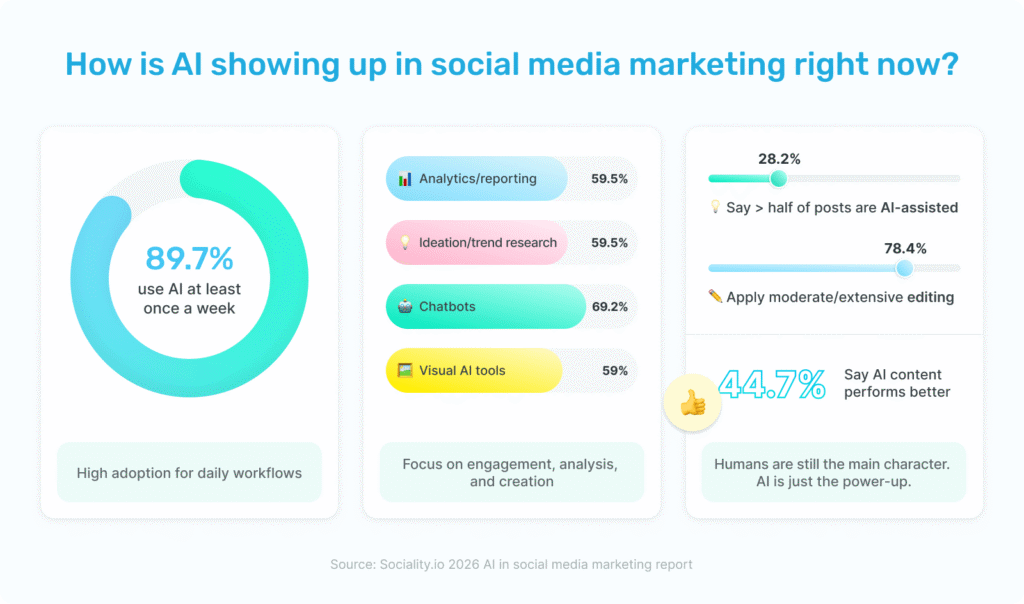
Trend 9: AI Will Help Brands Create Data-Driven Marketing Decisions
In the past, many independent online stores made social media decisions based on assumptions.
Business owners often asked questions like:
- What type of content should we create?
- Which platform should we focus on?
- Why did one video perform well while another failed?
- What products are customers most interested in?
Without reliable insights, marketing decisions often became a process of trial and error.
In 2026, AI-powered analytics are changing the way brands understand customers.
Instead of simply measuring views and likes, AI can help businesses discover deeper patterns.
From Basic Metrics to Customer Behavior Insights
Traditional social media measurement often focuses on:
- Number of followers
- Likes
- Comments
- Shares
- Views
While these numbers are useful, they do not always explain customer intent.
AI analytics can help identify:
- Which content attracts potential buyers
- Which topics create strong emotional reactions
- Which audiences are most likely to purchase
- Which customer concerns prevent conversions
- Which products generate long-term interest
This allows brands to create content based on customer behavior rather than guesswork.
AI Predictive Analysis for Future Campaign Planning
One of the most exciting developments in AI marketing is predictive analysis.
Instead of only analyzing past performance, AI can help estimate future possibilities.
For example, AI systems may identify:
- Seasonal buying patterns
- Emerging customer interests
- Potential viral content themes
- Product demand changes
A home decor brand might discover that minimalist workspace products are gaining attention before the trend becomes mainstream.
A fashion brand might identify rising color preferences before launching its next collection.
This gives independent brands more time to prepare and compete.
Trend 10: AI Will Reduce Advertising Waste and Improve Paid Social Campaigns
Paid social advertising remains an important growth channel for independent online stores.
However, advertising costs continue to increase.
Many businesses struggle with:
- Rising customer acquisition costs
- Poor-performing ads
- Limited testing budgets
- Difficulty identifying winning audiences
AI is changing how brands manage advertising campaigns.
AI-Powered Audience Targeting
Instead of manually selecting audiences based on limited information, AI systems can analyze large amounts of behavioral data.
They can help identify:
- Customer interests
- Purchase patterns
- Similar customer groups
- High-value audiences
This allows brands to spend advertising budgets more efficiently.
AI Creative Testing for Better Ads
Successful advertising depends heavily on creative quality.
A single campaign may require testing:
- Multiple images
- Different headlines
- Various video styles
- Different customer messages
AI can help generate and compare creative variations faster.
For example, a skincare brand might test:
Version A:
“Simple skincare for busy mornings”
Version B:
“Wake up with healthier-looking skin”
Version C:
“The five-minute routine everyone loves”
AI can analyze which message attracts stronger customer responses.
Dynamic Advertising Content
In the future, advertisements will become increasingly personalized.
Different customers may see different versions of the same product campaign.
For example:
A new customer may see:
“Discover our bestselling collection”
A returning customer may see:
“Your favorite product is back in stock”
A previous buyer may see:
“Complete your routine with these recommendations”
AI makes this level of personalization possible at scale.
Trend 11: AI Translation Will Help Independent Brands Expand Globally
Cross-border eCommerce continues to grow, and many independent brands are looking beyond their local markets.
However, international expansion creates challenges:
- Language barriers
- Cultural differences
- Local customer preferences
- Regional marketing styles
AI translation tools are making global marketing easier.
Beyond Simple Translation
Traditional translation converts words.
Modern AI localization understands context.
It can help brands adapt:
- Product descriptions
- Social media captions
- Advertising messages
- Customer communication
For example, a phrase that works well in the United States may not create the same emotional response in another market.
AI can help adjust communication styles based on local preferences.
AI-Powered Multilingual Social Media Management
A brand can now create one campaign and adapt it for multiple markets.
For example:
A product launch campaign can be transformed into:
- English content for U.S. customers
- Spanish content for Latin American audiences
- French content for European markets
- Japanese content for Japanese consumers
This allows smaller companies to reach global audiences without building large international teams.
Trend 12: Authenticity Will Become More Important in the AI Content Era
As AI-generated content becomes more common, consumers will value authenticity even more.
This creates an interesting situation:
AI helps brands create more content, but human connection becomes more valuable.
People do not want to follow brands that feel completely automated.
They want:
- Real stories
- Honest experiences
- Behind-the-scenes moments
- Founder personalities
- Customer voices
The Future Winning Formula: AI Efficiency + Human Creativity
The strongest brands in 2026 will not choose between AI and human creativity.
They will combine both.
AI handles:
- Research
- Organization
- Content assistance
- Data analysis
- Automation
Humans handle:
- Brand vision
- Emotional storytelling
- Customer relationships
- Creative decisions
This balance creates content that is efficient but still meaningful.
How Independent Stores Can Build Their 2026 AI Social Media Strategy
A successful AI-powered marketing strategy does not require using every available tool.
The goal is creating a practical system that supports business growth.
Here is a simple framework.
Step 1: Define Your Brand Identity
Before using AI, understand your foundation.
Ask:
- Who are your ideal customers?
- What problems do your products solve?
- What makes your brand different?
- What emotions should customers associate with your brand?
AI can improve execution, but it cannot replace a clear brand identity.
Step 2: Create a Content System
Instead of randomly posting, build content categories.
A balanced social media plan may include:
Educational Content
Examples:
- How-to guides
- Product tips
- Industry knowledge
Purpose:
Build trust and expertise.
Entertainment Content
Examples:
- Trends
- Challenges
- Creative videos
Purpose:
Increase reach and engagement.
Product Content
Examples:
- Demonstrations
- Comparisons
- Customer reviews
Purpose:
Encourage purchases.
Community Content
Examples:
- Customer stories
- Behind-the-scenes posts
- Brand updates
Purpose:
Create emotional connections.
Step 3: Use AI to Improve Each Stage
AI can support every content category.
For educational content:
AI helps research topics and organize information.
For entertainment content:
AI helps identify trends and generate creative concepts.
For product content:
AI helps create scripts, visuals, and variations.
For community content:
AI helps analyze feedback and identify customer stories.
Step 4: Focus on the Right Social Platforms
Not every platform is suitable for every business.
Different platforms serve different purposes.
TikTok
Best for:
- Viral discovery
- Product demonstrations
- Younger audiences
- Creative storytelling
Best for:
- Brand aesthetics
- Lifestyle content
- Community building
- Visual products
YouTube
Best for:
- Educational videos
- Product reviews
- Long-term customer trust
Best for:
- Inspiration-based shopping
- Home products
- Fashion
- Design categories
Best for:
- Community groups
- Mature audiences
- Retargeting campaigns
The key is not being everywhere.
The key is creating excellent content where your customers already spend time.
Trend 13: AI Will Help Brands Build Stronger Customer Loyalty
Acquiring new customers is becoming increasingly expensive.
Because of this, customer retention will become more important in 2026.
AI can help brands strengthen relationships after the first purchase.
Personalized Follow-Up Experiences
AI can assist with:
- Personalized product recommendations
- Customer appreciation messages
- Loyalty campaigns
- Re-engagement strategies
A customer who feels understood is more likely to return.
AI-Based Customer Feedback Analysis
Customer reviews and comments contain valuable information.
AI can analyze feedback to identify:
- Common complaints
- Favorite product features
- Improvement opportunities
- New product ideas
Instead of viewing reviews only as ratings, brands can use them as business intelligence.