















 En

 37 min read
Introduction: Is Your Influencer Marketing Actually Making Money?
Influencer marketing has become an important growth strategy for brands across industries. From small independent online stores to established direct-to-consumer (DTC) businesses, companies are investing in content creators to increase brand awareness, build trust, generate website traffic, and drive sales.
However, there is one question that every marketer eventually needs to answer:
Is influencer marketing actually delivering a profitable return on investment?
A creator may generate thousands of likes, hundreds of comments, and impressive video views. A campaign may even attract a noticeable increase in website traffic. But these numbers do not automatically mean that the business is making money.
A campaign with high engagement can still lose money if the audience does not purchase. A creator with a relatively small following may generate substantial revenue if their audience has strong buying intent. Meanwhile, a collaboration that produces modest immediate sales may still create value through repeat purchases, customer referrals, and increased brand recognition.
This is why accurately calculating influencer marketing ROI requires more than comparing campaign spending with reported sales.
Businesses need to understand all relevant costs, track measurable outcomes, distinguish attributed revenue from incremental revenue, and evaluate profitability over an appropriate period.
This guide explains how to calculate influencer marketing ROI step by step, including the formulas, metrics, tracking methods, attribution models, practical examples, and common mistakes that can lead to misleading results.
Whether you are working with Instagram creators, TikTok influencers, YouTube reviewers, bloggers, or industry experts, the same fundamental principle applies: measure what the campaign contributes to business results, not just what it generates in social media activity.

1. What Is Influencer Marketing ROI?
Influencer marketing ROI measures the financial return a business receives from its investment in influencer collaborations.
ROI stands for return on investment. In simple terms, it compares the financial value generated by a campaign with the amount spent to run it.
The basic formula is:
ROI = (Return − Investment) ÷ Investment × 100%
For influencer marketing, a more useful profit-based formula is:
Influencer Marketing ROI = (Attributed Contribution Profit − Total Campaign Cost) ÷ Total Campaign Cost × 100%
This second formula is particularly important for e-commerce businesses because sales revenue is not the same as profit.
Consider a simple example.
A brand spends $5,000 on an influencer campaign and generates $15,000 in attributed sales. At first glance, the campaign appears to have generated three dollars in revenue for every dollar invested.
However, the business still needs to account for product costs, shipping subsidies, payment processing, discounts, refunds, and other variable expenses.
If the contribution profit from those sales is only $6,000, the actual campaign ROI is:
($6,000 − $5,000) ÷ $5,000 × 100% = 20%
The campaign is profitable, but its return is much smaller than the revenue figure initially suggests.
This distinction is essential when comparing creators, deciding whether to renew partnerships, and determining how much budget to allocate to influencer marketing.
ROI vs. ROAS: Understanding the Difference
Two metrics are frequently used to evaluate influencer campaigns: ROI and ROAS.
ROAS stands for return on ad spend. It measures revenue generated relative to advertising or campaign spending.
ROAS = Attributed Revenue ÷ Campaign Spend
ROI measures profit relative to investment, while ROAS measures revenue relative to spending.
For example:
- Campaign spending: $2,000
- Attributed revenue: $8,000
- Contribution profit before campaign spending: $3,000
ROAS = $8,000 ÷ $2,000 = 4.0x
ROI = ($3,000 − $2,000) ÷ $2,000 × 100% = 50%
Both metrics are useful, but they answer different questions.
ROAS helps marketers understand revenue efficiency. ROI helps business owners determine whether the investment creates financial value.
For profitable campaign decisions, businesses should use both metrics while giving sufficient attention to contribution profit.
2. Identify Every Cost Before Calculating ROI
One of the biggest reasons influencer marketing ROI is calculated incorrectly is incomplete cost accounting.
Brands often count only the creator’s fee. However, influencer collaborations usually involve additional expenses that can materially affect profitability.
To calculate ROI accurately, all campaign-related costs should be recorded.
2.1 Influencer Fees
Creator compensation is often the largest direct campaign expense.
Payment arrangements may include:
- Fixed fees for sponsored posts
- Fees for short-form videos
- YouTube integration or dedicated video fees
- Fees for Instagram Stories or Reels
- Long-term ambassador retainers
- Affiliate commissions
- Performance bonuses
- Usage or licensing fees
If a creator charges $1,500 for a sponsored TikTok video, that payment should be included in the campaign investment.
For campaigns involving multiple creators, record each creator’s compensation separately.
This makes it easier to compare performance and identify which partnerships deliver the strongest financial return.
2.2 Product Seeding and Samples
Many brands send free products to creators before or during a collaboration.
These products have a real cost, even if no cash payment is involved.
The relevant expense may include:
- Product manufacturing or acquisition cost
- Packaging
- Fulfillment labor
- Shipping
- Customs or import charges, where applicable
- Additional sample units
It is important to distinguish product cost from retail value.
If a product sells for $100 but costs the business $30 to produce, the $30 product cost is generally the more relevant amount for profitability analysis.
However, if the business is measuring its cash outlay, it should also record the actual fulfillment and shipping expenses.
Avoid counting both the retail price and the manufacturing cost as separate expenses. That would inflate the campaign cost.
2.3 Content Production and Creative Expenses
Some influencer campaigns require additional creative support.
These expenses may include:
- Product photography
- Video editing
- Scriptwriting
- Creative direction
- Studio rentals
- Props and materials
- Freelance production support
- Additional revisions
If a brand spends $600 on editing and creative support for a creator campaign, that cost should be included when it is directly attributable to the campaign.
For shared production expenses, establish a consistent allocation method rather than assigning the entire cost to multiple campaigns.
2.4 Affiliate Commissions and Incentives
Affiliate partnerships create variable expenses based on sales performance.
For example, a creator may receive 10% of eligible sales generated through a unique affiliate link.
If the creator generates $4,000 in commissionable sales, the commission is $400.
Performance bonuses should also be included.
A creator might receive an additional $200 after reaching a sales target. That payment is part of the campaign investment.
Make sure the commission calculation accounts for the agreed treatment of discounts, cancellations, returns, and taxes.
2.5 Paid Media Amplification
Many brands turn successful influencer content into paid advertisements.
For example, a company may obtain permission to use a creator’s video in TikTok Ads or Meta Ads.
The resulting advertising expenditure should be recorded separately from the creator’s original compensation.
A useful cost structure is:
- Creator production and collaboration cost
- Paid media distribution cost
- Additional creative adaptation cost
This distinction helps businesses understand whether performance came from the creator’s organic audience or from paid distribution.
If the objective is to measure the entire influencer-led campaign, include all relevant costs. If the objective is to evaluate organic creator performance only, exclude paid amplification and report it separately.
2.6 Internal Labor and Management Costs
Influencer campaigns also require employee time.
Marketing teams may spend hours:
- Researching creators
- Negotiating contracts
- Reviewing content
- Managing product shipments
- Monitoring campaign performance
- Coordinating affiliate payments
- Preparing reports
For a comprehensive profitability assessment, businesses can assign a reasonable labor cost to these activities.
This does not always need to be included in a simplified campaign report. However, larger brands should consider it when comparing influencer marketing with other customer acquisition channels.
A Practical Influencer Campaign Cost Checklist
Before calculating ROI, make sure the following categories have been reviewed:
| Cost category | Example |
|---|---|
| Creator fees | Sponsored content payment |
| Product samples | Product and packaging costs |
| Shipping | Sample delivery |
| Creative production | Editing and photography |
| Affiliate commissions | Percentage of eligible sales |
| Paid amplification | Advertising spend |
| Agency fees | External management |
| Internal labor | Campaign management time |
| Bonuses | Performance-based incentives |
The objective is not to make campaign accounting unnecessarily complicated. It is to avoid overlooking expenses that could turn an apparently profitable campaign into an unprofitable one.
3. Choose the Right Revenue and Profit Metrics
Once campaign costs are clear, the next step is deciding which outcomes should be measured.
Different influencer campaigns have different objectives. A product launch, brand awareness campaign, affiliate partnership, and long-term ambassador program should not necessarily be evaluated using identical metrics.
However, revenue and profit should remain central whenever the primary objective is commercial performance.
3.1 Attributed Revenue
Attributed revenue is the sales revenue assigned to an influencer campaign through a defined tracking method.
It may come from:
- Unique discount codes
- Affiliate links
- UTM-tagged website traffic
- Dedicated landing pages
- Platform reporting
- Customer surveys
- Multi-touch attribution models
For example, if a creator’s unique link generates 75 orders with an average order value of $80, attributed revenue is:
75 × $80 = $6,000
However, attributed revenue should be treated as an estimate of campaign-associated sales, not automatic proof that the campaign created every sale.
Some customers may have purchased anyway. Others may discover a brand through an influencer and complete the purchase through a different channel.
Attribution rules should therefore be documented and applied consistently.
3.2 Contribution Profit
Contribution profit is often more useful than revenue when evaluating campaign profitability.
A simplified formula is:
Contribution Profit = Net Sales Revenue − Variable Costs
Variable costs may include:
- Product cost
- Fulfillment
- Shipping subsidies
- Payment processing
- Discounts
- Returns and refunds
- Other transaction-related expenses
Consider an example:
- Gross sales: $10,000
- Discounts: $500
- Refunds: $300
- Product costs: $3,000
- Fulfillment and shipping costs: $800
- Payment processing: $250
Net sales revenue = $10,000 − $500 − $300 = $9,200
Contribution profit = $9,200 − $3,000 − $800 − $250 = $5,150
The business has generated $9,200 in net sales, but only $5,150 in contribution profit before campaign expenses and other fixed operating costs.
This is the amount that should be compared with campaign investment when calculating contribution-based ROI.
3.3 Customer Acquisition Cost
Customer acquisition cost, or CAC, measures how much a business spends to acquire a new customer.
A simple campaign-level formula is:
Influencer CAC = Total Influencer Campaign Cost ÷ New Customers Acquired
Suppose a campaign costs $3,000 and generates 100 verified first-time customers.
CAC = $3,000 ÷ 100 = $30
This means the brand spent an average of $30 to acquire each new customer through the campaign.
However, businesses should distinguish new customers from repeat customers.
If 150 orders are generated but only 100 belong to first-time buyers, dividing campaign cost by 150 would understate the cost of customer acquisition.
For established businesses, customer records should be used to identify first-time purchasers wherever possible.
3.4 Average Order Value
Average order value, or AOV, helps explain how much customers spend per order.
AOV = Net Sales Revenue ÷ Number of Orders
If an influencer campaign generates $9,000 in net sales from 120 orders:
AOV = $9,000 ÷ 120 = $75
Comparing AOV across creators can reveal differences in purchasing behavior.
For example, one creator may generate many small orders, while another attracts fewer customers who purchase higher-value product bundles.
Both may be valuable, but the more profitable partnership depends on product margins, acquisition costs, and repeat purchase behavior.
3.5 Customer Lifetime Value
Some influencer campaigns attract customers who continue buying over time.
Customer lifetime value, or CLV, estimates the economic value a customer generates throughout the relationship with a business.
For practical analysis, brands should distinguish revenue-based lifetime value from contribution-profit lifetime value.
A simplified contribution-based approach is:
Customer Lifetime Contribution = Expected Lifetime Net Revenue − Expected Lifetime Variable Costs
If a customer generates $300 in lifetime net revenue and $180 in variable costs, their estimated lifetime contribution is $120.
This is more useful for acquisition decisions than simply reporting $300 in lifetime revenue.
However, lifetime value is an estimate. It should be based on actual customer cohorts, observed repeat purchase patterns, and realistic assumptions.
4. Set Up Accurate Influencer Campaign Tracking
Accurate ROI calculations depend on reliable tracking.
Without consistent tracking, businesses may miss influencer-driven sales, assign revenue to the wrong creator, or count the same order multiple times.
A strong tracking system should combine multiple measurement methods.
4.1 Create Unique UTM Parameters
UTM parameters are tracking tags added to website URLs.
They help analytics platforms identify where traffic originates and which campaign generated a visit.
A typical influencer URL may look like this:
The parameters provide useful information:
- utm_source identifies the traffic source.
- utm_medium identifies the marketing channel.
- utm_campaign identifies the campaign.
- utm_content distinguishes individual creators or creative assets.
For each influencer, create a unique tracking link.
For example:
Creator A:
utm_source=instagram
utm_medium=influencer
utm_campaign=summer_launch
utm_content=creator_a
Creator B:
utm_source=tiktok
utm_medium=influencer
utm_campaign=summer_launch
utm_content=creator_b
This allows the marketing team to compare creators more accurately.
Use consistent naming conventions. Avoid changing parameter names randomly between campaigns, because inconsistent tracking makes reporting more difficult.
4.2 Assign Unique Discount Codes
Discount codes provide another way to identify influencer-driven purchases.
For example:
- ALEX10
- SUMMERWITHJANE
- MIKE15
Each code should be assigned to one creator or one clearly defined campaign.
Discount codes are particularly useful when customers discover products on social media but complete their purchases later by directly visiting the website.
However, discount codes have limitations.
Customers may share codes on coupon websites. Some buyers may use a code even if they discovered the brand elsewhere. Others may forget to enter it.
Therefore, discount-code revenue should not automatically be treated as the complete or perfectly accurate measure of influencer impact.
4.3 Use Dedicated Landing Pages
Dedicated landing pages can make campaign tracking easier.
A creator-specific page may include:
- A personalized introduction
- Recommended products
- Creator-approved content
- A unique offer
- Frequently asked questions
- A clear purchase path
For example, a skincare brand might create a landing page featuring a creator’s recommended routine.
This approach provides more context than sending every influencer audience to the homepage.
It also makes it easier to measure page visits, product interactions, add-to-cart events, and completed purchases.
4.4 Track the Entire Conversion Funnel
A campaign should not be evaluated only by clicks and purchases.
Intermediate events help explain where potential customers leave the buying process.
A useful funnel includes:
- Content impressions
- Video views or meaningful content interactions
- Link clicks
- Landing-page sessions
- Product views
- Add-to-cart events
- Checkout starts
- Completed purchases
- Repeat purchases
These events help marketers identify whether a campaign has a reach problem, a traffic-quality problem, or a website conversion problem.
For example, a creator may generate significant traffic but few purchases.
The issue could be weak audience purchase intent, an irrelevant landing page, high shipping costs, or an unattractive offer.
Without funnel tracking, marketers may incorrectly conclude that the creator is ineffective.
4.5 Track Purchases Correctly
Purchase tracking should be treated as the most important conversion event for sales-focused campaigns.
Make sure each completed order is recorded accurately.
Important checks include:
- Avoid duplicate purchase events.
- Use a consistent order identifier where supported.
- Exclude test transactions.
- Separate canceled orders from completed orders.
- Account for refunds and returns.
- Confirm that tracking works across devices and browsers where possible.
If the same order is recorded by multiple analytics systems, do not add all reported purchases together.
A single order should represent one transaction, even if multiple platforms report that they observed it.
5. Understand Influencer Attribution Models
Attribution determines how sales credit is assigned to marketing interactions.
This is particularly important because customers rarely follow a perfectly linear purchasing journey.
A person may watch an influencer’s video, search for the product on Google, read customer reviews, visit the website, and purchase several days later.
Which channel deserves credit?
The answer depends on the attribution model.
5.1 First-Touch Attribution
First-touch attribution gives full credit to the first recorded marketing interaction.
For example:
A customer discovers a brand through an influencer video, visits the website, leaves, and later purchases through an email campaign.
Under first-touch attribution, the influencer receives the credit.
This model is useful for understanding discovery and customer acquisition.
However, it may undervalue channels that help customers complete their purchases later.
5.2 Last-Touch Attribution
Last-touch attribution gives full credit to the final recorded marketing interaction before purchase.
Using the same example, the email campaign would receive the credit.
This model is simple and commonly used in performance reporting.
However, it may underestimate the contribution of influencers who introduce products early in the customer journey.
A customer might never have discovered the brand without the original influencer recommendation.
5.3 Linear Attribution
Linear attribution distributes credit evenly across recorded touchpoints.
If a customer interacts with an influencer, a search advertisement, and an email before purchasing, each receives one-third of the credit.
This model acknowledges multiple interactions but assumes that every touchpoint contributes equally.
That assumption may not reflect actual customer behavior.
5.4 Position-Based Attribution
Position-based attribution assigns greater weight to selected interactions, often the first and last touchpoints.
For example, a business might assign:
- 40% to the first interaction
- 40% to the final interaction
- 20% to interactions in between
This model recognizes the importance of both discovery and conversion.
It can be useful for brands with longer purchase journeys, although the chosen percentages should not be treated as universal truths.
5.5 Data-Driven Attribution
Data-driven attribution uses observed customer interactions and statistical methods to estimate how different touchpoints contribute to conversions.
Depending on the platform and available data, it may provide a more nuanced picture than fixed-rule models.
However, data-driven attribution still depends on tracking coverage, platform methodology, privacy limitations, and the quality of available data.
It should not be interpreted as perfect measurement of causal impact.
Which Attribution Model Should You Use?
There is no single model that works for every influencer campaign.
For practical reporting, consider using multiple views:
- First-touch attribution to understand customer discovery.
- Last-touch attribution to understand conversion assistance.
- Platform and affiliate reporting to understand tracked campaign activity.
- Cohort analysis to evaluate repeat purchasing.
- Incrementality testing to estimate sales that would not otherwise have occurred.
The most important requirement is consistency.
Do not change attribution rules between creators simply because one method makes a particular campaign look more profitable.
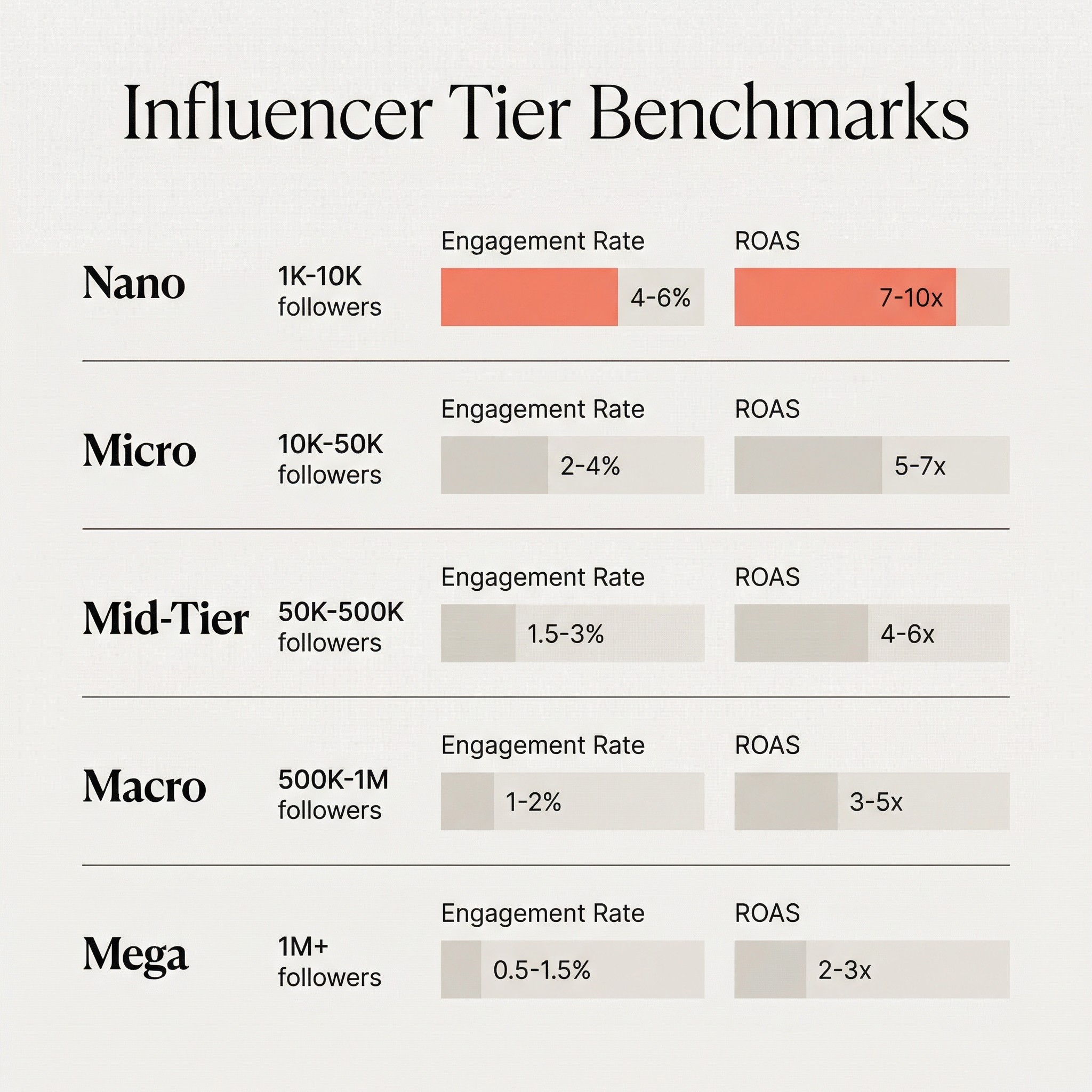
6. The Most Important Metrics for Evaluating Influencer Performance
An effective influencer report should include enough metrics to explain financial performance without becoming overloaded with irrelevant numbers.
6.1 Revenue per Creator
Revenue per Creator = Attributed Revenue from Creator ÷ Number of Creators
For individual creator comparisons, report attributed revenue separately for each partnership.
This helps identify creators who generate meaningful commercial outcomes.
6.2 Cost per Acquisition
CPA = Campaign Cost ÷ Number of Acquired Customers
CPA is useful when the primary objective is customer acquisition.
For example, a creator who generates 80 first-time customers at a total cost of $2,400 has a campaign CPA of $30.
6.3 Conversion Rate
Conversion Rate = Purchases ÷ Relevant Website Sessions × 100%
If 1,000 influencer-attributed sessions generate 40 purchases:
Conversion rate = 40 ÷ 1,000 × 100% = 4%
Conversion rate helps marketers understand the quality of traffic and the effectiveness of the landing page.
Always specify the denominator. A website-session conversion rate is different from a click-to-purchase conversion rate.
6.4 Engagement Rate
Engagement rate measures audience interaction with content.
Depending on the platform and reporting method, engagement may include likes, comments, shares, saves, or other interactions.
A common formula is:
Engagement Rate by Reach = Total Engagements ÷ Reach × 100%
Engagement is useful for assessing audience response, but it should not replace financial performance metrics.
A creator with a lower engagement rate may still deliver strong purchases if their audience has high buying intent.
6.5 Cost per Thousand Impressions
CPM measures the cost of generating one thousand impressions.
CPM = Campaign Cost ÷ Impressions × 1,000
If a brand spends $2,000 and receives 400,000 impressions:
CPM = $2,000 ÷ 400,000 × 1,000 = $5
CPM is useful for comparing awareness campaigns and media efficiency.
However, it does not measure profit or customer acquisition.
6.6 Revenue per Click
Revenue per Click = Attributed Revenue ÷ Tracked Clicks
If a creator generates $6,000 in attributed sales from 1,200 tracked clicks:
Revenue per click = $5
This metric can help compare traffic quality across creators.
6.7 New Customer Percentage
New Customer Percentage = First-Time Customers ÷ Total Customers × 100%
A campaign generating 100 customers, 70 of whom are first-time buyers, has a new customer percentage of 70%.
This is important because a campaign that mostly generates purchases from existing customers may be better understood as a retention or reactivation effort rather than a pure acquisition campaign.
7. A Step-by-Step Example: Calculating Influencer Marketing ROI
Let’s consider a fictional DTC brand selling premium home accessories.
The company partners with three creators to promote a new product collection.
The campaign runs for four weeks.
Campaign Investment
| Expense | Amount |
|---|---|
| Creator A fee | $1,200 |
| Creator B fee | $1,000 |
| Creator C fee | $800 |
| Product and sample costs | $300 |
| Shipping | $120 |
| Creative editing | $280 |
| Affiliate commissions | $500 |
| Total investment | $4,200 |
Campaign Performance
The tracking system reports:
- Total attributed orders: 120
- Attributed gross sales: $12,000
- Discounts: $600
- Refunds: $400
- Product costs: $3,600
- Fulfillment and shipping costs: $900
- Payment processing costs: $300
First, calculate net sales revenue:
$12,000 − $600 − $400 = $11,000
Next, calculate contribution profit:
$11,000 − $3,600 − $900 − $300 = $6,200
Now calculate ROAS:
$12,000 ÷ $4,200 = 2.86x
For net-sales ROAS:
$11,000 ÷ $4,200 = 2.62x
Finally, calculate contribution-based ROI:
($6,200 − $4,200) ÷ $4,200 × 100% = 47.62%
The campaign generated approximately 47.6% contribution-based ROI.
This is a much more informative result than simply reporting that the brand generated $12,000 in sales.
Calculate Customer Acquisition Cost
Suppose the 120 orders came from 95 unique customers, including 70 first-time buyers.
New customer CAC:
$4,200 ÷ 70 = $60
The brand now knows that the campaign acquired new customers at an average cost of $60.
The next question is whether those customers are likely to generate enough future contribution profit to justify the acquisition expense.
Compare the Three Creators
Suppose the individual creator reports show the following:
| Metric | Creator A | Creator B | Creator C |
|---|---|---|---|
| Campaign cost | $1,200 | $1,000 | $800 |
| Attributed revenue | $4,000 | $5,000 | $3,000 |
| Orders | 40 | 50 | 30 |
| Tracked clicks | 800 | 1,000 | 600 |
| Revenue per click | $5.00 | $5.00 | $5.00 |
Creator B generated the highest attributed revenue and order volume.
However, the three creators generated identical revenue per click in this simplified example.
A deeper comparison should examine new customer percentage, average order value, contribution margin, refunds, and repeat purchase behavior.
The creator with the highest revenue may not necessarily deliver the strongest long-term return.
8. How to Measure the Long-Term Value of Influencer Campaigns
Influencer marketing does not always produce its full financial impact immediately.
Some customers purchase weeks after seeing content. Others return for additional products months later.
For brands with repeat-purchase business models, measuring only the first transaction may underestimate campaign value.
8.1 Build Customer Cohorts by Acquisition Source
A customer cohort groups buyers according to a shared characteristic, such as the month they first purchased or the channel that acquired them.
For influencer marketing, brands can create cohorts based on:
- Creator-specific discount codes
- Affiliate referral sources
- UTM campaign data
- First recorded acquisition channel
- Customer survey responses
Then compare how these customers behave over time.
Useful metrics include:
- Repeat purchase rate
- Average order value
- Purchase frequency
- Refund rate
- Cumulative net revenue
- Cumulative contribution profit
For example, customers acquired through one creator may have a lower initial order value but a higher repeat purchase rate.
That creator could be more valuable over a longer evaluation period.
8.2 Calculate Repeat Purchase Contribution
Suppose a campaign acquires 50 new customers.
During the first 90 days:
- Initial contribution profit: $2,000
- Repeat purchase contribution profit: $900
- Total contribution profit: $2,900
If the campaign cost $2,000, the 90-day contribution-based ROI is:
($2,900 − $2,000) ÷ $2,000 × 100% = 45%
This calculation gives a more complete view of the campaign than first-purchase revenue alone.
However, avoid assuming that every customer will repeat purchase at the same rate indefinitely.
Use observed cohort data and clearly identify the measurement period.
8.3 Consider Brand Awareness as a Separate Outcome
Some influencer campaigns focus on awareness rather than immediate sales.
Their potential benefits may include:
- More branded searches
- Increased direct website visits
- Greater social media following
- More customer inquiries
- Improved product familiarity
- Increased consideration during future purchases
These outcomes can be valuable, but they should not automatically be converted into speculative revenue estimates.
Instead, report awareness indicators separately and investigate whether they are followed by measurable changes in customer behavior.
This creates a more transparent evaluation framework.
9. Measuring Incremental ROI Instead of Just Attributed ROI
One of the most important improvements brands can make is distinguishing attributed sales from incremental sales.
Attributed sales are purchases assigned to a campaign by a tracking system.
Incremental sales are additional purchases that occurred because of the campaign and would not otherwise have happened.
These are not necessarily the same.
For example, a loyal customer may have planned to buy a product anyway. If that customer later uses an influencer discount code, the tracking system may assign the purchase to the influencer.
The sale is attributed, but the campaign may not have created the entire purchase.
9.1 Why Incrementality Matters
Without incrementality analysis, businesses may overestimate campaign impact.
This is especially likely when:
- Creators promote heavily discounted products.
- Existing customers frequently use creator codes.
- Brand awareness is already high.
- Multiple channels reach the same audience.
- Customers are exposed to several campaigns simultaneously.
Incrementality helps answer a more meaningful question:
How much additional business did this influencer campaign actually generate?
9.2 Use Geographic or Audience-Based Holdout Tests
A controlled test can help estimate incremental impact.
For example, a brand might compare two similar geographic markets.
One market receives influencer promotion, while the other does not during the test period.
If sales increase more in the exposed market than in the comparison market, the difference may provide evidence of incremental lift.
However, the markets should be reasonably comparable, and external factors such as seasonality, pricing, and other promotions must be considered.
9.3 Use Staggered Campaign Launches
When a formal control group is not practical, brands can introduce creator campaigns in stages.
For example:
- Week One: Launch with Creator A.
- Week Two: Add Creator B.
- Week Three: Add Creator C.
Monitor changes in traffic, new customers, branded searches, and sales.
This approach is not a perfect experiment because other factors may influence performance. However, it can help reveal patterns and identify which campaign activities coincide with changes in business outcomes.
9.4 Calculate Incremental ROI
If a test estimates that the campaign generated $8,000 in incremental contribution profit and the campaign cost $5,000:
Incremental ROI = ($8,000 − $5,000) ÷ $5,000 × 100%
Incremental ROI = 60%
This is a more useful estimate of causal financial impact than simply assigning all tracked revenue to the campaign.
When incremental contribution profit cannot be measured reliably, report attributed ROI and label it clearly rather than presenting it as proven incremental ROI.
10. Build an Influencer Marketing ROI Dashboard
A dashboard helps marketing teams monitor campaign performance and make decisions without manually combining reports every time.
A useful dashboard should connect financial outcomes with the activity that produced them.
10.1 Core Dashboard Sections
Campaign Overview
Include:
- Campaign name
- Campaign period
- Number of creators
- Total campaign investment
- Attributed revenue
- Net sales revenue
- Contribution profit
- ROAS
- ROI
Creator Performance
Include:
- Creator name
- Platform
- Content type
- Creator fee
- Product and shipping costs
- Tracked clicks
- Orders
- New customers
- Attributed revenue
- Contribution profit
- CAC
- Creator-level ROI, where data is sufficient
Conversion Funnel
Include:
- Impressions
- Reach
- Engagements
- Link clicks
- Website sessions
- Product views
- Add-to-cart events
- Checkout starts
- Purchases
Customer Quality
Include:
- First-time customer share
- Average order value
- Refund rate
- Repeat purchase rate
- Customer cohort contribution
10.2 Use the Right Data Sources
Depending on the business, a dashboard may combine information from:
- E-commerce platforms
- Website analytics
- Affiliate platforms
- Social media reporting tools
- Advertising platforms
- Customer relationship management systems
- Payment and order databases
- Financial reporting systems
For a Shopify-based store, for example, order data can provide transaction-level information, while analytics tools and affiliate systems provide traffic and referral context.
The business should define which system is authoritative for orders, refunds, discounts, and product costs.
Social platforms may report attributed conversions using their own methodologies. Those numbers should be presented separately rather than automatically added to store orders.
10.3 Create a Consistent Reporting Schedule
A practical reporting schedule may include:
- Daily monitoring during major launches
- Weekly creator performance reviews
- Monthly campaign profitability analysis
- Quarterly customer cohort evaluation
Avoid making final decisions based on incomplete data immediately after a creator publishes content.
Allow sufficient time for delayed purchases, returns, and cancellations to become visible.
11. Common Influencer ROI Calculation Mistakes
Even experienced marketing teams can make mistakes when measuring influencer performance.
Understanding these issues can help prevent inaccurate reporting.
Mistake 1: Using Revenue Instead of Profit
A campaign generating $20,000 in sales may appear successful.
But if product costs, discounts, fulfillment, refunds, and campaign expenses consume most of the revenue, the actual return may be negative.
Always evaluate contribution profit.
Mistake 2: Counting the Same Sale Multiple Times
An order may appear in an affiliate platform, social platform report, website analytics tool, and advertising dashboard.
These systems may all claim attribution.
Adding their conversion totals together can significantly overstate revenue.
Use a transaction-level order record as the financial source of truth and treat platform reports as separate attribution views.
Mistake 3: Ignoring Product Seeding Costs
Free samples are not free to the business.
Product costs, packaging, and shipping should be recorded.
Otherwise, creator partnerships may appear more profitable than they actually are.
Mistake 4: Evaluating Creators Only by Follower Count
A creator with one million followers does not necessarily deliver more revenue than a creator with 20,000 followers.
Audience relevance, trust, content quality, purchasing intent, and product fit often matter more than follower count alone.
Mistake 5: Ignoring Repeat Purchases
A campaign may generate a modest first order but attract customers who purchase repeatedly.
Ignoring these later transactions can undervalue long-term partnerships.
Use customer cohorts to understand repeat purchase behavior.
Mistake 6: Treating Every Discount-Code Order as Incremental
A discount code shows that an order used a particular offer. It does not prove that the customer would not have purchased without the influencer.
Use codes as one tracking signal, not as definitive causal evidence.
Mistake 7: Ignoring Returns and Cancellations
Gross sales can overstate the financial outcome if many orders are later refunded or canceled.
Use net sales and mature transaction data wherever possible.
Mistake 8: Comparing Campaigns With Different Measurement Rules
If one creator is measured over seven days and another over 30 days, the comparison may be misleading.
Similarly, different attribution windows, discount treatments, and refund rules can create inconsistent results.
Standardize reporting definitions before comparing creators.
12. How to Improve Influencer Marketing ROI
Once the measurement system is in place, the next step is improving campaign performance.
The goal is not simply to reduce spending. It is to invest in partnerships that generate stronger financial outcomes.
12.1 Prioritize Audience Relevance
A creator’s audience should closely match the brand’s target customers.
Evaluate:
- Geographic distribution
- Age and lifestyle characteristics where legitimately available
- Content interests
- Audience purchasing behavior
- Product category relevance
- Historical engagement quality
Avoid selecting creators based only on large follower counts.
A smaller creator with a highly relevant audience may generate better conversion rates and stronger customer relationships.
12.2 Test Multiple Creators Before Scaling
Instead of committing a large budget to one creator immediately, start with a controlled test.
Work with several creators using comparable products, offers, and measurement rules.
Then evaluate:
- Cost per new customer
- Contribution profit
- Revenue per click
- Conversion rate
- Refund rate
- Repeat purchase behavior
Scale partnerships that demonstrate strong results, while continuing to test new creators.
12.3 Improve the Offer and Landing Page
Even an excellent creator may struggle to convert if the offer is unclear or the landing page creates friction.
Improve the buying experience through:
- Clear product benefits
- Relevant creator content
- Strong product photography
- Transparent pricing
- Clear shipping information
- Simple checkout
- Appropriate promotional incentives
- Visible customer reviews
The landing page should match the expectations created by the influencer’s content.
If a creator promotes a specific product, customers should not have to search through a large catalog to find it.
12.4 Negotiate Performance-Based Partnerships
Performance-based compensation can help align brand and creator incentives.
Possible arrangements include:
- A smaller fixed fee plus commission
- Tiered affiliate commissions
- Bonuses for verified new customers
- Bonuses for contribution-profit targets
- Longer-term contracts tied to agreed performance indicators
However, performance-based agreements should still compensate creators fairly for the value of their content and production work.
The brand should also define how sales, refunds, attribution windows, and commissions will be calculated.
12.5 Repurpose High-Performing Creator Content
A successful influencer video may have value beyond its original organic post.
With appropriate usage rights, brands can repurpose creator content in:
- Paid social advertising
- Product landing pages
- Email marketing
- Product detail pages
- Retargeting campaigns
- Brand social channels
Before doing so, clarify content ownership, licensing duration, territories, platforms, editing permissions, and paid usage rights.
Repurposing successful content can increase the value of the original production investment.
12.6 Build Long-Term Creator Relationships
One-off promotions may generate short-term sales, but consistent creator partnerships can help brands build familiarity and trust.
Long-term partnerships may offer:
- More authentic product recommendations
- Better audience understanding
- More efficient content production
- Improved creative consistency
- Opportunities for repeat promotions
- Stronger customer relationships
Evaluate long-term creators using cumulative contribution profit, customer quality, and campaign consistency rather than relying on one isolated post.
13. A 30-Day Action Plan for Better Influencer ROI Measurement
Brands that currently rely on basic engagement metrics can improve their measurement process in stages.
Week One: Audit Existing Campaign Data
Review recent influencer collaborations.
Collect:
- Creator fees
- Product and shipping costs
- Affiliate commissions
- Tracked links
- Discount codes
- Orders
- Refunds
- New customer counts
Identify missing cost categories and inconsistent tracking practices.
Week Two: Standardize Tracking
Create a consistent UTM naming structure.
Assign unique links and discount codes to creators.
Check purchase-event tracking and confirm that order records can be reconciled with analytics and affiliate reports.
Document attribution rules.
Week Three: Build a Profitability Dashboard
Create a simple dashboard showing:
- Total campaign cost
- Net attributed sales
- Contribution profit
- ROAS
- ROI
- New customer CAC
- Creator-level performance
Start with a small number of reliable metrics instead of adding every available platform statistic.
Week Four: Evaluate and Optimize
Compare creators using consistent measurement periods.
Identify which partnerships generate the strongest customer acquisition and contribution profit.
Review weak-performing campaigns to determine whether the problem comes from audience fit, creative content, the offer, the landing page, or the purchasing experience.
Then use the findings to plan the next round of collaborations.
14. Frequently Asked Questions About Influencer Marketing ROI
What Is a Good Influencer Marketing ROI?
There is no universal ROI benchmark that applies to every brand.
A profitable result depends on product margins, customer acquisition costs, repeat purchase behavior, campaign objectives, and operating expenses.
A high-margin product may support a different acquisition cost from a low-margin product.
The most useful benchmark is the business’s own break-even requirement and historical campaign performance.
Should Influencer Marketing ROI Be Calculated Using Revenue or Profit?
For financial decision-making, contribution profit is generally more useful.
Revenue helps measure sales generation, while contribution profit accounts for the variable costs associated with those sales.
Businesses can report revenue-based ROAS alongside profit-based ROI to understand both dimensions.
How Long Should You Wait Before Calculating Influencer ROI?
The appropriate period depends on the product and customer buying cycle.
For impulse purchases, results may become visible quickly.
For expensive products or products requiring research, customers may take longer to purchase.
A practical approach is to report early results separately from final results after the agreed attribution and return windows have matured.
Can Small Influencers Deliver Better ROI Than Large Influencers?
Yes.
Smaller creators may have more focused audiences, stronger community relationships, and better product-category relevance.
However, creator size alone does not determine performance.
Compare actual acquisition costs, contribution profit, and customer quality.
How Do You Calculate Influencer ROI Without Discount Codes?
You can use UTM links, affiliate tracking, dedicated landing pages, customer surveys, and other attribution methods.
A combination of tracking signals usually provides a more complete picture than relying on one method.
For campaigns with limited tracking coverage, report the uncertainty instead of presenting an exact causal ROI figure.
Should Free Products Be Included in Influencer Campaign Costs?
Yes.
Product samples have a real cost to the business, including product acquisition or manufacturing costs, packaging, and shipping.
They should be included when calculating comprehensive campaign profitability.
Is ROAS the Same as Influencer Marketing ROI?
No.
ROAS measures attributed revenue relative to campaign spending.
ROI measures financial return relative to investment.
A campaign can have strong ROAS but weak or negative ROI if product margins and other expenses are high.
How Can You Compare Influencers Fairly?
Use consistent tracking rules, comparable reporting periods, and the same cost and revenue definitions.
Compare new customer CAC, contribution profit, conversion rate, average order value, and repeat purchase behavior.
Also consider whether creators have different campaign objectives or content formats.
Conclusion: Measure Profit, Not Just Popularity
Influencer marketing can be a powerful growth channel, but its value should not be judged by views, likes, comments, or follower counts alone.
Accurately calculating influencer marketing ROI requires a clear understanding of campaign investment, reliable conversion tracking, realistic attribution rules, and a focus on contribution profit.
Start by recording every meaningful expense, including creator fees, product samples, shipping, creative production, commissions, and paid amplification.
Then establish a consistent tracking system using UTM parameters, unique discount codes, landing pages, and purchase-event monitoring.
Evaluate both immediate financial performance and longer-term customer value. Distinguish attributed revenue from incremental sales, and avoid counting the same purchase across multiple platforms.
Most importantly, turn the results into better decisions.
Invest more in creators who attract relevant customers, generate sustainable contribution profit, and support repeat purchasing. Improve offers and landing pages when traffic is strong but conversions are weak. Test new partnerships before committing large budgets, and use high-performing creator content strategically across other marketing channels.
The most successful influencer marketing strategy is not necessarily the one with the largest reach or the highest engagement rate. It is the one that consistently turns relevant audience relationships into measurable, sustainable business growth.