














 En
En
 8 min read
In digital advertising, budget is never just a number—it is a control system. Especially in Facebook (Meta) advertising, how you allocate and manage spend directly determines whether your campaigns stabilize, scale, or collapse into inefficiency.
Many advertisers focus heavily on creative and targeting, but overlook a more fundamental question:
How should budget be structured so that the system can actually learn, optimize, and scale efficiently?
The answer lies in understanding how Meta’s auction system works, how bidding strategies influence delivery, and how spend behavior shapes machine learning performance over time.
This guide breaks down Facebook Ads budget management from first principles to advanced scaling strategy, helping you move from reactive spending to structured performance control.
1. Why Budget Is Not Just “Money You Spend”
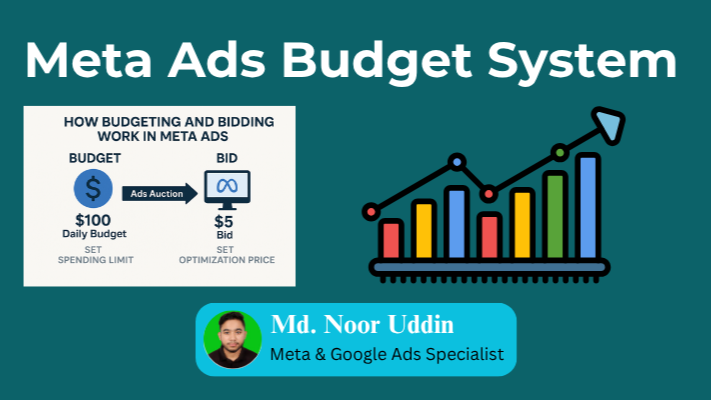
In Facebook advertising, budget is not simply a financial input. It is also a signal.
Every budget decision communicates something to the algorithm:
- How much data should be collected
- How aggressively delivery should scale
- How stable the learning phase will be
- How wide or narrow exploration should be
This means poor budget management doesn’t just waste money—it actively disrupts optimization.
Two advertisers with identical creatives and targeting can achieve completely different results based solely on budget structure.
2. How the Facebook Ad Auction Really Works
Facebook operates on a real-time auction system where every impression is allocated based on three main factors:
- Bid amount (how much you’re willing to pay)
- Estimated action rate (likelihood of conversion)
- Ad quality and relevance
The key insight is:
You are not just competing on price—you are competing on predicted performance.
Budget determines how often you enter the auction and how aggressively you compete within it.
3. The Learning Phase and Why Budget Stability Matters
Every new campaign enters a learning phase where Meta’s algorithm tests delivery patterns.
During this phase:
- Data is collected
- Audience signals are analyzed
- Conversion probability models are built
Budget plays a critical role here.
If budget is too low:
- Not enough data is generated
- Learning phase stalls
- Optimization never stabilizes
If budget is too high:
- Rapid exploration creates noisy data
- Algorithm struggles to converge
- Cost volatility increases
The goal is not maximum spending—it is controlled data accumulation.
4. Daily Budget vs Lifetime Budget: Strategic Differences
4.1 Daily Budget
Daily budgets provide:
- Predictable spending limits
- Stable pacing
- Easier testing environments
Best for:
- Early-stage campaigns
- Ongoing evergreen ads
- Controlled scaling tests
However, daily budgets can sometimes restrict aggressive scaling.
4.2 Lifetime Budget
Lifetime budgets allow:
- Flexible pacing across time
- Algorithm-driven optimization of spend distribution
- Better performance during known peak periods
Best for:
- Time-bound promotions
- Seasonal campaigns
- Launch events
But they require careful setup to avoid front-loading spend too early.
5. The Core Bidding Strategies Explained
Facebook offers multiple bidding strategies, each influencing how budget is spent.
5.1 Lowest Cost (Automatic Bidding)
This is the default strategy.
The system:
- Spends your full budget
- Optimizes for cheapest available conversions
- Prioritizes volume over cost control
Advantages:
- Easy to use
- Good for scaling and testing
- Maximizes delivery speed
Disadvantages:
- Less cost predictability
- Can overspend in competitive auctions
Best for:
- Early testing phases
- Broad audience campaigns
5.2 Cost Cap
Cost Cap allows you to set a target cost per result.
The system tries to:
- Stay near your target CPA
- Balance volume and efficiency
Advantages:
- More cost control
- Better long-term predictability
Disadvantages:
- Can restrict delivery if cap is too strict
- Slower scaling
Best for:
- Mature campaigns
- Stable conversion environments
5.3 Bid Cap
Bid Cap sets a maximum bid in the auction.
This is the most restrictive strategy.
Advantages:
- Strong cost control
- Useful in highly competitive niches
Disadvantages:
- Can severely limit delivery
- Requires deep auction knowledge
Best for:
- Advanced advertisers
- Controlled environments with known benchmarks
5.4 ROAS Control (Value Optimization)
This strategy optimizes for return on ad spend.
The system prioritizes:
- High-value conversions
- Revenue efficiency over volume
Best for:
- E-commerce
- Subscription models
- Mature data-rich accounts
6. Budget Allocation Strategy: The Foundation of Efficiency
Even the best bidding strategy fails without proper allocation.
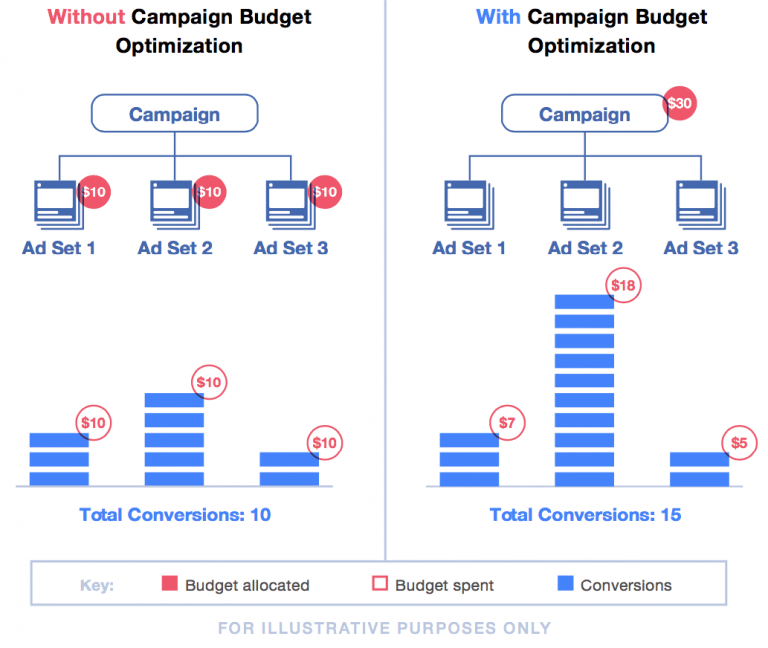
6.1 Campaign-Level Budgeting (CBO)
Campaign Budget Optimization allows Facebook to distribute budget across ad sets automatically.
Benefits:
- Algorithm-driven allocation
- Reduced manual management
- Better scaling efficiency
Risks:
- Potential over-concentration in one ad set
- Reduced experimental diversity
6.2 Ad Set Budgeting (ABO)
Ad Set Budget Optimization gives manual control at the ad set level.
Benefits:
- Precise testing control
- Better for structured experiments
- Easier isolation of performance variables
Risks:
- Less efficient scaling
- Requires more management effort
7. Budget Distribution Principles That Actually Work
Principle 1: Avoid over-fragmentation
Too many ad sets dilute learning data.
Result:
- Slow optimization
- Weak signal accumulation
Principle 2: Match budget to conversion volume
A simple rule:
Each ad set needs enough budget to generate statistically meaningful conversions.
Without sufficient volume, learning cannot stabilize.
Principle 3: Respect the learning threshold
If budget is too small:
- Ads stay in learning phase
- Performance remains unstable
- Optimization signals are weak
Principle 4: Scale gradually, not abruptly
Sudden budget increases cause:
- Re-learning cycles
- Delivery instability
- Cost spikes
A controlled scaling approach preserves model stability.
8. Scaling Budget: Horizontal vs Vertical Expansion
8.1 Vertical scaling
Increasing budget on existing ad sets.
Pros:
- Builds on existing data
- Maintains learning continuity
Cons:
- Can destabilize if increased too quickly
8.2 Horizontal scaling
Adding new ad sets or campaigns.
Pros:
- Expands audience reach
- Reduces dependency on a single dataset
Cons:
- Requires new learning cycles
9. The Relationship Between Budget and Algorithm Learning
Budget determines how fast the system learns.
- Low budget = slow learning, high stability
- High budget = fast learning, higher volatility
The key is balance.
You want:
Enough budget to generate meaningful signals, but not so much that data becomes noisy.
10. Common Budget Mistakes That Kill Performance
Mistake 1: Changing budget too frequently
This resets learning signals and prevents stabilization.
Mistake 2: Scaling too fast
Rapid scaling creates unstable cost structures and unpredictable delivery.
Mistake 3: Underfunding test campaigns
Without enough budget, you never reach statistically meaningful results.
Mistake 4: Ignoring cost per conversion variability
Focusing only on average CPA hides volatility issues.
11. Advanced Spend Management Techniques
11.1 Dayparting strategies
Adjusting budget allocation based on time-of-day performance.
11.2 Budget pacing control
Ensuring spend is evenly distributed to avoid early depletion.
11.3 Performance-based reallocation
Shifting budget toward high-performing ad sets dynamically.
11.4 Funnel-based budgeting
Dividing spend across:
- Awareness
- Consideration
- Conversion
This ensures full-funnel optimization.
12. Interpreting Spend Data Correctly
Key metrics to monitor:
- Cost per acquisition (CPA)
- Return on ad spend (ROAS)
- Impression distribution
- Frequency
- Conversion rate stability
But the most important insight is not static numbers—it is trend stability over time.
13. How Budget Affects Auction Competition
Higher budgets:
- Increase impression share
- Improve auction participation
- Raise visibility consistency
But also:
- Increase exposure to expensive auctions
- Require stronger creative performance to maintain efficiency
Budget is therefore both an opportunity and a constraint.
14. Building a Sustainable Budget Framework
A strong system typically includes:
- Controlled testing budgets
- Stable scaling budgets
- Performance-based reallocation rules
- Clear exit criteria for underperforming campaigns
This turns budget management from reactive spending into structured control.
Final Thoughts: Budget Is a Strategic System, Not an Expense
In Facebook advertising, success is not determined by how much you spend—but by how intelligently you structure that spend.
Budget influences:
- Algorithm learning speed
- Auction competitiveness
- Scaling stability
- Cost efficiency
- Long-term performance consistency
Advertisers who treat budget as a dynamic control system—not just a financial input—consistently outperform those who simply “spend more.”
The goal is not maximum spend.
The goal is maximum efficiency per unit of spend over time.