















 En
En
 17 min read
Cross-border e-commerce sellers know that choosing an overseas warehouse is a critical step, yet even a small misstep can affect shipping efficiency or lead to significant losses. Lost goods, low listing rates, delayed shipments, skyrocketing storage fees… these are common pain points.
So, how can you find the right overseas warehouse to truly boost operational efficiency? Five years of cross-border experience have distilled five key points to help sellers avoid pitfalls.
Systematization ability
Overseas warehouse, you may first look at the warehouse area is not big, more or less labor, but the real impact on efficiency, is it in the end “smart or not”.
How to judge the systematization ability of overseas warehouse? Look at these three points
System docking ability
If your overseas warehouse still relies on Excel to manually enter orders, then you really need to consider changing. A good overseas warehouse should be docked to your store with one click, so that the order data is automatically synchronized, eliminating the trouble of manual import.
You can just ask:
● What platforms are supported? Now the mainstream cross-border platforms are TikTok, Temu, Shein, Amazon, eBay, can your overseas warehouse directly dock?
● Can you choose the logistics? Are they bound to only one courier, or can they integrate UPS, FedEx, DHL, USPS, etc. to help you intelligently match the optimal program?
● Is it easy to manage orders? Can you manage all the orders in one system instead of spreading the forms around?
Reality Case:
You have 1000 orders, one click to synchronize and the warehouse starts processing immediately. Compare that to manually entering 1,000 orders, which you can do until dark just by entering them.
Intelligent inventory management
Sellers are most afraid of two situations: inventory burst, hoarding a bunch of goods that can not be sold; inventory is broken, buyers shoot and find no goods to send.
If the overseas warehouse is smart enough, it can help you solve these two problems:
● Real-time inventory update: there will be no such outrageous situation as “the background shows that there is stock, but actually there is no stock”.
Sales Forecast: It can forecast your replenishment needs based on historical sales data and market trends, so as to avoid stocking up or stocking out.
Multi-warehouse collaboration: If you have markets in multiple countries, the system can help you allocate inventory, automatically select the nearest warehouse to ship, and shorten delivery time.
Reality Case:
Black Friday is coming soon, and the demand for your pop-up items is surging. If the system of the overseas warehouse is smart enough, it will remind you in advance that it’s time to replenish your stock, instead of waiting until it’s out of stock and you realize it, missing the sales opportunity.
Beware of Fake Automation!
Some overseas warehouses under the banner of “intelligent”, but the actual operation is still fully dependent on manual labor, the peak season will be the original form of the frequent occurrence of problems, making the seller anxious. For example, the volume of orders, the warehouse simply can not handle over, buyers wait for several days has not yet been shipped, the urge to single one email after another, and finally can not wait for direct refunds, orders are lost in vain.
More outrageous is that the manual operation of the order, the probability of wrong shipment increased dramatically. Buyers clearly ordered the red model, the result is to receive the blue model, the mood directly from “expectation” to “disappointment”, and then asked for a refund. Worse still, the return shipping costs are often borne by the seller, not only losing a transaction, but also an additional cost.
Therefore, whether the overseas warehouse is smart or not, not to see the publicity, but to see whether it can still hold its ground in the peak season. A truly intelligent warehouse, relying on automated systems + data-driven management, rather than a group of manual manual entry, sorting, packing, relying on manpower to pile up efficiency. Select overseas warehouse, don’t be “intelligent” three words fooled, field inspection, test system, in order to see the real ability.
Case in point:
Certain sellers in the Black Friday period, the overseas warehouse order processing can not come, resulting in 50% of the orders delayed shipment, the results of the sales did not rise, the store rating but was pulled down, the loss is not worth it.
Legal compliance
Different countries have different legal requirements for warehousing and logistics, before choosing an overseas warehouse, you have to figure out: is it licensed?
U.S. Market
If your products are to be sold in the U.S., then your overseas warehouse needs to comply with these regulations:
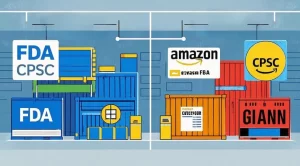
●FDA (U.S. Food and Drug Administration): If your goods involve food, health products, cosmetics or medical devices, the warehouse must meet FDA storage standards.
●CPSC (U.S. Consumer Product Safety Commission): All consumer products entering the U.S. market must meet CPSC safety standards, or they may be seized, recalled or even face hefty fines.
● Amazon FBA Requirements: if you plan to send goods to Amazon FBA warehouses, overseas warehouses must comply with Amazon’s storage and packaging requirements or they may be rejected.
Case in point:
A seller sells health care products in the US market, but ended up choosing an overseas warehouse that doesn’t meet FDA standards, resulting in the goods being stopped during customs clearance, and in the end, not only did they pay a high fine, but also lost a large amount of inventory. European Market
The European market has more stringent legal requirements, mainly related to environmental protection, customs clearance and compliant storage standards:
●EPR (Extended Producer Responsibility): If your product involves packaging, electronics, batteries, etc., you must register for EPR in Germany, France, and other countries, or you may be banned.
●WEEE (Waste Electrical and Electronic Equipment Directive): If you sell electronic products, you must comply with WEEE regulations to ensure that your products are recyclable, or you may face environmental taxes.
●VAT Compliance: Some European countries require sellers to pay Value Added Tax (VAT), if the overseas warehouse can’t provide compliant VAT service, your store may face the risk of financial review or even blocking.
Customs clearance transparency
Customs clearance is the most problematic aspect of cross-border e-commerce. Some overseas warehouses in order to grab customers, will play the banner of “low-cost customs clearance”, in fact, the use of “gray customs clearance” mode.
Gray customs clearance, that is, through the non-compliance of the way to let the goods into the country, it seems to be able to save tariffs and time, but in fact, the risk is very high, once checked, the consequences are far more serious than the savings of the money.
For example, some overseas warehouses will be in the clearance of low declaration of the value of goods, that is, a 50 U.S. dollars of goods falsely declared as 10 U.S. dollars, tariffs will naturally be less. But the problem is that the customs is not a fool, once the inspection found that the value of the goods is false, the light is to pay the tax, the heavy is directly fined, detained goods, and even affect your customs clearance credit, resulting in the future of the goods are “special care”, increase the probability of inspection, the risk of exponential growth.
There are also some warehouses will conceal or incorrectly declared product categories, such as in order to avoid taxes, electronic products reported as ordinary plastic products, or branded goods disguised as unbranded products, in an attempt to muddle through. However, once the Customs and Excise Department finds out the discrepancy between the physical goods and the declared information, the lightest consequence will be the return of the goods, and the seriousness will even lead to the confiscation of the goods, and the seller will lose all his money, and may even be involved in the legal responsibility.
More dangerous is the use of non-compliant agent customs clearance company. Some logistics companies use the guise of “no tax clearance” to attract sellers to take “special channels”, promising low-cost, fast customs clearance. But this way is often the use of loopholes in the operation, the long term is extremely unstable, once a link out of the problem, such as policy tightening, the channel is blocked, all the goods to go this way will be seized, the seller is not only the loss of goods, but also may be traced back to the responsibility.
Therefore, gray customs clearance is not a “smart way to avoid taxes”, but a time bomb, short-term seems to save money, long-term may destroy the entire business. Although the cost of complying with customs clearance is a little higher, but it can make your business grow steadily and avoid unnecessary losses. For cross-border sellers, choose an overseas warehouse must ensure that the customs clearance process is transparent, formal, traceable, do not let yourself fall into the “low price trap”, and finally lost a wife and soldiers.
Case:
Some sellers use “low-cost customs clearance” overseas warehouse, initially think the tariff is cheap, logistics is fast, but then the customs began to scrutinize, the result is that all the goods were seized, and ultimately had to pay a high fine to get back the goods, the loss is not worth it.
How to judge the transparency of customs clearance?
1. Can the overseas warehouse provide formal customs clearance documents?
Is the tariff calculation clear?
Can you provide customs declaration records?
Can you provide formal import certificates?
2. Are the charges clear? Are there any hidden fees?
Is there a “low declaration” option? If there is, it may be playing with gray customs clearance.
Is the fee structure transparent? Some overseas warehouses will suddenly charge extra fees of various unknown names after customs clearance.
3. Does it have any experience in complying with customs clearance?
Is there any case of successful operation of Amazon FBA, European EPR, FDA compliant goods?
Is there any long-term cooperation with a compliant customs clearance agent, rather than a temporary patchwork of customs clearance channels?
Logistics network
When choosing overseas warehouse, many service providers will use “global coverage of 100+ countries” as a slogan to attract sellers. But the reality is that your target customers are really all over the world? Wider coverage, if the delivery time can not keep up, it does not make any sense.
For cross-border e-commerce, the real competitiveness of the overseas warehouse is not “how many countries can be sent”, but in your core market, can you quickly and accurately to the hands of buyers.
Overseas warehouse location is not randomly selected, it directly determines the delivery speed and logistics costs. If you choose well, the order can be delivered quickly, the buyer experience will be improved, and the return rate will be reduced; if you choose poorly, the delivery will be slow, the logistics will be expensive, and it will even affect your store rating.
US market: warehouse location determines timeliness
If your main market is in the United States, the location of your overseas warehouse is crucial. The United States is a vast country with a complex logistics network, and a reasonable choice of warehouse location can get your orders to buyers faster and cheaper.
Close to Amazon FBA warehouse (e.g., ONT8)
If your business involves FBA replenishment, choose an overseas warehouse close to the FBA hub, you can replenish the goods faster, avoid inventory breaks, and even seize the “same day delivery” or “next day delivery” traffic. For example, **ONT8 (Ontario Warehouse) in California** is one of the most important FBA warehouses of Amazon, and nearby overseas warehouses can greatly improve distribution efficiency.
Proximity to major city logistics centers
Major logistics hub cities in the United States include Los Angeles, Chicago, New York, Dallas, and so on. If your overseas warehouse is close to the logistics centers in these cities, the timeframe for shipping to all over the United States will be faster. In contrast, if you choose a warehouse in a remote area, you may not be able to deliver the goods for 5-7 days, and the customer experience will be seriously affected.
Cross-border direct mail vs. local delivery
If the overseas warehouse has a local courier partner (e.g. UPS, FedEx, USPS), it can ensure faster delivery time, reduce transportation costs and improve buyer satisfaction. For example, some warehouses can directly interface with Amazon Buy with Prime, so that your self-shipment orders can also enjoy FBA-level logistics experience.
Data-driven screening
Many sellers choose overseas warehouses, is a “one-time decision”, selected and no longer care. But the problem is that the market is changing, logistics costs are changing, warehousing costs are changing, if you do not optimize your warehousing solutions, profits may be a little bit eaten.
You may think the warehouse “looks good”, but really decide whether it is good or not, is the data, not the feeling. If your overseas warehouse delivery is slow, the delivery rate is low, the inventory backlog is serious, then no matter how low the offer, the actual cost will continue to rise, and even affect the overall operation.
Signing rate is the core indicator for judging the ability of the warehouse to deliver tailgate, which should be above 98% under normal circumstances. If it is lower than this standard, it means that there may be problems in tailgate logistics, such as the instability of the cooperating courier provider or the loopholes in the address matching system, resulting in an increase in the delivery failure rate. Buyers can not receive the goods, direct refund complaints, return costs and platform rating both damaged.
Delivery time determines the customer experience, especially in the competitive market, delivery speed directly affects the repurchase rate and store praise. The reasonable delivery time of the U.S. domestic warehouse is less than 3 days, more than 5 days is considered slow, the customer waits impatiently, the order cancellation rate and refund rate will increase. The European market is relatively complex, the general delivery time should be controlled in 5-7 days, more than 10 days of overseas warehouse can be eliminated, otherwise customer satisfaction will decline significantly.
Inventory turnover rate reflects the inventory flow of the warehouse, if the inventory has not been turned more than 4 times a year, it means that your inventory backlog is too much, the funds are occupied for a long time, and you may also be charged a high long-term storage fee by the overseas warehouse. In the long run, this not only increases operating costs, but also reduces the efficiency of capital utilization and affects overall profitability.

The core of choosing an overseas warehouse is to balance cost, efficiency and risk. An excellent overseas warehouse not only reduces operating costs, but also improves shipping efficiency and helps sellers seize the market advantage. Systematic management and data screening are the key to cross-border sellers to improve warehouse operation.
Choosing an overseas warehouse is not only about cost control, but also the key to order fulfillment efficiency and customer satisfaction. A good overseas warehouse not only reduces storage and distribution costs, but also improves logistics efficiency, reduces returns and bad reviews, and makes your cross-border business more efficient and stable.
DropSure: Efficient Delivery for Global Expansion
DropSure has multiple overseas warehouses in Germany and the United States covering core markets in Europe and North America, ensuring that your orders are delivered quickly and accurately to your target customers. Whether you are selling on Amazon, independent sites or multi-channel, DropSure can provide you with intelligent inventory management, compliant customs clearance, and flexible logistics solutions to make your supply chain more stable and your operations easier.

Advantage of German warehouse: applicable to European market, meet the requirements of EPR, WEEE and other regulations, able to efficiently deliver to France, the Netherlands, Belgium, the Czech Republic and other countries.
U.S. warehouse advantage: covering the whole U.S., close to Amazon FBA hubs (e.g., ONT8), supporting local distribution, and utilizing logistics channels such as UPS, FedEx, USPS, etc., to improve the delivery rate and customer satisfaction.

In the highly competitive cross-border e-commerce market, choosing the right overseas warehouse is choosing the right future. If you want to reduce operating costs and improve distribution efficiency, DropSure’s overseas warehouse network will be your trustworthy choice. Letting data drive warehousing decisions and intelligent systems optimize inventory management, DropSure helps you expand your global business easily and seize more market opportunities.