En
En
 10 min read
Facebook advertising remains one of the most powerful digital marketing tools available today. With billions of active users across Facebook, Instagram, Messenger, and the broader Meta ecosystem, businesses of all sizes can reach highly targeted audiences, generate qualified leads, increase online sales, and build long-term brand awareness.
Yet despite the platform’s advanced targeting capabilities and sophisticated optimization algorithms, many advertisers fail to achieve the results they expect.
The reason is rarely the platform itself.
More often, poor campaign performance stems from avoidable mistakes in strategy, audience targeting, creative development, budget allocation, campaign optimization, or performance analysis.
Many businesses assume that running Facebook ads is as simple as launching a campaign and waiting for conversions. In reality, successful Facebook advertising requires careful planning, testing, data interpretation, and continuous refinement.
Whether you’re a small business owner, an eCommerce entrepreneur, a marketing manager, or a digital advertising professional, understanding these common mistakes can help you improve campaign performance and maximize your return on investment.
Let’s explore the 10 most common Facebook advertising mistakes and learn how to avoid them.
Mistake #1: Choosing the Wrong Campaign Objective
One of the most damaging mistakes occurs before an ad is even launched.
Many advertisers select campaign objectives based on what sounds attractive rather than what aligns with their actual business goals.
Facebook’s algorithm optimizes delivery according to the objective you choose.
Common objectives include:
- Brand Awareness
- Reach
- Traffic
- Engagement
- Leads
- App Promotion
- Sales
For example, if your goal is online purchases but you select a Traffic campaign, Facebook will prioritize users who frequently click links—not necessarily those who make purchases.
As a result:
- Click-through rates may look good.
- Conversion rates remain poor.
- Advertising costs increase.
Best Practice
Always choose the campaign objective that directly reflects your desired outcome.
If sales are your goal, use a Sales campaign.
If lead generation is your goal, use a Leads campaign.
Allow Meta’s algorithm to optimize toward the action that matters most.
Mistake #2: Targeting an Audience That Is Too Broad or Too Narrow
Audience targeting plays a major role in campaign success.
Many advertisers make one of two mistakes:
Targeting Too Broad
Some advertisers attempt to reach everyone.
The result:
- Lower relevance
- Wasted budget
- Poor engagement
Targeting Too Narrow
Others create highly restrictive audiences.
This can lead to:
- Limited delivery
- Higher CPMs
- Audience fatigue
- Slower learning phases
Best Practice
Focus on balanced audience sizes.
Combine:
- Demographics
- Interests
- Behaviors
- Custom audiences
- Lookalike audiences
Allow Facebook’s machine learning system enough data to optimize effectively.
Mistake #3: Ignoring the Facebook Pixel and Conversion Tracking
Many businesses launch campaigns without properly configuring tracking systems.
This is similar to driving a car with a covered windshield.
Without accurate tracking, advertisers cannot determine:
- Which ads generate sales
- Which audiences convert best
- Which campaigns deserve additional budget
Common tracking issues include:
- Missing pixel installation
- Duplicate events
- Incorrect event prioritization
- Broken tracking parameters
Best Practice
Install and verify:
- Meta Pixel
- Conversion API
- Standard events
- Custom conversions
Accurate data is the foundation of effective optimization.
Mistake #4: Focusing Only on Ad Clicks
A high click-through rate does not automatically indicate success.
Many advertisers celebrate large amounts of traffic while ignoring actual business outcomes.
For example:
An ad may generate:
- Thousands of clicks
- Strong engagement
- Low CPC
Yet produce very few purchases.
Why?
Because clicks alone don’t pay the bills.
Important Metrics to Monitor
Focus on:
- Cost per acquisition (CPA)
- Return on ad spend (ROAS)
- Conversion rate
- Revenue generated
- Customer lifetime value
The ultimate goal is profitability, not vanity metrics.
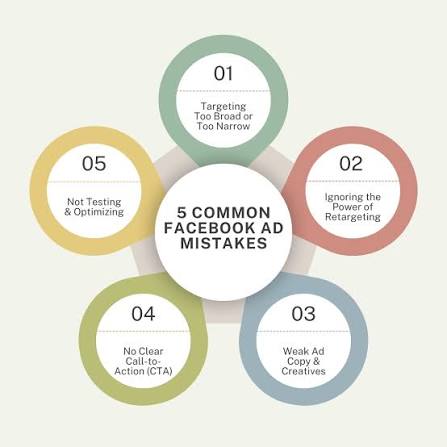
Mistake #5: Using Weak Ad Creative
Creative quality is often the biggest performance driver in Facebook advertising.
Many businesses spend weeks refining audience targeting while investing very little effort into creative development.
Common creative mistakes include:
- Generic stock photos
- Poor-quality videos
- Weak headlines
- Unclear value propositions
- Lack of differentiation
Users scroll through enormous amounts of content daily.
Your ad has only seconds to capture attention.
Best Practice
Create visuals that:
- Stop the scroll
- Communicate benefits quickly
- Highlight customer pain points
- Demonstrate solutions
Strong creative often outperforms perfect targeting.
Mistake #6: Sending Traffic to a Poor Landing Page
Even excellent ads cannot compensate for a poor website experience.
Many advertisers blame Facebook when the real issue lies on the landing page.
Common landing page problems include:
- Slow loading speeds
- Confusing layouts
- Weak calls-to-action
- Mobile usability issues
- Lack of trust signals
Every additional second of load time can significantly reduce conversion rates.
Best Practice
Optimize landing pages for:
- Mobile users
- Fast loading speeds
- Clear messaging
- Simple navigation
- Easy checkout processes
Your ad and landing page should work together as a single conversion system.
Mistake #7: Giving Up Too Quickly
One of the most expensive mistakes is shutting down campaigns before sufficient data has accumulated.
Facebook’s algorithm requires time to learn.
During the learning phase, performance often fluctuates.
Advertisers frequently make decisions based on:
- One day of results
- Limited impressions
- Incomplete conversion data
This prevents campaigns from reaching their full potential.
Best Practice
Allow campaigns enough time to gather meaningful data before making major adjustments.
Avoid reacting emotionally to short-term fluctuations.
Successful advertising requires patience and data-driven decision-making.
Mistake #8: Constantly Editing Active Campaigns
Many advertisers continuously modify campaigns.
They change:
- Budgets
- Audiences
- Creatives
- Placements
- Optimization settings
sometimes multiple times per day.
Frequent edits can reset Facebook’s learning process and disrupt performance.
Best Practice
Implement changes strategically.
Allow the algorithm time to stabilize before introducing additional modifications.
A structured testing process produces better long-term results than constant intervention.
Mistake #9: Neglecting Retargeting Campaigns
Most website visitors do not convert on their first visit.
In fact, many purchasing decisions require multiple interactions.
Yet countless advertisers focus exclusively on cold audiences while ignoring retargeting opportunities.
This leaves significant revenue untapped.
Effective Retargeting Audiences
Consider targeting:
- Website visitors
- Product page viewers
- Cart abandoners
- Video viewers
- Email subscribers
- Previous customers
Retargeting campaigns often generate some of the highest returns in Facebook advertising.
Best Practice
Develop a complete customer journey that includes:
- Awareness campaigns
- Consideration campaigns
- Retargeting campaigns
- Customer retention campaigns
Mistake #10: Treating Facebook Ads as a “Set It and Forget It” System
Perhaps the most common misconception is that Facebook advertising can run on autopilot indefinitely.
Digital advertising environments constantly change.
Factors influencing performance include:
- Audience behavior
- Market competition
- Seasonal demand
- Creative fatigue
- Platform updates
Even successful campaigns eventually require optimization.
Best Practice
Monitor:
- Frequency
- Audience saturation
- Creative performance
- Conversion trends
- Cost metrics
Continuous improvement is essential for long-term profitability.
Bonus Mistake: Ignoring Mobile Users
A significant percentage of Facebook traffic comes from mobile devices.
Yet many advertisers still design campaigns primarily for desktop users.
This creates several issues:
- Poor user experience
- Reduced engagement
- Lower conversion rates
Mobile Optimization Checklist
Ensure:
- Mobile-friendly landing pages
- Fast loading times
- Vertical video formats
- Readable text
- Simple forms
Mobile optimization should never be an afterthought.
Bonus Mistake: Copying Competitors Without Understanding Their Strategy
Many businesses see a competitor’s successful ad and immediately attempt to replicate it.
However, effective advertising depends on factors beyond creative design.
Success may be influenced by:
- Audience segmentation
- Offer structure
- Customer data
- Retargeting funnels
- Brand positioning
Blind imitation rarely produces identical results.
Best Practice
Study competitors for inspiration, but build campaigns around your unique value proposition.
How to Build a Strong Facebook Advertising Strategy
Avoiding mistakes is important, but success requires a complete strategy.
A well-structured Facebook advertising framework typically includes:
Audience Research
Understand:
- Customer needs
- Pain points
- Buying behaviors
- Interests
Creative Testing
Develop multiple:
- Images
- Videos
- Headlines
- Ad copies
Testing reveals what resonates with your audience.
Funnel Development
Guide users through:
- Awareness
- Consideration
- Conversion
- Retention
Conversion Tracking
Measure:
- Leads
- Purchases
- Revenue
- Customer value
Optimization
Analyze data regularly and refine campaigns based on actual performance.
Key Metrics Every Advertiser Should Monitor
Successful Facebook advertisers track more than just clicks.
Important metrics include:
CPM (Cost Per Thousand Impressions)
Measures advertising efficiency.
CTR (Click-Through Rate)
Evaluates ad engagement.
CPC (Cost Per Click)
Measures traffic acquisition cost.
Conversion Rate
Tracks landing page effectiveness.
CPA (Cost Per Acquisition)
Measures customer acquisition efficiency.
ROAS (Return on Ad Spend)
Evaluates profitability.
Frequency
Identifies audience fatigue.
Monitoring these metrics provides a comprehensive view of campaign health.
The Future of Facebook Advertising
The Facebook advertising landscape continues to evolve.
Emerging trends include:
- AI-powered campaign optimization
- Automated creative generation
- Advanced audience modeling
- Privacy-focused measurement
- First-party data strategies
- Enhanced Conversion API adoption
Advertisers who embrace these developments will be better positioned for long-term success.
Conclusion
Facebook advertising offers tremendous opportunities for businesses seeking growth, but success rarely comes from simply launching a campaign and hoping for the best. The most effective advertisers understand that strong performance depends on strategic planning, accurate tracking, compelling creative, audience insights, continuous testing, and disciplined optimization.
The ten mistakes discussed in this article—from selecting the wrong campaign objective and neglecting conversion tracking to ignoring retargeting and making constant campaign edits—are among the most common reasons businesses struggle to achieve profitable results.
The good news is that these mistakes are entirely avoidable.
By focusing on the right objectives, leveraging accurate data, creating high-quality ad creatives, optimizing landing pages, and adopting a long-term testing mindset, advertisers can dramatically improve campaign performance and generate more consistent returns.
So take a closer look at your current Facebook advertising strategy.
How many of these mistakes are you making today?
Identifying and correcting even a few of them could be the difference between a campaign that burns through budget and one that becomes a reliable engine for business growth.