














 En
En
 9 min read
Deepseek is an insanely powerful AI tool that has taken the tech world by storm, even wiping out $600 billion from Nvidia’s market value overnight!
But that’s not all—it might just change the game for dropshipping.
In this article, I’ll show you how to leverage deepseek to optimize your dropshipping store, enhance product listings, and implement AI-driven strategies to boost conversions.
Most importantly, stay until the end because I’ll reveal a groundbreaking technique—deepseek can fully analyze your store and provide personalized growth recommendations!
Ready? Let’s unlock the power of this revolutionary AI together!
What Exactly Is Deepseek?
If you’ve ever run a dropshipping store, you know how overwhelming the operations can be—product selection, optimizing listings, running ads, increasing conversions… Every step demands time and effort.
That’s where Deepseek comes in!
This free AI chat assistant acts as your personal smart assistant, automating repetitive tasks, saving you time, and boosting efficiency. With Deepseek, running your dropshipping business becomes easier and more streamlined than ever!
Core Advantages of Deepseek
1.Advanced reasoning and analytical capabilities – Deepseek deeply understands your business needs and provides targeted solutions.
2.Real-time web search – Instantly access the latest market trends, hot products, and ad strategies to stay ahead of the competition.
3.Completely free – Yet its performance rivals expensive premium AI tools.
How to Use Deepseek to Improve Your Operations?
Step 1: Create an Account
● Simply sign up using your Google account—it takes just a few seconds.
● Once you’re in, click “Start Now”, and you’re ready to go!
Step 2: Let Deepseek Help You Choose a Store Name
Many dropshipping sellers struggle with one big question: How do I pick the perfect store name?
No worries! Deepseek can generate the best store name based on your products, market positioning, or business model—helping you create a name that stands out!
Examples:
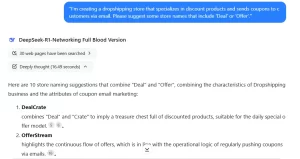
Discount & Promo Store
Input:
“I’m creating a dropshipping store that specializes in discount products and sends coupons to customers via email. Please suggest some store names that include ‘Deal’ or ‘Offer’.”
Electronics & Tech Store
Input:
“My store sells high-tech electronics like wireless earbuds and smartwatches. I want a name that sounds modern and tech-savvy.”

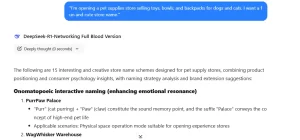
Pet Supplies Store
Input:
“I’m opening a pet supplies store selling toys, bowls, and backpacks for dogs and cats. I want a fun and cute store name.”
Fitness & Wellness Store
Input:
“My store specializes in yoga mats, fitness gear, and wellness products. I want a name that reflects energy and health.”
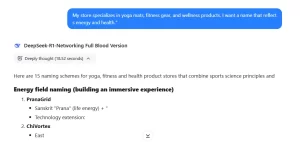
Conclusion
● Enter your brand positioning (main products, target market, and preferred style).
● Let Deepseek generate multiple name options and pick the one that best fits your brand identity.
● Check domain availability (using services like GoDaddy or Namecheap) to ensure your store name can be registered as a domain.
Start your store with the perfect name today.
Step 3: Use Deepseek for Product Research and Discover 2025’s Emerging Markets
Product selection is the key to dropshipping success. Pick the right product, and your sales can skyrocket. Pick the wrong one, and you might not even recover your ad spend.
This is where Deepseek comes in. It helps you quickly identify 2025’s most promising niche markets, ensuring you stay ahead of the competition instead of falling behind.
How to Use Deepseek to Discover Profitable Niches
● Open Deepseek and enter the following prompt:
“I want to add new products to my Shopify store. Please list 10 high-potential, unsaturated markets for 2025 that have strong social influence on TikTok and Instagram.”
● Click the search button, and Deepseek will analyze the latest market trends and social media datato pinpoint the hottest, yet untapped, product markets.
By leveraging AI-driven insights, you can secure winning products before the competition catches on!
Example:
Let’s say Deepseek suggests the niche “Cable Organizers” as a trending market for 2025. You might not have considered this product before, but after analyzing the data, you realize it’s a high-demand, low-competition opportunity.
Now, follow these steps to validate whether it’s worth selling:
● Step 1:Search “Cable Organizer”on Zik Analytics to check Shopify sales data.
● Step 2: You find that a similar product sold 107 units in the past 30 days at $9.95 each, proving strong market demand.
● Step 3: Source the same product on AliExpress for just $4.21, ensuring low cost and high profit margins.
● Step 4: If you price it at $19.95, after Shopify fees, you’ll earn around $14 per order.
● Step 5: This store made nearly $1,500 in 30 days from just one product—with potentially low ad costs.
By using Deepseek to identify emerging trends early, you can seize profitable opportunities before they become oversaturated!
Step 4: Use AI to Generate High-Converting Product Descriptions
Not great at writing product descriptions? No problem! Deepseek can instantly create high-quality, engaging descriptions for your Shopify store.
Example:
You can enter the following prompt into Deepseek:
“I will send the raw product details from the supplier’s website. Please rewrite it into a Shopify-friendly, user-friendly product description.”
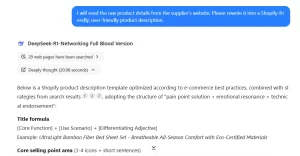
Then, copy and paste the supplier’s product details into Deepseek, and within seconds, it will generate a polished, high-converting product description. It can even add emoji to make the content more engaging!
Customize Your Descriptions Further
Want to fine-tune the AI’s output? Simply ask Deepseek to:
● Shorten the description
● Refine the wording
● Match your brand’s tone
With AI-generated copy, you can create professional, conversion-optimized product descriptions in seconds—no writing skills required!
Step 5: Social Media Marketing + AI-Generated Content
How to Find the Best Social Media Platform for Your Brand?
● Step 1: Search for your niche (e.g., “Yoga Products”) in Zik Analytics.
● Step 2: Identify successful Shopify stores in your market.
● Step 3: Analyze their social media strategy—Are they running ads on Facebook/Instagram? How active are their TikTok and Instagram accounts?
Once you find high-engagement competitor content, you can replicate and improve their strategy!
Example:
Let’s say you find a high-engagement Instagram post about “Ultimate Fat-Burning Yoga Workouts”. You can use Deepseek to generate a similar post for your own product.
Simply enter:
“I found a highly engaging Instagram post about ‘Ultimate Fat-Burning Yoga Workouts.’ Please generate a similar Instagram Reels post for an oversized green yoga mat in the same style.”

Deepseek will instantly create a high-converting post, mimicking the style of trending content—while keeping it unique to your brand!
Step 6: Use Deepseek to Optimize Your Shopify Store
So, you’ve launched your Shopify store, picked the right products, and even started running ads. But the conversion rate isn’t great?
This could be due to user experience issues, such as:
● Slow loading speeds
● A complicated checkout process
● Unattractive or unoptimized page design
If you’re unsure what needs improvement, Deepseek can analyze your Shopify store and provide specific optimization recommendations to make it more professional, efficient, and conversion-friendly.
How to Optimize Your Store with Deepseek
1.Open Deepseek and enter the following prompt:
“Please check this Shopify store and tell me how to optimize the user experience:”
2.Enter your Shopify store URL
3,Enable Deep Think (R1) Mode
4,Let Deepseek scan your store and generate personalized improvement suggestions
With AI-powered insights, you can fine-tune your store’s performance, fix weak points, and ultimately boost your sales!
Example:
Input in deepseek:
“Please check this Shopify store and tell me how to optimize the user experience:”
(Enter your Shopify store URL)
Deepseek will scan your store and provide personalized optimization suggestions, such as:
● Page loading speed – Identify elements slowing down your site and recommend optimizations.
● Checkout process optimization – Simplify checkout to reduce cart abandonment.
● Mobile experience improvement – Ensure a smooth, responsive design for mobile users.
● Design and layout adjustments – Improve visuals and UI for better navigation and engagement.
With Deepseek’s AI-driven insights, you’ll know exactly what to improve—turning your store into a high-converting, user-friendly shopping experience!
Automate Dropshipping Business with DropSure
With Deepseek, you can quickly find winning products, optimize your store, generate high-converting copy, and create data-driven social media marketing strategies—all to boost your Shopify store’s conversion rate effortlessly.
But a successful dropshipping business isn’t just about AI-powered operations—it also needs a stable, efficient supply chain.
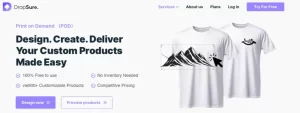
That’s where DropSure comes in.
As a dropshipping supply chain management platform, DropSure provides:
● Lower product costs to maximize profits
● Smarter logistics management for seamless order fulfillment
● Reliable inventory synchronization to prevent stockouts
By combining deepseek’s AI-driven automation with DropSure’s efficient supply chain solutions, you can build a fully automated, data-driven eCommerce business—one that’s smarter, more scalable, and more profitable.
Ready to take your dropshipping business to the next level? Start using deepseek + DropSure today!