














 En

 37 min read
You launch a new advertising campaign, and everything looks promising. Your ads attract attention, click-through rates are strong, purchases are coming in, and your return on ad spend (ROAS) is moving in the right direction. For a while, the campaign seems to run almost effortlessly.
Then performance begins to change.
Impressions continue to grow, but fewer people click. Cost per click increases. Conversion rates weaken. The same audience that previously responded enthusiastically to your ads starts scrolling past them. Your campaign may still generate sales, but the cost of acquiring each customer becomes increasingly difficult to justify.
This is a common challenge for ecommerce brands, direct-to-consumer businesses, and independent online stores: ad creative fatigue.
Creative fatigue occurs when an audience repeatedly encounters similar advertising content and gradually becomes less responsive to it. The message may still be relevant, the product may still be attractive, and the offer may still be competitive. However, the creative no longer captures enough attention or motivates enough action.
When this happens, ROAS can decline quickly.
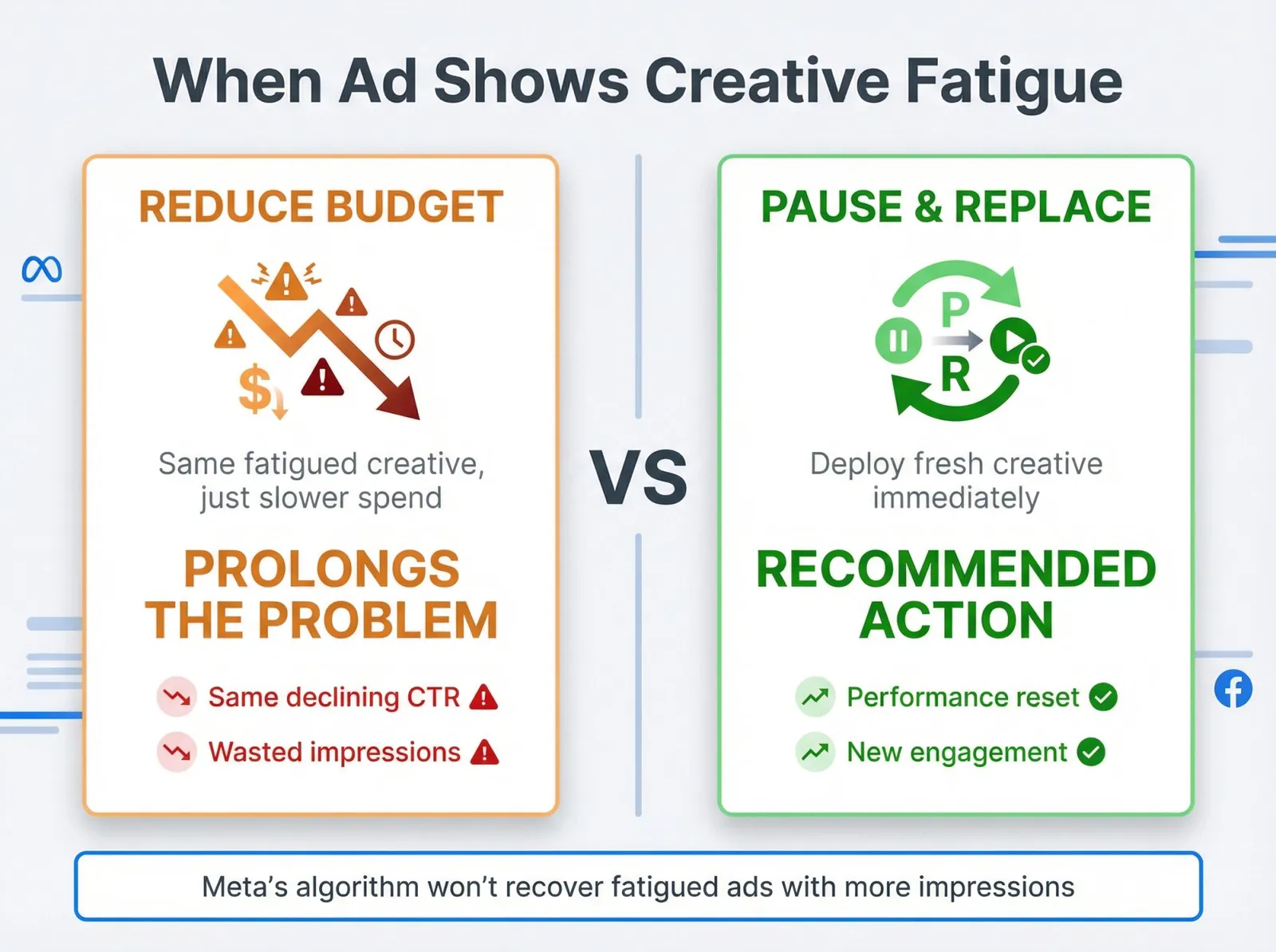
The solution is not simply to produce more advertisements or replace every image whenever performance drops. A more sustainable approach is to build a structured creative testing system that identifies what works, explains why it works, and turns those insights into new advertising concepts.
This guide explains how to recognize creative fatigue, understand its impact on ROAS, test advertising concepts systematically, and develop a repeatable creative optimization process that supports long-term growth.

1. What Is Ad Creative Fatigue?
Ad creative fatigue happens when an advertising audience becomes less responsive to a particular creative or group of similar creatives after repeated exposure.
It can affect almost any advertising format, including:
- Static product images.
- Lifestyle photography.
- Short-form videos.
- Product demonstrations.
- User-generated content (UGC).
- Testimonials and customer reviews.
- Carousel advertisements.
- Collection advertisements.
- Promotional graphics.
- Brand storytelling videos.
The most obvious sign is declining engagement. However, creative fatigue does not always begin with a dramatic drop in clicks or purchases.
Sometimes, the first warning is a gradual decrease in click-through rate. In other cases, impressions become more expensive, video engagement weakens, or conversion performance declines even though traffic remains relatively stable.
Why Does Creative Fatigue Happen?
People naturally become less attentive to advertising they have already seen.
When users encounter the same product image, headline, opening video scene, or promotional message repeatedly, the content becomes familiar. It loses its ability to interrupt their browsing experience.
This is especially important on social platforms, where users scroll quickly through large volumes of content.
An advertisement must compete not only with other brands but also with entertainment, personal updates, creator content, news, and everyday conversations.
If the same creative appears too frequently without offering a new reason to pay attention, users may begin ignoring it.
Creative fatigue can also develop when an advertiser continues targeting the same audience with nearly identical messages.
For example, a home improvement brand may repeatedly show a product against the same white background, using the same headline and discount message. Even if the product solves a genuine customer problem, the audience eventually becomes familiar with the presentation.
The product has not necessarily lost its value. The advertising approach has lost some of its effectiveness.
Creative Fatigue Is Not the Same as Product Fatigue
It is important to distinguish between creative fatigue and declining product demand.
Creative fatigue means the advertisement is becoming less effective at attracting or converting attention.
Product fatigue means the audience may be losing interest in the product itself, or the product may no longer match current demand.
These situations require different solutions.
If the product remains attractive but the advertisement is underperforming, a new creative angle may restore engagement.
If demand is declining because of seasonality, competition, pricing, or changing customer preferences, new images alone may not solve the problem.
Before replacing advertisements, identify what is actually weakening.
2. How Creative Fatigue Causes ROAS to Drop
ROAS measures the revenue attributed to advertising relative to advertising spend.
The basic formula is:
ROAS = Attributed Revenue ÷ Advertising Spend
For example, if a campaign spends $1,000 and generates $4,000 in attributed purchase revenue, its ROAS is 4.0.
When creative fatigue reduces advertising effectiveness, the campaign may generate fewer purchases for the same amount of spending.
Several performance indicators can deteriorate together.
1. Lower Click-Through Rate
Click-through rate (CTR) measures how often people click after seeing an advertisement.
When an audience becomes familiar with a creative, fewer users may feel motivated to click.
A declining CTR can indicate that the advertisement is losing its ability to attract attention.
However, CTR should not be evaluated in isolation. Different campaign objectives, placements, and audience segments can produce different click behavior.
A high CTR does not automatically mean that an advertisement generates profitable purchases.
2. Higher Cost Per Click
If fewer people respond to an advertisement, the campaign may need to spend more to generate the same number of clicks.
Cost per click (CPC) can increase because of declining engagement, auction competition, changes in audience quality, or placement differences.
Creative fatigue is one possible contributor, but it should not be assumed to be the only explanation.
3. Lower Conversion Rate
Even when people continue clicking, they may become less interested in the advertising message.
For example, a user may click because a discount headline catches their attention but leave after discovering that the product does not match their expectations.
If an advertisement repeatedly emphasizes the same feature without addressing other customer concerns, it may attract less qualified traffic over time.
Conversion rate can therefore decline when the creative no longer communicates a compelling reason to purchase.
4. Higher Customer Acquisition Cost
Customer acquisition cost (CAC) measures how much a business spends to acquire a customer.
When the same advertising budget produces fewer purchases, acquisition costs increase.
This can reduce profitability, especially for businesses with narrow margins or high fulfillment expenses.
5. Declining ROAS
ROAS may fall because of lower click volume, weaker conversion rates, higher advertising costs, or changes in purchase value.
For ecommerce businesses, the most useful analysis should focus on actual purchase performance rather than treating every platform-reported conversion action as equally valuable.
Add-to-cart events, checkout initiations, and completed purchases represent different stages of the customer journey. They should not be combined and interpreted as though they all represent revenue.
A campaign that generates many cart additions but few completed purchases may look active while delivering poor commercial results.
For a more accurate evaluation, track purchases, purchase revenue, ROAS, and relevant profitability indicators separately.
3. Seven Warning Signs That Your Ad Creatives Are Becoming Fatigued
Creative fatigue is easier to manage when it is identified early.
Instead of waiting until ROAS collapses, monitor several indicators together.
Warning Sign 1: CTR Declines Over Time
A gradual decline in CTR can suggest that an advertisement is losing its appeal.
Compare the creative’s recent performance with its earlier performance under similar conditions.
For example, if an advertisement consistently generated strong engagement during its first two weeks but begins attracting fewer clicks afterward, investigate whether repeated exposure is contributing to the change.
Avoid comparing periods with very different audience sizes, placements, budgets, or seasonal conditions.
Warning Sign 2: Frequency Increases While Engagement Weakens
Frequency represents the average number of times a person in the selected audience has been exposed to an advertisement during a given period.
Higher frequency is not automatically bad. Some purchases require multiple exposures before customers feel ready to buy.
However, increasing frequency combined with declining CTR and purchase performance can be a warning sign.
The important question is not whether frequency has reached a universal threshold. There is no single number that defines creative fatigue for every business.
Instead, evaluate frequency relative to your own campaign history and audience behavior.
Warning Sign 3: CPC Continues Rising
A rising CPC can indicate that an advertisement is becoming less competitive in the auction or that users are responding less frequently.
Check whether the increase is associated with declining engagement or whether it reflects broader auction competition.
If CPC rises while CTR falls, the creative deserves closer attention.
Warning Sign 4: Purchase Volume Falls Despite Similar Spending
If spending remains relatively stable but completed purchases decline, investigate the entire advertising funnel.
Look at:
- Impressions.
- Reach.
- Frequency.
- CTR.
- CPC.
- Landing page sessions.
- Add-to-cart events.
- Checkout initiations.
- Completed purchases.
- Purchase conversion rate.
- Purchase revenue.
- ROAS.
This helps determine whether the problem begins with the creative, traffic quality, website experience, or checkout process.
Warning Sign 5: Video Engagement Weakens
For video advertisements, watch for declining performance in the opening seconds.
A weak opening can prevent users from reaching the product demonstration, key benefit, or offer.
Compare hook retention, average watch time, completion rates, and click behavior where available.
If users repeatedly leave before the main message appears, the creative may need a stronger opening or a clearer structure.
Warning Sign 6: Existing Audiences Respond Less Than Before
A creative may continue working for new audiences while becoming less effective among people who have already seen it several times.
Compare performance across prospecting and retargeting groups.
However, remember that these audiences have different levels of purchase intent. Their performance should not be compared without considering their roles in the funnel.
Warning Sign 7: New Creatives Outperform the Existing Winner
A new creative that consistently generates more purchases or stronger ROAS under comparable conditions may indicate that the old creative is losing effectiveness.
Do not immediately declare a winner based on a few conversions.
Allow enough time and spending for meaningful evaluation, especially when purchase volume is low.
4. Identify the Real Cause Before Replacing Your Ads
A decline in ROAS does not always mean creative fatigue.
Replacing advertisements without understanding the underlying problem can waste production resources and disrupt campaigns that are otherwise healthy.
A structured diagnosis should examine five areas.
1. Creative Performance
Check whether engagement indicators have weakened.
Questions to ask:
- Has CTR declined?
- Has frequency increased?
- Are users watching less of the video?
- Are comments or interactions changing?
- Are several similar creatives declining at the same time?
If the answer to several questions is yes, creative fatigue becomes a stronger possibility.
2. Audience Quality
An advertisement may perform poorly because it is reaching people who are less likely to purchase.
Check whether audience targeting, expansion settings, exclusions, and geographic distribution have changed.
A campaign that gradually reaches less relevant users may experience declining conversion rates even if the creative itself remains effective.
3. Landing Page Performance
Sometimes the advertisement continues attracting clicks, but the website fails to convert them.
Check:
- Page loading speed.
- Mobile usability.
- Product availability.
- Pricing clarity.
- Shipping costs.
- Return policies.
- Product images.
- Customer reviews.
- Checkout functionality.
If CTR remains stable but purchase conversion rate declines, investigate the landing page before assuming that the advertisement is fatigued.
4. Offer and Pricing
An advertisement may lose effectiveness because the market has changed.
Competitors may introduce better offers, shipping costs may increase, or customers may become more price-sensitive.
A creative refresh can help communicate product value, but it cannot always compensate for an uncompetitive offer.
5. Seasonality and External Competition
Demand changes throughout the year.
For example, winter products may experience strong demand during the beginning of the season but weaker demand after the main purchasing period.
Auction competition can also increase during major shopping events.
Compare campaign performance with previous periods and consider changes in market demand before making major creative decisions.
5. Build a Sustainable Creative Testing Framework
The most effective way to prevent repeated creative fatigue is to establish a continuous testing system.
Instead of creating advertisements only when performance declines, maintain a steady pipeline of new concepts, variations, and proven winners.
A practical framework has six stages:
- Research customer motivations.
- Develop distinct creative concepts.
- Produce controlled variations.
- Test with appropriate budgets.
- Evaluate purchase performance.
- Turn winning insights into new creative ideas.
Each stage should produce information that improves the next one.
Stage 1: Research Customer Motivations
Strong advertisements begin with a clear understanding of why customers buy.
Do not start by asking, “What image should we create?”
Start by asking, “What problem is the customer trying to solve, and what would make the product worth purchasing?”
Useful research sources include:
- Customer reviews.
- Product questions.
- Customer service conversations.
- Social media comments.
- Competitor reviews.
- Search queries.
- Post-purchase surveys.
- Return and refund reasons.
- Sales team feedback.
Look for recurring themes.
For example, customers buying cellular window shades may care about insulation, privacy, light control, appearance, installation, and long-term maintenance.
These motivations can become separate advertising angles.
One creative may focus on keeping rooms comfortable during winter. Another may demonstrate how the shades provide privacy. A third may explain how the cellular structure helps reduce heat transfer.
Each advertisement communicates a different reason to consider the same product.
This creates meaningful creative variety rather than simply changing the background color of an existing image.
Stage 2: Develop Distinct Creative Concepts
A creative concept is the central idea behind an advertisement.
It determines the problem being addressed, the benefit being emphasized, and the emotional or practical reason for taking action.
For example, a skincare brand might test:
- A problem-and-solution concept.
- A product ingredient explanation.
- A customer testimonial.
- A daily routine demonstration.
- A comparison with common alternatives.
- A limited-time promotional message.
These concepts are more meaningfully different than six advertisements using the same product photo with slightly different headlines.
A strong testing system explores different customer motivations, not just different visual designs.
Stage 3: Produce Multiple Variations
Once a concept shows promise, create variations to identify which presentation works best.
For example, a product demonstration concept could include:
- A short 10-second video.
- A 20-second demonstration.
- A static image showing the result.
- A carousel explaining the process.
- A UGC-style testimonial.
- A close-up product feature video.
Keep the central message consistent when testing execution variations.
This makes it easier to determine whether the difference in performance comes from the visual presentation, video structure, headline, or other creative element.
Stage 4: Test With Appropriate Budgets
Testing requires enough exposure and spending to produce useful information.
If an advertisement receives only a small number of impressions and no purchases, it is too early to conclude that the concept is ineffective.
However, spending should also be controlled.
Set testing budgets according to your average order value, target acquisition cost, conversion volume, and available resources.
Avoid distributing a small budget across too many advertisements.
For a low-volume ecommerce store, testing two or three distinct concepts at a time may produce more useful information than launching twenty advertisements simultaneously.
Stage 5: Evaluate Purchase Performance
Creative testing should ultimately support business results.
Review engagement indicators to understand why an advertisement attracts attention, but use completed purchases and purchase revenue to determine commercial value.
Important metrics include:
| Metric | What It Helps You Understand |
|---|---|
| CTR | Whether the creative attracts clicks |
| CPC | How much each click costs |
| Landing page conversion rate | Whether visitors become customers |
| Purchases | How many completed orders are generated |
| Purchase revenue | Revenue attributed to completed purchases |
| CPA | Cost per completed purchase |
| ROAS | Purchase revenue relative to ad spend |
| Average order value | Average revenue per order |
| Frequency | How often the audience sees the advertisement |
A creative with a high CTR but very few purchases may not be a strong winner.
Likewise, a creative with a lower CTR may still be valuable if it attracts highly qualified customers and generates profitable purchases.
Stage 6: Turn Winning Insights Into New Ideas
A successful advertisement should not be treated as a one-time discovery.
Analyze what made it work.
Was it the opening hook? The product demonstration? The customer testimonial? The price presentation? The problem being addressed?
Use the strongest elements as the foundation for new creative concepts.
For example, if a video demonstrating a product’s ease of installation generates strong purchase performance, test:
- A faster installation demonstration.
- A customer-led installation story.
- A step-by-step tutorial.
- A comparison of installation methods.
- A short video showing the finished result.
The goal is to preserve the winning insight while introducing enough novelty to maintain audience interest.
6. Use a Creative Testing Matrix Instead of Randomly Making Ads
A creative testing matrix helps organize ideas and prevents repeated testing of nearly identical advertisements.
You can structure the matrix around five dimensions:
- Audience motivation.
- Creative format.
- Opening hook.
- Core message.
- Call to action.
Consider a home furnishing brand selling insulating cellular shades.
| Testing Dimension | Example Variations |
|---|---|
| Customer motivation | Energy efficiency, privacy, comfort, appearance |
| Format | Static image, UGC video, carousel, product demonstration |
| Opening hook | Winter problem, customer question, product reveal |
| Core message | Cellular structure, light control, room comfort |
| Call to action | Shop now, explore styles, get a quote |
The matrix makes it easier to create genuinely different advertisements.
For example, instead of producing five images that all say “Stay Comfortable This Winter,” the brand can test different customer motivations:
- “Cold air near your windows? Explore a smarter window covering option.”
- “Enjoy natural daylight without giving up daytime privacy.”
- “See how cellular construction helps create an insulating layer.”
- “Find a window covering style that works with your room.”
- “Make your winter home more comfortable with thoughtful window treatments.”
Each message appeals to a different reason for considering the product.
Prioritize Concepts Before Production
Not every idea deserves equal production resources.
Score creative concepts using criteria such as:
- Customer relevance.
- Product differentiation.
- Clarity of message.
- Visual potential.
- Production cost.
- Expected testing value.
A simple scoring model can help your team prioritize concepts.
For example, assign each criterion a score from 1 to 5 and calculate the total.
This does not predict performance with certainty, but it encourages a consistent decision-making process.
7. The Most Effective Creative Angles to Test
A sustainable testing system should explore several types of advertising messages.
The following creative angles work across many ecommerce categories, although the specific execution should match the product and audience.
Angle 1: Problem and Solution
This approach identifies a recognizable customer problem and shows how the product addresses it.
Structure:
- Present the problem.
- Explain why it matters.
- Introduce the product.
- Demonstrate the solution.
- Provide a clear next step.
For example, a winter home improvement advertisement might begin with a room that feels uncomfortable near the windows, then introduce a suitable window covering as one part of a broader comfort strategy.
The message should be accurate and avoid unsupported performance claims.
Angle 2: Product Demonstration
Show the product in action.
Demonstrations help customers understand how an item works, how it is used, and what makes it different.
Useful formats include:
- Before-and-after demonstrations.
- Step-by-step tutorials.
- Close-up product footage.
- Installation videos.
- Feature demonstrations.
- Side-by-side comparisons.
For products that require explanation, demonstration-based creative can be especially useful.
Angle 3: Customer Testimonials and UGC
Customer-generated content can make advertisements feel more relatable.
A genuine customer story may explain:
- Why the customer purchased the product.
- What problem they wanted to solve.
- Which features they found useful.
- How they use the product.
- What they would tell another potential buyer.
Use real customer experiences and obtain appropriate permissions.
Do not invent testimonials, exaggerate results, or imply that one customer’s experience represents a guaranteed outcome.
Angle 4: Educational Content
Educational advertisements answer questions before customers make a purchase.
For example:
- How does the product work?
- What materials are used?
- What is the difference between two product types?
- How should customers choose the right size?
- What maintenance does the product require?
Educational content can help reduce uncertainty and attract customers who are actively researching their options.
Angle 5: Comparison-Based Advertising
Comparison advertisements explain how your product differs from alternatives.
They may focus on:
- Materials.
- Design.
- Product features.
- Installation.
- Customization.
- Maintenance.
- Customer support.
Comparisons should be factual and verifiable.
Avoid misleading competitor claims or statements that cannot be supported.
Angle 6: Offer and Promotion
Promotional creative communicates a clear purchase incentive.
Examples include:
- Seasonal discounts.
- Bundle offers.
- Free shipping.
- Limited-time promotions.
- First-order incentives.
However, discounts should not become the only reason people respond to your advertising.
If every winning creative depends on a price reduction, customers may become less interested in purchasing at regular prices.
Angle 7: Brand Storytelling
Brand storytelling communicates the people, values, process, and ideas behind a business.
This can help build familiarity and trust, especially for products where quality, craftsmanship, or service matters.
A brand story may explain how products are designed, how materials are selected, or how the company helps customers solve a specific problem.
8. How to Test Video Ads More Effectively
Video advertisements offer many opportunities for testing, but their performance depends heavily on structure.
A video can contain excellent product information and still fail if the first few seconds do not capture attention.
Test the Hook Separately
The hook is the opening moment that gives viewers a reason to keep watching.
Examples include:
- A direct customer question.
- A surprising product detail.
- A recognizable problem.
- A close-up product demonstration.
- A quick transformation.
- A short customer statement.
Test different hooks while keeping the remaining video structure relatively consistent.
This helps identify which opening creates stronger engagement.
Keep the Main Message Clear
A short video should not attempt to explain every product feature.
Choose one central message and build the video around it.
A useful structure is:
Hook → Problem → Product Demonstration → Key Benefit → Call to Action
For example:
- First few seconds: Show a common customer problem.
- Next section: Introduce the product.
- Middle section: Demonstrate the most relevant feature.
- Final section: Explain the benefit and provide a clear next step.
The exact length should depend on the platform, placement, and complexity of the product.
Test Different Video Lengths
A short video may communicate one benefit effectively, while a longer version may be better for explaining a complex product.
Test different lengths without assuming that shorter is always better.
Evaluate whether viewers remain engaged long enough to understand the message and whether the video generates purchases.
Design for Mobile Viewing
Many social advertisements are viewed on mobile devices.
Make sure:
- The product is visible on small screens.
- Text is easy to read.
- Important information is not hidden by interface elements.
- The opening communicates the topic quickly.
- Captions are available when appropriate.
- The video works without relying entirely on sound.
A technically attractive video may still perform poorly if its message is difficult to understand on a phone.
9. How to Test Static Images and Carousel Ads
Static advertisements remain useful, particularly for ecommerce products with strong visual appeal.
They can also be produced and tested relatively quickly.
Test Different Visual Compositions
Try variations such as:
- Product-only photography.
- Lifestyle photography.
- Close-up detail shots.
- Product-in-use images.
- Feature-focused graphics.
- Customer environment photography.
- Comparison layouts.
Each composition should communicate a distinct benefit or use case.
Test Headline and Image Combinations
The image and headline should reinforce one another.
A beautiful product photograph may attract attention, but a clear headline can help customers understand why the product matters.
Test different headline approaches:
- Benefit-focused.
- Problem-focused.
- Question-based.
- Educational.
- Promotional.
- Comparison-based.
Avoid changing too many elements simultaneously if the goal is to identify which specific factor drives the improvement.
Use Carousels to Explain Multiple Benefits
Carousel advertisements can present several product features in sequence.
For example, a furniture brand might use individual cards to explain materials, construction, dimensions, styling, and maintenance.
A well-designed carousel gives each card a clear purpose.
Do not fill every card with the same promotional message.
10. How Much Should You Change When Testing a New Creative?
One of the biggest testing mistakes is changing too many elements at once.
Suppose an advertisement originally features a product demonstration with a customer testimonial.
A new version changes the opening hook, video length, music, headline, offer, background, and call to action.
If the new advertisement performs better, it is difficult to identify which change created the improvement.
A better approach is to distinguish between concept testing and execution testing.
Concept Testing
Concept testing compares fundamentally different advertising ideas.
For example:
- Customer testimonial.
- Product demonstration.
- Problem-and-solution story.
- Educational explanation.
Because the concepts are different, several creative elements may change together.
The goal is to discover which overall message has the strongest potential.
Execution Testing
Execution testing compares variations within an established concept.
For example, once a product demonstration works, test:
- Different opening scenes.
- Different camera angles.
- Different captions.
- Different video lengths.
- Different calls to action.
The central message remains consistent.
This makes the results easier to interpret.
Avoid Testing Too Many Variables With Too Little Budget
If you have limited spending, a smaller number of well-designed tests is usually more useful than a large collection of underfunded advertisements.
Prioritize the questions that matter most.
For example:
- Does a product demonstration outperform a static image?
- Does a customer testimonial generate more purchases than a feature explanation?
- Does a winter-specific message outperform a general product benefit?
- Does a new opening hook improve video retention?
Each test should answer a meaningful business question.
11. How to Set a Creative Testing Budget
There is no universal testing budget that works for every ecommerce business.
The appropriate amount depends on:
- Average order value.
- Target CPA.
- Gross margin.
- Purchase volume.
- Existing campaign performance.
- Platform auction costs.
- Available production resources.
A business with a high average order value may need a different testing approach from a store selling low-cost accessories.
Separate Testing and Scaling Budgets
A practical structure is to allocate a defined portion of advertising resources to experimentation and another portion to proven campaigns.
For example, a business might initially reserve 15% to 25% of its advertising budget for creative testing, while keeping the remainder available for established campaigns.
This is an illustrative starting point, not a fixed rule.
The allocation should change according to business maturity, campaign stability, and available creative resources.
A newer store may need more experimentation. A mature brand with a large library of proven creatives may devote more spending to scaling.
Calculate the Maximum Acceptable CPA
Before testing, estimate the acquisition cost your business can support.
A simplified example:
- Average order value: $100.
- Gross margin before advertising: 50%.
- Gross profit before advertising: $50.
If the business wants to retain at least $20 in gross profit after advertising, the maximum advertising cost per purchase would be approximately $30, before accounting for other variable costs that may not already be included.
This is a simplified illustration. Actual break-even CPA should account for shipping, fulfillment, payment fees, discounts, refunds, taxes where applicable, and repeat-purchase economics.
The purpose is to prevent creative testing from becoming disconnected from profitability.
12. How to Scale Winning Creatives Without Causing New Fatigue
Finding a winning advertisement is only the beginning.
The next challenge is expanding its reach while preserving performance.
Scale Gradually
Increasing budgets too aggressively can change campaign delivery and introduce new performance volatility.
Monitor purchases, CPA, and ROAS as spending increases.
Do not assume that an advertisement that performs well at a small budget will maintain identical efficiency at a much larger scale.
Create Variations Around the Winning Concept
A winning creative often reveals something important about customer motivation.
Use that insight to produce related advertisements.
For example, if an educational video explaining a product’s construction performs well, develop:
- A close-up material demonstration.
- A shorter educational version.
- A customer question-and-answer video.
- A comparison with alternative designs.
- A visual explanation of the product’s main benefit.
These variations can help maintain audience interest while preserving the core message.
Expand Into New Audience Segments
A strong creative may work for more than one audience group.
Consider testing relevant new customer segments, geographic markets, or placements when appropriate.
However, do not assume that a winning creative will perform identically everywhere.
Different audiences may respond to different benefits and formats.
Keep Proven Creatives in Your Library
Do not delete every advertisement that stops being a top performer.
Some creatives may still work well with different audience segments, seasonal messages, or campaign objectives.
Maintain a creative library containing:
- Original assets.
- Performance history.
- Audience information.
- Main concept.
- Opening hook.
- Format.
- Key message.
- Testing dates.
- Purchase results.
This makes future creative development faster and more informed.
13. Build a Repeatable Weekly Creative Optimization Routine
A sustainable creative process needs a regular operating schedule.
Without a consistent routine, teams often wait until performance becomes poor before producing new content.
A weekly workflow helps prevent this reactive approach.
Monday: Review Performance
Analyze the previous week’s campaign results.
Review:
- Spend.
- Impressions.
- Reach.
- Frequency.
- CTR.
- CPC.
- Purchases.
- CPA.
- Purchase revenue.
- ROAS.
Identify which creatives are improving, stable, or declining.
Separate creative performance issues from changes in audience, auction costs, landing page conversion, and seasonal demand.
Tuesday: Generate New Concepts
Use customer feedback, product questions, reviews, and campaign results to develop new ideas.
Prioritize concepts that explore different customer motivations.
Do not simply copy the previous week’s best-performing design.
Wednesday: Produce Creative Variations
Create the selected assets.
Depending on the business, this may include:
- Short-form videos.
- Product photography.
- UGC content.
- Static graphics.
- Carousel advertisements.
- Product demonstrations.
Keep production organized so that each asset can be connected to a specific concept and test.
Thursday: Launch Controlled Tests
Launch a manageable number of tests.
Check tracking, landing page links, product availability, campaign settings, and creative formatting.
Make sure the test has a clear objective.
Friday: Record Early Signals
Review initial engagement and delivery indicators.
Avoid making final decisions too early if the advertisements have not received enough exposure or purchases.
Record useful observations, but allow tests sufficient time to develop.
Ongoing: Refresh the Creative Pipeline
Creative development should not stop when one advertisement becomes a winner.
Maintain a backlog of concepts and a schedule for producing new variations.
The goal is to ensure that new creative ideas are available before existing advertisements experience serious fatigue.
14. Common Creative Testing Mistakes That Waste Advertising Budget
Even a well-funded advertising account can struggle if its testing process is poorly organized.
Avoid these common mistakes.
Mistake 1: Replacing Every Advertisement at the Same Time
Replacing all existing creatives can make it difficult to understand what caused performance changes.
It may also remove advertisements that are still generating profitable purchases.
Refresh systematically rather than rebuilding everything at once.
Mistake 2: Declaring Winners Based on CTR Alone
High engagement does not always translate into purchases.
An advertisement may attract curiosity without attracting qualified buyers.
Evaluate completed purchases, CPA, and ROAS alongside engagement indicators.
Mistake 3: Testing Only Different Images
Changing the product photo while keeping the same message, headline, and structure may not create enough variation to reach a new audience motivation.
Explore different concepts, stories, demonstrations, and customer concerns.
Mistake 4: Giving Every Creative Too Little Budget
Launching too many advertisements simultaneously can divide spending so widely that none receives enough data.
Prioritize fewer, more meaningful tests.
Mistake 5: Ignoring the Landing Page
An advertisement cannot compensate for a confusing product page, unexpected shipping costs, poor mobile performance, or a difficult checkout process.
Evaluate the entire purchase journey.
Mistake 6: Copying Competitors Without Understanding Their Strategy
Competitor advertisements can provide useful inspiration, but copying their visual style does not guarantee results.
You may not know their audience, margins, conversion rates, or campaign objectives.
Use competitor research to identify market trends and customer expectations, then develop your own differentiated concepts.
Mistake 7: Stopping Testing After Finding One Winner
A winning advertisement can eventually lose effectiveness.
If your entire advertising strategy depends on one creative, performance becomes vulnerable to audience fatigue and changing market conditions.
Build a library of proven concepts and keep testing new approaches.
15. How AI and Automation Can Support Creative Testing
AI tools can help advertising teams produce and organize creative variations more efficiently.
However, automation should support strategic decisions rather than replace them.
Generate More Concept Ideas
AI can help turn product features, customer reviews, and common questions into potential advertising angles.
For example, a product with five major benefits can be used to develop several different concept directions.
The marketing team can then select the most relevant ideas for production.
Create Script Variations
For video advertising, AI can help generate alternative:
- Opening hooks.
- Short-form scripts.
- Product explanations.
- Calls to action.
- Headline variations.
- Caption options.
Human review remains essential to ensure that claims are accurate and that the language matches the brand.
Organize Creative Data
Creative testing produces large amounts of information.
A structured spreadsheet or reporting dashboard can organize:
- Creative names.
- Concept categories.
- Formats.
- Launch dates.
- Spend.
- Purchases.
- CPA.
- ROAS.
- Testing status.
- Key observations.
This makes it easier to identify patterns across campaigns.
Use Automation Carefully
Automated reporting and alerts can help identify changes in performance.
For example, a system may notify the team when CTR drops significantly, frequency rises, or purchase CPA exceeds a predefined limit.
However, automated alerts should trigger investigation rather than immediate replacement.
A short-term fluctuation may not indicate genuine creative fatigue.
16. How to Build a Creative Library That Gets More Valuable Over Time
A creative library is one of the most useful long-term assets an ecommerce advertising team can develop.
Instead of storing advertisements as disconnected image and video files, organize them around the information they contain.
Each creative record should include:
Creative ID: A unique identifier for the asset.
Product: The product or product category being promoted.
Concept: The main advertising idea.
Audience motivation: The customer need or concern being addressed.
Format: Video, static image, carousel, or another format.
Hook: The opening message or visual.
Core benefit: The main value proposition.
Launch date: When the advertisement began running.
Performance: Purchases, CPA, ROAS, and other relevant metrics.
Status: Testing, scaling, stable, fatigued, or archived.
Learning: What the team discovered from the test.
Over time, the library becomes more than a collection of advertisements. It becomes a record of customer behavior and marketing knowledge.
A team may discover that certain product benefits consistently generate purchases, that educational videos work better for complex products, or that customer testimonials are particularly effective for reducing purchase hesitation.
These insights can guide future creative production and reduce unnecessary experimentation.
17. A 30-Day Plan for Reducing Creative Fatigue
If your advertising account is already experiencing declining ROAS, a focused 30-day plan can help restore structure to your creative process.
The following framework can be adapted to different advertising budgets and campaign volumes.
Week 1: Diagnose and Organize
Review existing campaign performance.
Identify advertisements with declining CTR, rising CPC, increasing frequency, or weakening purchase performance.
Check whether the problem may also involve audience quality, landing page conversion, pricing, or seasonality.
Organize existing creative assets and identify concepts that still generate purchases.
Main objective: Understand what is happening before changing the account.
Week 2: Develop New Concepts
Review customer feedback, product reviews, and competitor messaging.
Create several distinct creative concepts based on customer motivations.
Prioritize a manageable number of ideas that can be produced and tested properly.
Main objective: Build a new creative pipeline.
Week 3: Launch and Evaluate Tests
Launch the new concepts using controlled budgets.
Compare their performance with existing advertisements under reasonably comparable conditions.
Evaluate both engagement and completed purchases.
Do not declare a winner based on a small number of clicks or isolated conversions.
Main objective: Identify promising creative directions.
Week 4: Refine and Scale
Create new variations around the strongest concepts.
Increase spending gradually where performance supports it.
Pause or revise advertisements that consistently fail to meet business objectives.
Document what the team learned.
Main objective: Turn test results into a repeatable optimization process.
At the end of 30 days, the business should have a clearer understanding of which messages attract customers, which formats generate purchases, and which creative directions deserve further investment.
The objective is not to eliminate creative fatigue permanently. That is unrealistic in an environment where audiences, competitors, and customer preferences continue to change.
The objective is to make the business less dependent on any single advertisement.
Conclusion: Sustainable ROAS Growth Requires Continuous Creative Learning
Ad creative fatigue is one of the reasons advertising performance can deteriorate even when a product, website, and campaign structure remain largely unchanged.
Repeated exposure can reduce audience interest, weaken engagement, increase acquisition costs, and eventually contribute to declining ROAS.
However, replacing advertisements randomly is not a sustainable solution.
A stronger approach begins with understanding customer motivations, developing distinct creative concepts, testing variations systematically, and evaluating performance based on completed purchases and purchase revenue.
Businesses should monitor engagement indicators to identify early warning signs, but they should also investigate audience quality, landing page performance, pricing, and seasonal demand before attributing every decline to creative fatigue.
Most importantly, creative testing should become an ongoing business process rather than an emergency response.
The brands that build a consistent pipeline of new concepts, maintain an organized creative library, and learn from every test are better positioned to adapt to changing customer behavior.
A successful advertisement is valuable, but the knowledge gained from understanding why it works is even more valuable. When that knowledge becomes the foundation for the next generation of creative ideas, advertising optimization becomes more predictable, more efficient, and more sustainable.
Looking for ways to improve your advertising creatives and achieve more sustainable ROAS? Leave us a message to discuss your needs and request a customized quote.