En
En
 13 min read
If you ask experienced eCommerce advertisers what has the biggest impact on Shopping campaign performance, many people immediately think of bidding strategies, audience targeting, or product images. While these factors certainly matter, one of the most overlooked growth opportunities lies in a simple field inside your product feed: the product title.
Your product title is often the very first piece of information both search engines and shoppers use to understand what you are selling. It influences which search queries trigger your listing, how relevant your product appears, and whether a potential customer decides to click or scroll past.
The difference between a generic title like “Camping Lantern” and an optimized title like “Rechargeable LED Camping Lantern 1000 Lumens Waterproof for Hiking & Emergency Use” can be dramatic. The second title immediately communicates the product type, power source, brightness, durability, and use cases—all within a single line.
Many online retailers focus heavily on advertising budgets while ignoring feed optimization. Yet in countless Shopping campaigns, improving product titles alone has led to significant increases in click-through rates, stronger ad relevance, lower wasted impressions, and higher conversion quality.
This guide explores how Shopping feed optimization works, why product titles matter so much, and the exact strategies you can use to create titles that attract more clicks and more qualified buyers.

Why Product Titles Matter More Than Most Advertisers Realize
Unlike traditional text ads, Shopping ads rely heavily on structured product data. Platforms such as Google Shopping, Microsoft Shopping, and many comparison shopping engines use feed attributes to determine when and where products should appear.
Among all these attributes, the product title carries exceptional weight because it helps define:
- Product relevance.
- Search query matching.
- User intent alignment.
- Category classification.
- Initial shopper engagement.
Think of your title as the digital equivalent of a store shelf label. If it is vague, incomplete, or poorly organized, shoppers may never notice your product—even if it is exactly what they want.
A stronger title increases the chance that your product appears for the right searches while also convincing users that your listing best matches their needs.
Understanding How Shopping Platforms Read Product Titles
Shopping algorithms don’t interpret product titles exactly the way humans do. They break the text into meaningful signals and compare them with search intent.
For example, consider the following title:
“Men’s Waterproof Hiking Boots Leather Mid-Top Lightweight Trail Shoes Size 10 Brown.”
The system identifies multiple valuable attributes:
- Gender: Men’s.
- Feature: Waterproof.
- Activity: Hiking.
- Material: Leather.
- Style: Mid-top.
- Benefit: Lightweight.
- Product type: Trail shoes/boots.
- Size and color.
The more accurately these attributes reflect common customer searches, the better the listing can match relevant traffic.
This is why feed optimization often produces better results than broad keyword expansion alone.
The Anatomy of a High-Performing Product Title
A successful Shopping title is not random. It follows a logical structure that prioritizes the information customers care about most.
Although the ideal format varies by industry, a common framework is:
Brand + Product Type + Key Attribute + Material/Model + Size/Capacity + Color + Primary Use Case
For example:
TrailMaster Men’s Waterproof Hiking Boots Leather Mid-Top Lightweight Outdoor Trekking Shoes Brown Size 10
This format quickly answers the questions shoppers naturally ask:
- What is it?
- Who is it for?
- What makes it different?
- What specifications matter?
- Is it suitable for my intended use?
The goal is clarity rather than cleverness.
Common Product Title Mistakes That Hurt Click-Through Rates
Many merchants unknowingly reduce campaign performance by using titles that provide too little information or include irrelevant details.
Mistake #1: Using Manufacturer Titles Without Modification
Manufacturers often create titles for inventory management rather than customer acquisition.
Example:
Model XJ-340B Industrial Lamp
This tells shoppers almost nothing.
A better version might be:
40W UV Germicidal Lamp Replacement Bulb T5 Quartz Tube 254nm for Air Purifier
Now the product’s function, specifications, and compatibility are immediately clear.
Mistake #2: Keyword Stuffing
Some sellers believe adding as many terms as possible will increase visibility.
Example:
Camping Lantern LED Camping Light Lantern Emergency Lantern Outdoor Lantern Hiking Lantern Rechargeable Lantern Waterproof Lantern
This looks unnatural, damages readability, and may reduce shopper trust.
Effective titles balance information with clarity.
Mistake #3: Omitting Important Attributes
Leaving out critical details forces shoppers to guess.
For apparel, this may include:
- Gender.
- Size.
- Material.
- Fit.
- Style.
For electronics, it may include:
- Wattage.
- Voltage.
- Capacity.
- Compatibility.
- Connector type.
Every missing attribute represents a missed opportunity to match user intent.
Mistake #4: Putting Less Important Information First
Shopping platforms often truncate titles, especially on mobile devices. The first 70–80 characters usually receive the most attention.
If the beginning of the title contains internal SKUs or promotional phrases, users may never see the information that matters.
Bad example:
Best Seller New Arrival Limited Edition XJ-340 UV Lamp 40W Quartz…
Better example:
40W UV Germicidal Lamp Quartz Replacement Tube 254nm for Water Purifier…
Lead with the information buyers actually search for.
How Customer Search Intent Should Shape Product Titles
One of the biggest shifts in modern feed management is moving away from product-centric thinking and toward customer-centric thinking.
Instead of asking:
“What is the official name of this product?”
Ask:
“What words would a buyer type into the search bar when looking for this item?”
For example, a retailer may internally call a product:
“Portable Outdoor Illumination Device.”
Customers are much more likely to search:
- Rechargeable camping lantern.
- LED emergency lantern.
- Waterproof hiking light.
The closer your product title mirrors real search behavior, the more relevant your listing becomes.
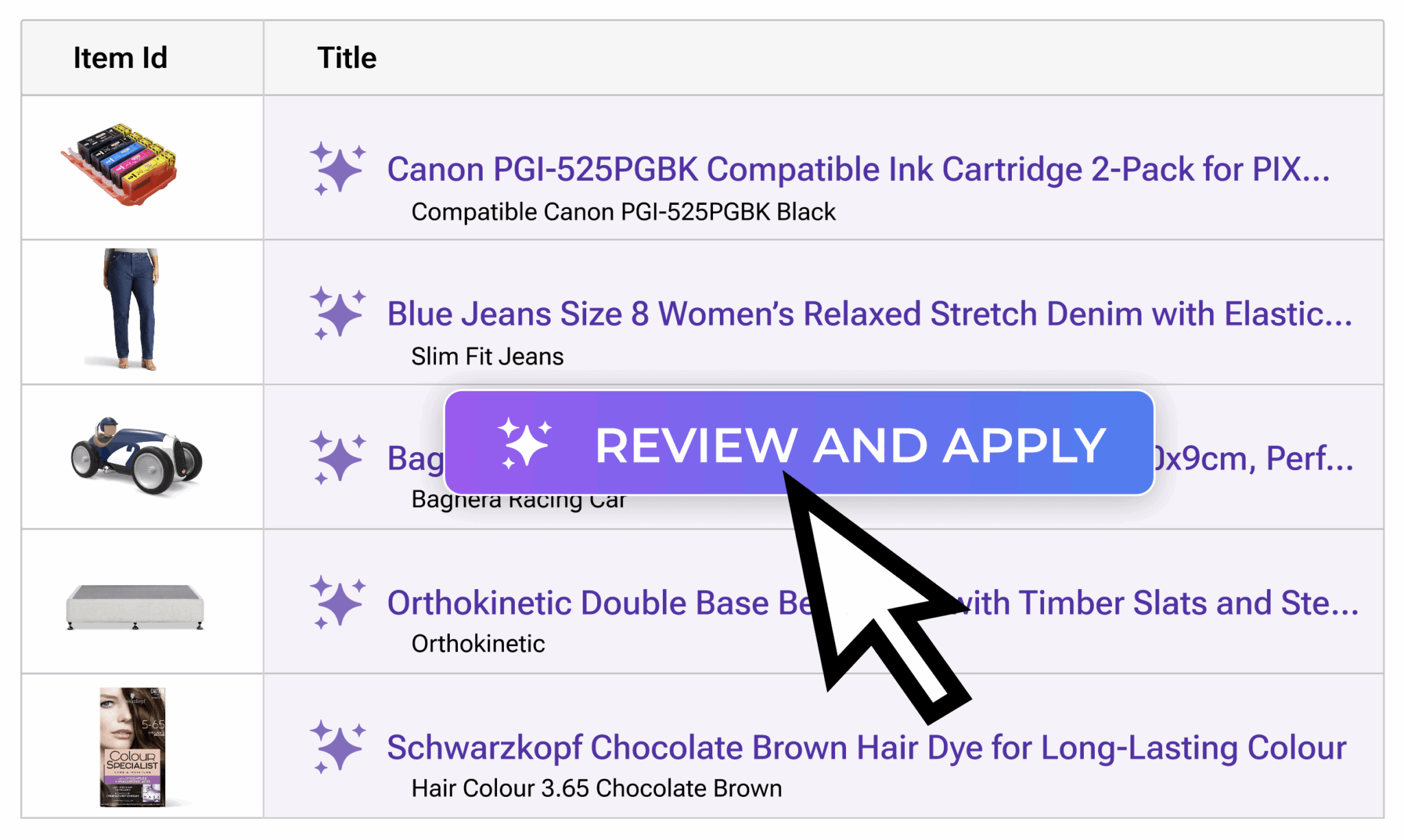
The Ideal Product Title Formula for Different Industries
Different categories require different title structures because shoppers prioritize different attributes.
Fashion and Apparel
Brand + Gender + Product Type + Material + Style + Color + Size
Example:
UrbanPeak Women’s Fleece Hiking Jacket Lightweight Zip-Up Outdoor Coat Blue Medium
Electronics
Brand + Product Type + Capacity/Power + Model + Compatibility + Key Feature
Example:
VoltPro 65W USB-C Laptop Charger Fast Charging Power Adapter for MacBook and Dell
Home and Kitchen
Brand + Product Type + Material + Size + Quantity + Primary Use
Example:
KitchenCraft Stainless Steel Mixing Bowls Set of 5 Nesting Bowls for Baking and Cooking
Automotive Parts
Brand + Part Type + Vehicle Compatibility + Engine Size + Year Range
Example:
Premium Air Filter for Toyota Camry 2.5L 2018-2023 Replacement Engine Filter
Industrial and Commercial Products
Product Type + Specification + Material + Application + Compatibility
Example:
Electronic UV Ballast 220V 40W Replacement Driver for Germicidal UV-C Lamps
The right structure depends on how buyers compare products in your category.
Why Features Outperform Marketing Language
Shopping titles should emphasize facts rather than slogans.
Weak wording:
- Premium quality.
- Amazing performance.
- Best choice.
- Top-rated.
Strong factual attributes:
- Waterproof.
- Rechargeable.
- Stainless steel.
- 1000 lumens.
- 40W output.
- Compatible with XYZ model.
Customers trust objective details more than promotional adjectives because they help them make purchasing decisions.
Leveraging Long-Tail Search Behavior
Broad search terms are often highly competitive and less specific.
A title optimized only for “backpack” may struggle against thousands of competing products.
However, a title like:
40L Waterproof Hiking Backpack Lightweight Travel Daypack with Laptop Compartment
captures multiple highly specific search patterns, such as:
- Waterproof hiking backpack.
- Lightweight travel backpack.
- 40L hiking daypack.
- Backpack with laptop compartment.
Long-tail specificity often attracts shoppers who are further along in the buying process.
How Product Titles Influence Click-Through Rate
Click-through rate (CTR) depends on one simple question:
Does the shopper believe your product best matches what they searched for?
When a title reflects the user’s exact intent, it naturally attracts more clicks.
Consider someone searching for:
“Rechargeable waterproof camping lantern.”
Which listing is more likely to receive the click?
Option A: Outdoor Light.
Option B: Rechargeable LED Camping Lantern Waterproof 1000 Lumens for Hiking & Emergency.
The answer is obvious because Option B removes uncertainty.
People click when they feel confident the product matches their needs.
The Relationship Between Product Titles and Conversion Quality
Higher click volume means little if the traffic is poorly qualified.
Well-optimized titles improve not only CTR but also conversion efficiency by pre-filtering users.
A title that clearly states:
- Voltage.
- Dimensions.
- Compatibility.
- Material.
- Intended use.
helps eliminate accidental clicks from shoppers seeking something different.
This often leads to:
- Better conversion rates.
- Lower bounce rates.
- Reduced wasted advertising spend.
- More profitable Shopping campaigns.
A/B Testing Product Titles for Continuous Improvement
Feed optimization should never be treated as a one-time project.
Successful advertisers continuously test title variations.
Variables worth testing include:
Attribute Order
Compare:
Brand + Product Type + Feature
versus
Feature + Product Type + Brand.
Use Case Inclusion
Adding phrases like:
- For camping.
- For office use.
- For pet owners.
- For commercial kitchens.
may improve relevance.
Specification Placement
Sometimes moving wattage, dimensions, or capacity closer to the beginning of the title increases engagement.
Track changes over time and evaluate performance using statistically meaningful data rather than short-term fluctuations.
Product Feed Segmentation and Title Strategy
Not every product requires the same optimization approach.
High-Volume Best Sellers
Invest significant effort into testing title variations because even small improvements can produce large gains.
Seasonal Products
Adjust titles to reflect seasonal intent when appropriate.
Example:
LED Christmas Window Lights Battery Operated Warm White Decoration Set
Commodity Products
For standardized goods, focus on specifications and compatibility to stand out from identical competitors.
The Role of Product Titles in Mobile Shopping
A growing percentage of Shopping traffic comes from mobile devices, where screen space is limited.
This means:
- The most important attributes must appear first.
- Titles should remain readable even when truncated.
- Unnecessary filler words should be eliminated.
Mobile shoppers scan listings quickly. Clear, information-rich titles gain an immediate advantage.
Practical Before-and-After Product Title Examples
Example 1: UV Lamp
Before: UV Lamp.
After: 40W UV-C Germicidal Lamp 254nm Quartz Replacement Bulb for Water Purifier System.
Example 2: Hiking Backpack
Before: Outdoor Backpack.
After: 40L Waterproof Hiking Backpack Lightweight Travel Daypack with Laptop Compartment.
Example 3: Electronic Ballast
Before: Ballast Model X120.
After: Electronic UV Ballast 220V 40W Replacement Driver for Germicidal UV Lamp Systems.
Example 4: Camping Lantern
Before: LED Lantern.
After: Rechargeable LED Camping Lantern 1000 Lumens Waterproof Emergency Light for Outdoor Hiking.
Each revised title provides substantially more useful information while closely aligning with real buyer intent.
Supporting Feed Attributes That Work Together with Product Titles
Although the title is crucial, it should work alongside other feed fields for maximum impact.
Product Description
Expand upon key features and use cases mentioned in the title.
Product Type
Use detailed category structures to improve classification.
Brand
Maintain consistency across the entire catalog.
GTIN and MPN
Accurate identifiers help platforms understand exactly what product is being offered.
High-Quality Images
A strong title attracts attention, but compelling visuals help secure the click.
Feed optimization works best when all product attributes reinforce one another.
Creating a Repeatable Product Title Optimization Workflow
As catalogs grow, manually rewriting every title becomes difficult. Establishing a standardized workflow improves consistency.
Step 1: Audit Existing Titles
Identify titles that are:
- Too short.
- Missing attributes.
- Duplicated.
- Manufacturer-generated.
- Keyword stuffed.
Step 2: Research Customer Language
Analyze internal site searches, Shopping search terms, and customer reviews to understand how people describe products.
Step 3: Build Category Templates
Create repeatable title formulas for each product category.
Step 4: Prioritize High-Traffic Products
Start with products generating the highest impression volume.
Step 5: Test and Refine
Review performance data regularly and adjust titles based on actual shopper behavior.
Optimization is an ongoing process rather than a one-time update.
Final Thoughts: Small Changes, Big Results
In Shopping advertising, product titles serve as the bridge between customer intent and your product catalog. They help algorithms understand relevance while giving shoppers the confidence that your listing is exactly what they need.
Many eCommerce businesses invest heavily in advertising budgets but overlook the quality of the data powering their campaigns. Yet a simple rewrite that adds the right attributes, follows a logical structure, and mirrors the language real customers use can significantly increase visibility and engagement.
The best-performing product titles are not the longest, the most creative, or the most promotional. They are the clearest. They communicate what the product is, who it is for, why it matters, and what makes it different—all within a concise, information-rich format.
If you want to improve Shopping campaign performance without increasing ad spend, start by looking at your product feed. The title field may seem small, but it often has the power to transform how customers discover, evaluate, and choose your products. In many cases, the path to a higher click-through rate begins not with a bigger budget, but with better words.