














 En
En
 15 min read
In this day and age of advertising, have you ever wondered about a strategy to grow your sales without spending money on advertising? The answer may lie in Organic Dropship. This marketing approach, which is centered on long-term trust and value output, is being seen by more and more entrepreneurs as a “secret weapon” for sustainable growth.
Let’s explore how time and creativity can replace advertising budgets and drive longer-lasting market returns.
Why is Organic Dropship “anti-anxiety marketing”?
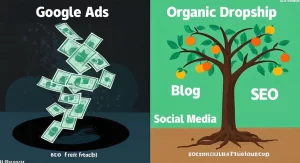
The core logic of Organic Dropship is to use value instead of advertising. Unlike traditional advertising that relies on “money for traffic”, Organic Dropship naturally attracts customers by continuously outputting content that is truly useful to users. 2023 HubSpot study shows that 61% of consumers trust bloggers’ recommendations more than brand advertisements, which is precisely the underlying advantage of Organic Dropship. -Replacing the hard sell with knowledge empowerment.
For entrepreneurs just starting out, this model effectively avoids two major pitfalls:
● The black hole of advertising bidding: Google Ads single click cost has exceeded $4.11, small businesses often become the platform algorithm “fuel”.
● The bursting of the traffic bubble: paid traffic stops when it stops, while quality content continues to bring in natural search traffic.
5 cost-effective customer acquisition combinations
Content Leverage: Turning Expertise into a Traffic Magnet
Content is the best traffic lever. If you can use content to solve users’ practical problems, customers will naturally come to you.
Sarah, a California organic farmer, shares her planting process on TikTok, and each short video on “how to recognize real organic food” can bring more than 200 precise inquiries. Her secret is to turn industry knowledge into solutions to user pain points, for example:
●Mother and baby brands: produced “10 Misconceptions of adding supplemental food 0”.
● Skincare studio: released “Ingredient Party Guide to Avoid the Pit
● Household cleaning brands: share “Tips for choosing non-toxic and eco-friendly cleaners”.
The key point is that it’s not just posting random content, but outputting valuable information around what users really care about.

SEO long-tail tactics: targeting “problem keywords”
SEO (Search Engine Optimization) is a long-term source of organic traffic, especially long-tail keywords, which often convert 300% higher than popular keywords.
Instead of going toe-to-toe with big brands and grabbing competitive keywords like “organic food”, aim for more specific and targeted problem keywords, such as:
● Organic snacks for pregnancy
● Gluten-allergic baby supplement options
●Fragrance-free skincare recommendations

The formula of social operation “sense of warmth
The key to social operation is not to post ads frequently, but to make users emotionally connected to the brand.
Let’s take a look at how Lush, a handmade soap brand from New York, operates on Instagram:
●30% Product display: let users see how the product works in practice
●40% User UGC (user-generated content): sharing fans’ real experiences to enhance trust
●30% Behind-the-scenes stories: Introducing the brand’s philosophy and the stories behind the products.
They organize “Studio Live” every Wednesday to show fans the handmade process, and the conversion rate is 5 times higher than ordinary posts.
You can also learn about ways to boost community interaction:
Want to make the community really active? Create interaction, rather than one-way output, so that users feel part of the brand, rather than passively receiving information.
You can create a “sense of ceremony”, such as a fixed time each week to organize community activities, so that users are accustomed to regular participation. This can be a prize quiz, limited-time discounts, product trial recruitment, or even a simple “weekly topic discussion”, which can enhance the user’s sense of participation.
Encourage user-generated content (UGC), such as inviting them to share their experiences and photos of products, or directing them to contribute content through interactive topics. When users’ content is recognized, reposted or commented on by the brand, they feel a greater sense of belonging and can influence more potential customers.

Precision Wake-Up Calls for Email Marketing
With an ROI of 42:1, email marketing is one of the most rewarding strategies of all marketing channels. However, the key to making email marketing really work is to accurately capture user email addresses and increase conversion rates through personalized content.
Offering high-value resources is the most effective way to acquire customers, such as free courses or utilities, to entice users to actively leave their email. After acquiring emails, develop personalized strategies for different user groups, such as recommending seasonal products that match their interests, opening exclusive pre-sale channels for regular customers to enhance loyalty, or planning user story collection activities to enhance brand interaction and sense of community.
Compared with simple advertising emails, precise and personalized communication can lead to actual purchases, so that each email becomes a bridge to build a long-term relationship between the brand and the user.
Precise Sniping by Micro KOL
Don’t trust the top stream bloggers with millions of followers, micro KOLs (nano-sized netroots) with 1-10 million followers tend to have a higher conversion rate for recommendation.
An organic cotton brand has cooperated with 20 mother and baby bloggers “30 days baby skin improvement program”, the final customer unit price increased by 65%. The reason why miniature KOL is more advantageous is that they have a stronger sense of reality, and fans to establish a deeper relationship of trust between the interaction rate is far greater than the big V, recommended more likely to lead to the purchase.
At the same time, compared with the top stream netroots, the cooperation cost of micro KOL is lower, the promotion effect is more accurate, and the ROI is higher. In order to maximize the conversion effect, it is recommended to take the way of sending tests, commission incentives and discount codes to make the promotion more natural and attractive.
Avoid These 3 Hidden Traps to Make Organic Dropshipping Truly Work
Organic Dropship sounds wonderful – you don’t have to burn money on advertising to get customers to come to you. But in the actual implementation, many people will fall into a few invisible traps, resulting in spending a lot of time and energy, but delayed to see the results. To really use this method, the following three major misunderstandings must be avoided.
The Time Black Hole: A Bunch of Content, But No Customers
The biggest challenge of Organic Dropship is the slow results. If you don’t allocate your time strategically, it’s easy to fall into the “infinite loop of content creation”, writing a bunch of articles and cutting a bunch of videos, but no one will watch them, let alone convert them.
The solution: adopt the “content matrix” strategy to increase the reuse rate of content.
Instead of creating content from scratch every time, it is better to adopt a content reuse strategy, so that a piece of high-quality content continues to play a role in multiple channels to maximize the impact. An in-depth long article can be split into multiple short video scripts for TikTok, Reels and YouTube Shorts to reach more users in a visual way.
Also, 10 social media texts can be distilled to cover platforms such as Twitter, LinkedIn and Facebook to increase brand exposure. In addition to this, the core content can be consolidated into a 3-issue email feature, which can be pushed out to subscribers on a regular basis to maintain a long-term connection.
In this way, the content is not consumed all at once, but continuously distributed in a more efficient form, saving time and improving overall marketing effectiveness.

Data Myths: Don’t Be Fooled by “False Prosperity”
When doing Organic Dropship, many people are easily confused by superficial “good data”, such as the number of social media likes, email open rate, website clicks, etc. However, these data do not necessarily represent actual conversions. However, these numbers don’t necessarily mean actual conversions.
What you should really focus on is whether or not users are actually engaging with the content and ultimately taking action. Example:
Content dwell time is more important than click-through rate. If a user clicks on a page and leaves in a few seconds, the content is not engaging and a high click-through rate is meaningless.
The second bounce after the email is opened is more important than the open rate. Whether the user is willing to click the link in the email after opening it is what really determines the marketing value of the email.
Social media saves are more valuable than likes. A user’s willingness to save your content shows that they really found it useful and may come back to repurchase in the future.
When optimizing your marketing strategy, make sure you focus on these key statistics that are more indicative of user intent, rather than getting caught up in the superficial “high exposure”.
Value Dilution: Prioritizing Quality Over Quantity in Content Creation
Many entrepreneurs mistakenly believe that Organic Dropship is to desperately output content, so they update a large number of low-quality articles and short videos every day, hoping to seize the market with “information bombing”. However, too much low-quality content will not only fail to attract users, but also damage the brand image.
High quality is more important than high frequency. Instead of updating a lot of worthless information every day, you should spend time every week to work on a piece of really useful content. Example:
Researching industry pain points and writing articles that make it into Google’s Featured Digest and get prioritized by search engines
Interviewing industry experts to produce long, in-depth analyses that enhance the brand’s authority among target user groups
Create social media content that generates discussion and increases engagement rates by incorporating user needs.
If the content is simply a pile of information, users will not have a sense of trust, and will not be willing to buy. Ensuring that every piece of content has real value is the key to making Organic Dropship truly effective.

Kickstart Your “Slow Growth” Plan
Under the Organic Dropshipping model, the key to success does not lie in overnight popularity, but rather in the gradual accumulation of trust and the creation of long-term traffic through continuous and stable content output. This approach does not rely on costly advertising, but rather on valuable content and accurate user interaction that naturally attracts potential customers and ultimately creates a stable brand growth model.
If you want to truly move away from reliance on advertising, you need to start a “slow growth” program that builds a solid customer pipeline through knowledge and value. The core of this program lies in the following areas:
1.Your content should be centered around the pain points, needs and interests of your target users, whether it’s in-depth blog posts, detailed product guides, or short videos and tutorials on social media, the core goal is to provide valuable information that will make your brand the first thing users think of when they need help.
2.Through keyword research, website structure optimization, and content updates, your content is more likely to be indexed by search engines and rank high in relevant search results. Compared with short-term advertising, SEO brings more stable natural traffic and at a lower cost.
3.Build a closer connection with users through social media, forums, email marketing and other means. Publish valuable content on a regular basis, take the initiative to interact with users, answer questions and share experiences, so that they are willing to pay attention to your brand for a long time and take the initiative to spread word of mouth for you.
Minimal Startup Program: 3 Steps to Build Your Organic Growth System
1.Identify 20 industry long-tail questions with AnswerThePublic tool
The goal is to find the questions that users really care about, rather than guessing out of thin air. For example, if you are doing skin care products, you can search for “natural ingredients for sensitive skin”, “skin care products for pregnant women” and other issues, these are high intent, accurate long-tail keywords.
2.Choose 3 platforms to build content hubs
Instead of spreading your efforts across all platforms, choose the official website + 1 video platform + 1 social media to build an efficient content matrix. For this, there are the following suggestions:
a.Official website blog: core knowledge base, helps SEO and long-term accumulation
b.YouTube: visual content is more attractive, especially suitable for tutorials, case studies
c. Social media (Instagram/TikTok/LinkedIn): for enhanced user interaction and brand reach

3. Design 1 high-value bait to build an initial mailing list
Want to get users to leave their email address? Don’t just think about “filling out a form for a discount”, the real effective way is to give them something practical and make them feel that the exchange is worthwhile. No one likes to be hard-sold, but if you provide a truly useful resource, users will not only want to leave their email address, they’ll probably look forward to your next email.
For example, you could give them a practical checklist, like “10 steps to the perfect skincare regimen,” to help them quickly avoid pitfalls and choose the right products. Or, give them a template or tool** that they can use straight away, like the **“Social Media Content Calendar Template”, so they can save time and effort and use it right away. If your product involves ingredients, performance, experience, users can not get these points, then give them an in-depth evaluation report, such as “10 natural shampoo ingredient comparison”, so that they buy more peace of mind, while building your brand authority.
These “knowledge assets” can not only help you build professionalism, but also accurately attract users who are really interested, rather than letting a bunch of people who casually fill in the mailbox, take the discount and then leave to take up your resources for nothing. When they receive your content and find it helpful, they are more likely to open the email next time and even come to you for advice. More than bombarding promotional emails, this is the kind of relationship maintenance that really delivers long-term value.
Leverage DropSure for Long-Term Growth: Turning Traffic into Sales
When your content consistently helps a specific group of people solve problems, sales conversions happen naturally. It’s more of a value marathon than a short-term traffic sprint tactic – the seeds of knowledge planted today may grow into a steady source of customer inquiries in six months.
DropSure is based on this philosophy to help sellers build a sustainable and growing cross-border e-commerce business. We not only provide stable supply chain support and intelligent product selection tools, but also help sellers optimize their marketing strategies through high-quality content and data analysis, so that your traffic growth has more long-term value, rather than relying only on advertising.
Instead of being anxious about expensive traffic every day, you can put more energy into brand building and user operation through DropSure’s product selection insights, order management and logistics optimization features. When your content system is gradually improved, SEO optimization brings a steady stream of natural traffic, and community interaction enhances brand loyalty, you will find – sales growth has become a matter of course.