< Blogs

Dropshipping vs Print on Demand – Complete Guide for 2025

Vivan Z.
Created on November 26, 2024 – Last updated on February 6, 20253 min read
Written by: Vivan Z.

In 2025, the e-commerce industry continues to grow rapidly, and Dropshipping and Print on Demand (POD) are two of the most popular business models. Many entrepreneurs often find themselves torn between the two when deciding which type of e-commerce store to start. So, what are the key differences? Which model is better for you? In this article, we will thoroughly compare these two business models, discuss their pros and cons, and help you make a well-informed decision.

What is Dropshipping?

Dropshipping is an e-commerce business model. The retailer doesn’t keep inventory. Instead, they team up with a supplier. When an order comes in, the supplier ships the products straight to the customers. In this model, the retailer focuses on sales and marketing while the supplier takes care of product manufacturing, inventory management, and shipping.

For more details on dropshipping, check out our previous article on What is Dropshipping & How to Start.
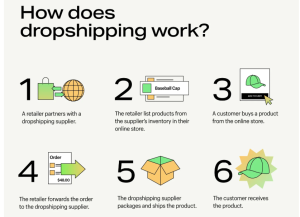
how does dropshipping work

What is Print on Demand?

Print on Demand (POD) is a custom e-commerce model where the retailer does not need to purchase large amounts of inventory upfront. Instead, products are printed and produced only when a customer places an order. This model is often used for custom items like T-shirts, mugs, posters, and more. It allows retailers to offer unique and personalized products without the need for upfront inventory investment.

For more detailed information on Print on Demand, refer to our earlier article on What is Print on Demand? A Beginner’s Guide to the Growing?.

Dropshipping vs Print on Demand: A Comparative Analysis
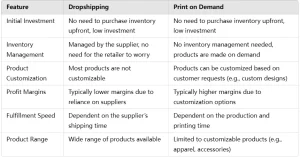
feature Dropshipping

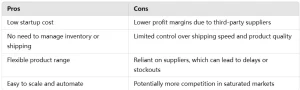
Dropshipping Pros & Cons
Dropshipping Pros&Cons

Print on Demand Pros & Cons


Dropshipping vs Print on Demand: A Comparative Analysis

Which One Should I Choose?

Instead of choosing between dropshipping and print on demand, the goal of this article is to help you gain a deeper understanding of both business models. By reading this guide, you should be able to make an informed decision about which industry or service is the best fit for you. Both models have their unique advantages, and your decision should be based on your business goals, target market, and product offerings.

Conclusion

As we discussed in the Dropshipping Pros section, services like DropSure can help streamline and enhance the dropshipping process. We encourage you to explore your options carefully and choose the model that aligns with your business vision and resources.

Buttom

DropSure is Your Best Partner
22 Years Experience
Affiliate Rebates
100% Quality Guarantee
Top-Up Rewards
10+ Global Warehouses
Custom Branding Support
Smart inventory System
24/7 Customer Support
Get a Quote in 24 Hours
Start Sourcing for Free

Keep Learning

When it comes to user experience (UX) design, a lot of people’s first reaction is something like, “Isn’t that just making the interface look good?”, “Isn’t that the same as UI?”, or “Isn’t it just about making things feel nice for the user?” Well… yes and no. UX design is so much more than just “looking good” or “feeling comfortable.” It’s a lot deeper—and a lot more strategic—than most people realize. What Is UX Design? UX stands for User Experience. Simple enough, right? But let’s be honest — “experience” is a pretty vague word. Is it a feeling? A process? A journey? Actually… it’s all of those things. So what exactly is user experience? Here’s a simple way to think about it: UX is everything a user perceives throughout their entire interaction with your product. Yes, everything. Not just whether your interface looks good or your buttons are easy to tap. UX also includes: How fast your app loads when you open it. Whether the feature names make sense — or leave you scratching your head. That moment you’re forced to fill out a form and get hit with annoying format rules. How responsive (or not) the customer support is. Whether the return process feels smooth or like pulling teeth. Even that final feeling you have when you uninstall the app — that counts too. This is why UX design isn’t just about making things look nice. It’s a systematic way of thinking, with one core mission: Take users from “I want to try this” to “I love this” — and eventually, “I can’t live without it.” What Does UX Design Actually Include At its core, UX design is about […]

Dropshipping has gained popularity as an easy entry point into e-commerce. Its appeal lies in low upfront costs, no inventory management, and the promise of flexibility. But is it truly the goldmine that marketers claim it to be? Dropshipping has some benefits, but it also comes with many challenges. These challenges can make it a tough choice for new entrepreneurs. In this blog, we’ll dive into eight reasons: Why Dropshipping Could Be a Significant Misstep. 8 Reasons Why Dropshipping Is A Bad Idea Low Profit Margins One of the most significant drawbacks of dropshipping is the razor-thin profit margins. Unlike traditional retail, where you can buy in bulk for discounts, dropshipping usually means buying single items. Retailers often sell these items at retail or near-retail prices. Now compare this to a traditional retailer who buys the same product in bulk at $5 per unit. They can sell it at $20 and enjoy a $12 profit after expenses. This big difference shows why dropshipping can be hard to grow. This is especially true if you want to make a lot of money. This is one of the main reasons why dropshipping is bad for many new entrepreneurs. It often does not provide the promised profits. High Competition Dropshipping’s low barrier to entry is both a blessing and a curse. Since anyone can start with minimal investment, sellers offering identical products have oversaturated the market. Let’s take Amazon as an example: – Search for a simple item like a “yoga mat” on Amazon. – You’ll find dozens of nearly identical listings, often undercutting each other by mere cents. This tough competition lowers prices. It makes it hard to stand out unless you […]

Want to start an online business? Most likely, you are envisioning dropshipping or Amazon FBA. Both have allowed literally thousands of entrepreneurs to thrive. But their functionality differs, so determining which is best for you, depending on your objectives and budget as well, is critical. By the time you finish this guide, you’ll know how each model works and its strengths and weaknesses. You’ll also know how to get the best results with them.” Ready to begin? Let’s dive in! How Does Dropshipping Work? One popular model in the e-commerce world is dropshipping. It’s a cheap, low-risk method of making sales online. You Won’t Have to Worry about Inventory Dropshipping is a business model where you sell products online without keeping any inventory. Instead of buying products upfront and storing them in a warehouse, you partner with a supplier who handles the storage, packaging, and shipping of products directly to your customers. Here’s how it works: List Products in Your Store Begin by making a list of the products that you would like to sell, on your store, or on platforms such as Shopify, or Amazon. Yes, these goods are on suppliers like AliExpress or calls like Oberlo or DropSure. Customer Places an Order When a customer makes a purchase, you get paid upfront. That means you can start making money immediately. Supplier Ships the Product After that your supplier sends the product to the customer. You don’t need to deal with any shipping or anything! Pros and Cons of Dropshipping Dropshipping is a popular way to start an online business, especially for beginners. However, like any business model, it has its own advantages and disadvantages. In this guide, we’ll break them down to help you weigh the pros and cons before getting started. Pros […]

Recommended for you